
The journal of the True Testament Assembly
Studies in Marcionite Christianity, Canon, and Origins. Edited by W. C. Muenchow IV
Topic
Scholarship
20 articles, newest first
 The Critic Who Handed the Lord’s Prayer Back to Marcion: Inside Gustav Volkmar’s Marcion’s Gospel (1852)In 1852 a German schoolteacher named Gustav Volkmar set out to settle whether Marcion cut down the Gospel of Luke or whether the church’s Luke was an enlarged form of Marcion’s Gospel. He decided against Marcion. Yet the same careful critic concluded that at the opening of the Lord’s Prayer and in several other places, Marcion’s Gospel kept Luke’s original wording. This is a guide to his book, now in our Library in English.Nov 21
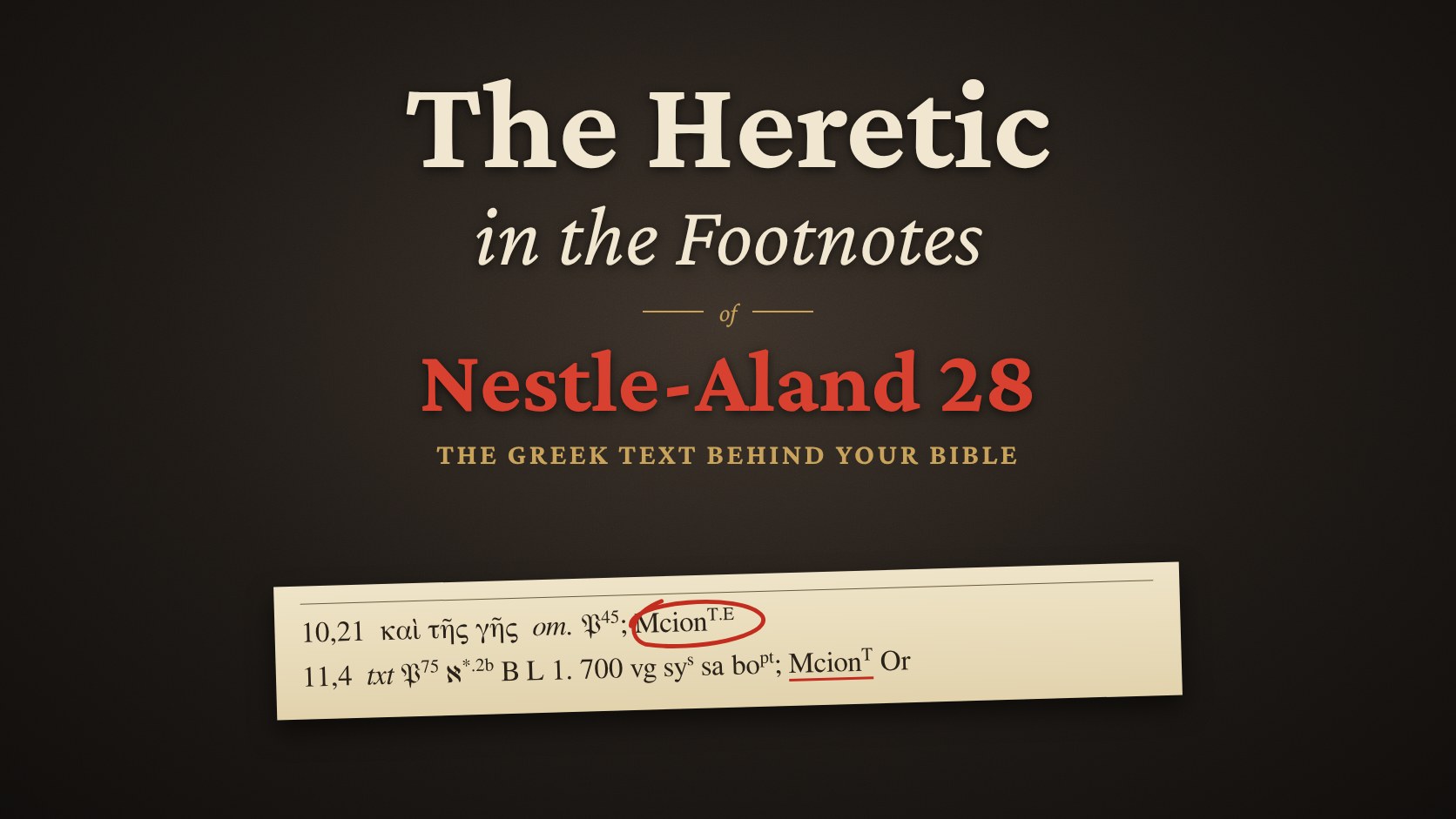 The Heretic in the Footnotes of Nestle-Aland 28, the Greek Text Behind Your BibleThe Nestle-Aland Novum Testamentum Graece, 28th edition, names Marcion 85 times in its footnotes to Luke, and by its own stated rule it cites only reliable witnesses to the text. Its own pages take apart the old charge that he mutilated the Gospel.Nov 15
 The Face of Marcion of SinopeNo likeness of Marcion survives, and the manuscript picture usually shown as him is most likely someone else. We built a portrait from the evidence instead: what his opponents let slip about his trade, wealth and age, the shipowners of his own city, the fashion of his day, Ephrem’s sackcloth and the genetic studies, with every feature graded by how sure it is.Nov 11
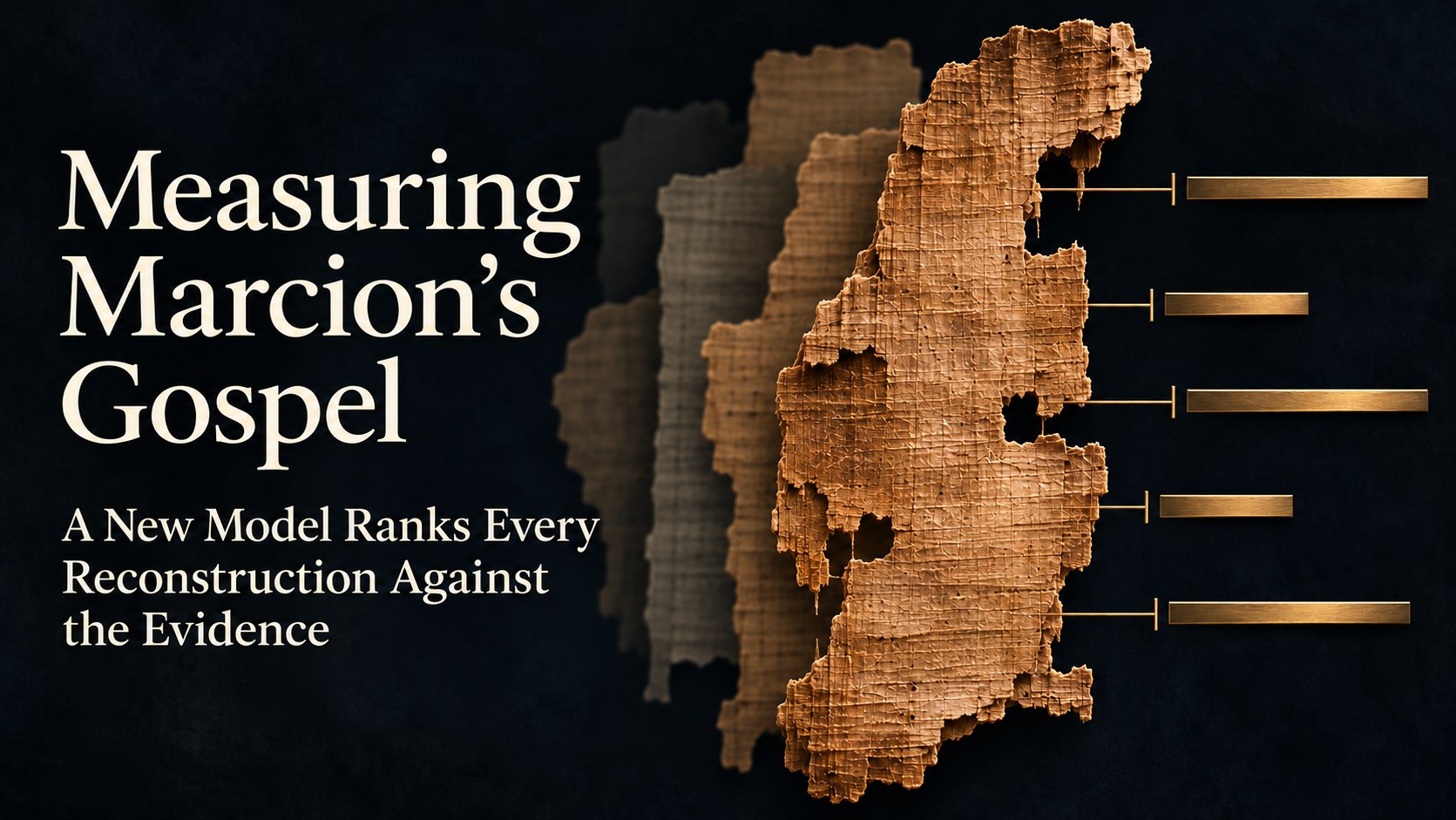 Measuring Marcion's Gospel: A New Model Weighs the Silences Verse by VerseFor nearly a third of Luke, no witness says a word about Marcion's text. Tertullian and Epiphanius turn out to describe the same text, but a corrected test shows that Tertullian's long silences do not by themselves prove a passage was missing. The model built on them gives every verse a probability, suggests a Gospel of about 740 verses if its central assumption holds, and sets the five modern reconstructions, our own among them, beside what it finds.Nov 8
 What Roth and BeDuhn Left OpenBy our count, Dieter Roth leaves 385 verses of Luke undecided and Jason BeDuhn 301. The critical edition of the Greek True Testament gives every one of them a label: 28 with a witness, 58 kept because the story needs them, 73 judged absent, and 226 that no one can decide. Here is how, with what Tertullian, Epiphanius, Harnack, Zahn and the older editors said along the way.Nov 5
 Marcion’s Greek, Word by Word Against NestleAncient writers quote Marcion’s Bible in Greek. Set word by word against Nestle’s Greek New Testament, their quotations differ from it in 236 places. Two out of three change nothing in the sense, and one in six changes only a detail. The 38 that touch the teaching are all listed here, and eight of them are readings the church’s own copies also carry. The old charge that Marcion took a knife to scripture does not survive the Greek evidence his opponents preserved.Nov 4
 Three Witnesses, One TextMarcion’s Bible survives only in the books written to refute it. We read its three main witnesses one at a time and compared them verse by verse. Where two or three of them report the same verse, they agree or fit together 149 times out of 156.Oct 31
 The Pigs That Never Ran Off the CliffOur Evangelion tells the story of the man possessed by Legion, but it ends when the demons are given permission to enter the pigs. The herd never runs into the lake. Here is what the True Testament has, what Tertullian and Epiphanius say, how Hahn, Zahn, Harnack and the modern editors judged the missing verses, and what we can and cannot claim from them.Oct 31
 Learning to Hear: Why Theology Is Like MusicPeople look at the study of theology and see something dry, the way a page of sheet music looks dry to someone who never learned to read it. Karl Barth called theology “a peculiarly beautiful discipline,” and he heard it the way he heard Mozart. Here is why the study of theology is like learning music: the scales, the theory, the score, the ear and the performance.Oct 28
 A Systematic Theology for Marcion's ScriptureSystematic Theology: True Testament Marcionism builds a full systematic theology on the True Testament alone, in fifty-six chapters and fourteen parts, with the evidence for every verse on the table. I explain how the book is built, the two rules that govern it, and why it matters for Marcionite studies: it tests the reconstructions, separates the text from the reports of Marcion's opponents, shows what the attested Paul does and does not say, and lets Marcionite doctrine be compared point by point with Chafer, Hodge, Berkhof and Grudem.Oct 26
 Every Word Accounted For, the Greek True Testament and Its Critical EditionThe True Testament now has its own Greek text for all 1,521 verses, along with a critical edition that marks where every Greek word comes from: an ancient witness, Nestle’s 1904 text, a retroversion from Latin, or our own decision. I explain how it was built, what the marks and about 1,100 apparatus entries show, and how it compares with Roth, Klinghardt, BeDuhn, Harnack, Zahn and others. No one before has given the whole Marcionite canon in a single Greek text with the evidence for every word laid out to check.Oct 26
 Check Our Work: The Evidence Behind the True Testament Is Now OpenEvery reconstruction of Marcion's scriptures rests on a long chain of judgments that readers have mostly had to take on trust. We have opened ours. The research data behind the True Testament and 21 of our books is now free to view, search, download and cite: every verse with its witnesses, our commentary, twelve editions' decisions side by side, Tertullian and Epiphanius in full, and the German scholars verse by verse.Oct 23
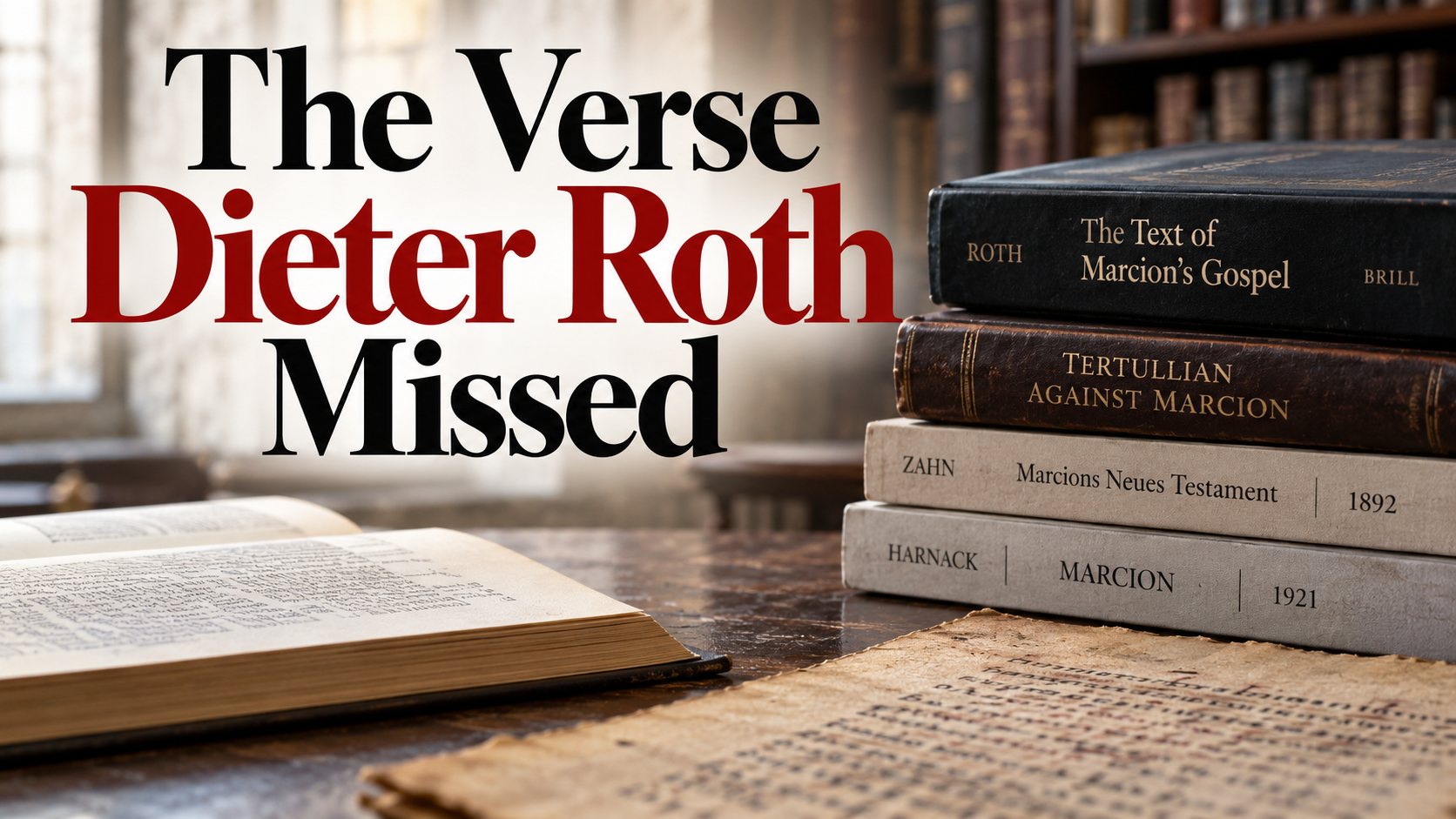 The Verse Dieter Roth MissedDieter Roth's The Text of Marcion's Gospel (Brill, 2015) is the most careful reconstruction of Marcion's Evangelion ever made, and the one English-speaking scholars now cite as standard. For Luke 19:12, the nobleman's journey to claim a kingship, his verdict is one word: "Unattested." But Tertullian attests the verse, in a sentence of Against Marcion that Roth himself quotes for a different purpose and even footnotes as an allusion to this very parable. The evidence sat in plain sight for a long time. Zahn passed over it in 1892, Harnack in 1921, and the clause has been rendered in the English of Luke 19:12 since 1868. This article sets out the sentence, shows what it attests, answers the objections, and adds a short list of smaller faults found while checking. It ends by correcting our own edition's apparatus on the same point, because the error we are describing is one we half made ourselves.Oct 20
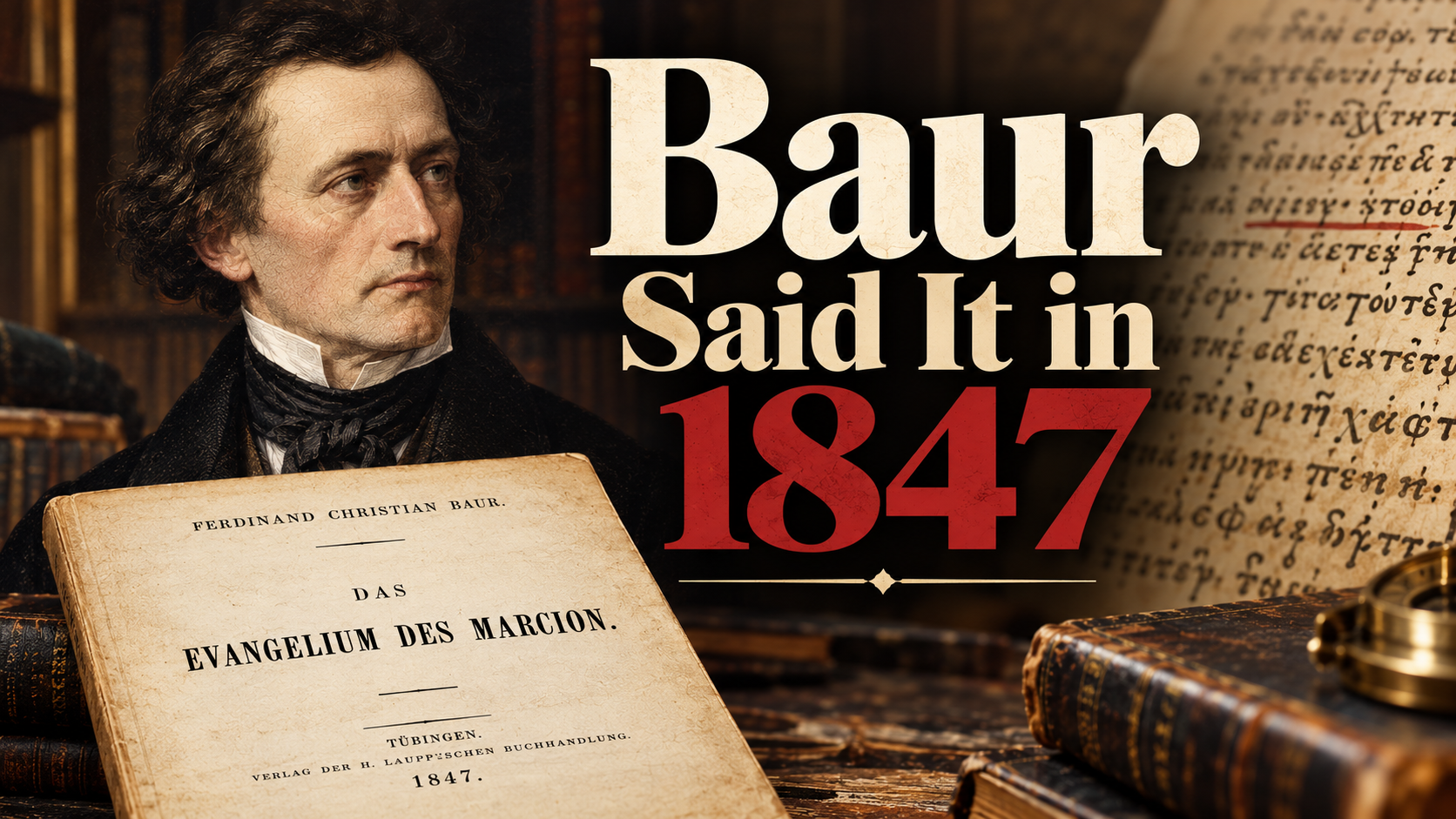 Ferdinand Christian Baur Said It in 1847The claim that the Gospel Marcion used is older than the church's Luke is being presented today as the newest thing in Gospel criticism. It is not. Ferdinand Christian Baur made the case in 1847, in a treatise that reached English only this year, and he made it from the Church Fathers' own evidence. He showed that Tertullian's charge of mutilation rests on inference and conjecture, that the Fathers charged Marcion even with ordinary textual variants, that a Gospel made by cutting would be without any analogy in the history of the Gospels, and that several of Marcion's readings are indisputably the original ones. Those readings are in our scripture. This article walks Baur's argument in his own words, with his 1847 page numbers, then follows what happened to it, and says where we part from him.Oct 15
 The Books Nobody TranslatedBetween 1846 and 1923, five German scholars, Ritschl, Baur, Zahn and Harnack (twice), wrote the most detailed studies of Marcion’s Bible ever produced. None reached English in full until 2026, after waits of 103 to 180 years. This article traces why, and finds no conspiracy, only a run of ordinary decisions pointing the same way. Ritschl withdrew his thesis and Baur revised his. Zahn and Harnack declared the question closed. Publishers paid for the books churches used, so Tertullian’s attack on Marcion was in English by 1868, while the scholars who tested his charge stayed in German. Specialists were expected to read German, the Tübingen name became a warning, and Harnack’s call to drop the Old Testament from the canon was overshadowed by the 1933 rally that demanded the same thing in cruder terms. English writers then learned the German debate from summaries that got it wrong. Now the books can be read.Oct 10
 Marcion Did Not Write the Evangelion: An Answer to Markus VinzentMarkus Vinzent has done more than any living scholar to put Marcion back at the start of the gospel story. In Marcion and the Dating of the Synoptic Gospels (2014) and the books that followed, he argues that the Evangelion came before Matthew, Mark, Luke, and John, and that those four were written in reaction to it. We agree with him on both points. He also argues that Marcion wrote the Evangelion. We don’t agree with that, and the disagreement matters. Oct 3
 A Response to M. David Litwa on the True TestamentA scholar-to-scholar response to M. David Litwa's review of the True Testament 5th Edition. The author concedes every place the review improved the book, including Laodiceans 5:11-14, and the missing citations for women as elders, and then answers Litwa's charge that printing Probable verses as scripture is spiritually harmful. It sets out the concrete tests a Probable verse must pass, the pastoral rule for reading the two stamps in an assembly, and a defense of printing Galatians 5, 1 Corinthians 2, the unattested letter closes, and Romans 9:1-3.Oct 1
 Evidence, Not Epithets: A Point-by-Point Reply to PatristicaPatristica published a ten-part judgment of the True Testament project and asked to be corrected if any evaluation proved false. This article accepts that invitation. Insults establish nothing historical or textual, so each allegation is answered with the reading, source, manuscript, and dataset behind it, along with the honest limits of every claim.Sep 1
 Marcionism — And the Scholars Who FlinchedMarcionism is the structural opposite of antisemitism. The split is theological — two gods, two covenants, two aeons — never two peoples. The Evangelion's passion narrative cannot produce a Christ-killer libel, and the modern scholarly flinch that softens Christ's descent out of fear of being called antisemitic gets the argument exactly backward.Aug 24
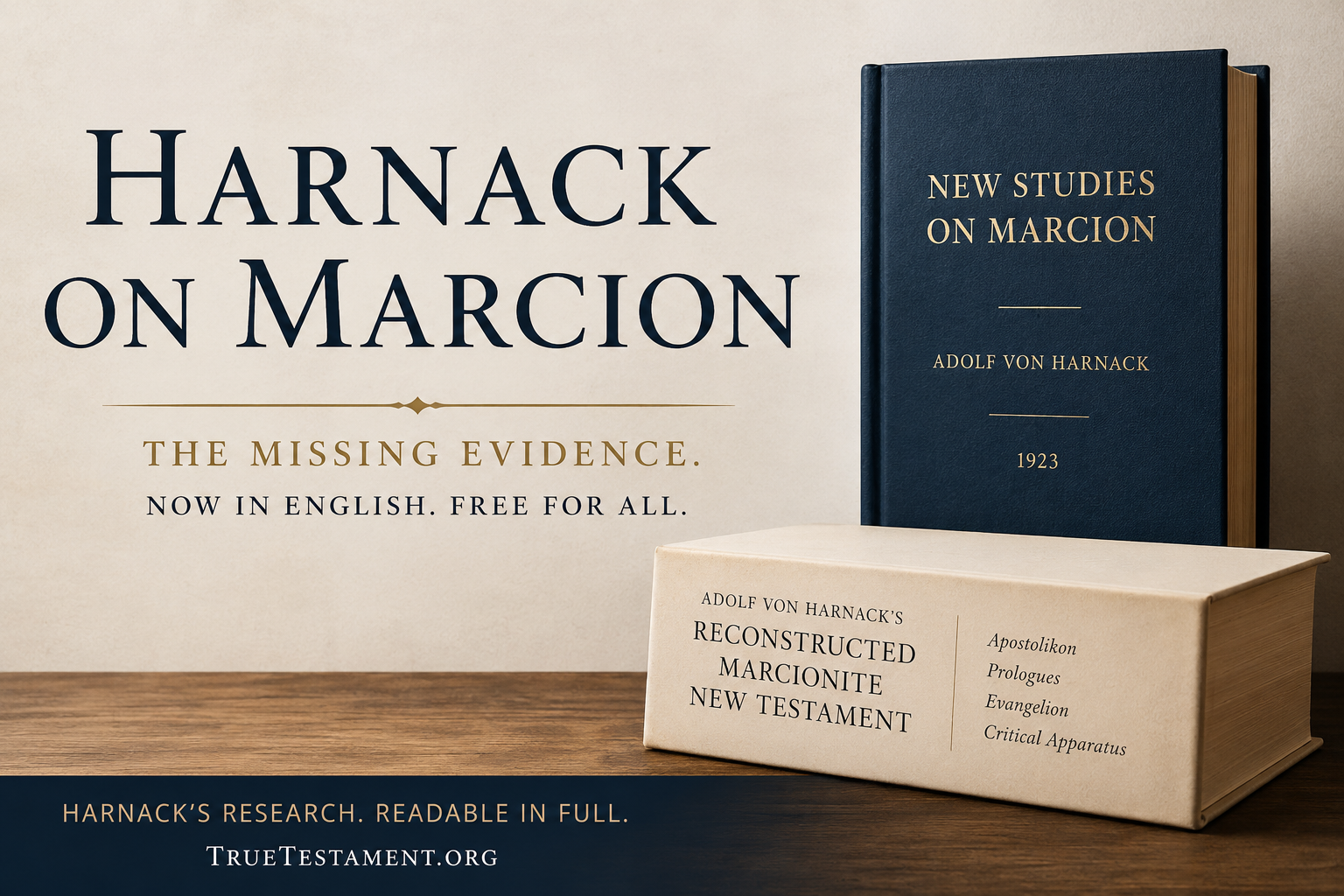 Harnack's Marcion in English: New Studies and the Reconstructed Marcionite New TestamentEnglish readers have known Adolf von Harnack's name more often than his evidence. I have published the first complete English translation of his 1923 Neue Studien zu Marcion and the first complete scholarly English translation of his reconstructed Marcionite New Testament. Both volumes are free to read, download, and hear at TrueTestament.org.Aug 14