
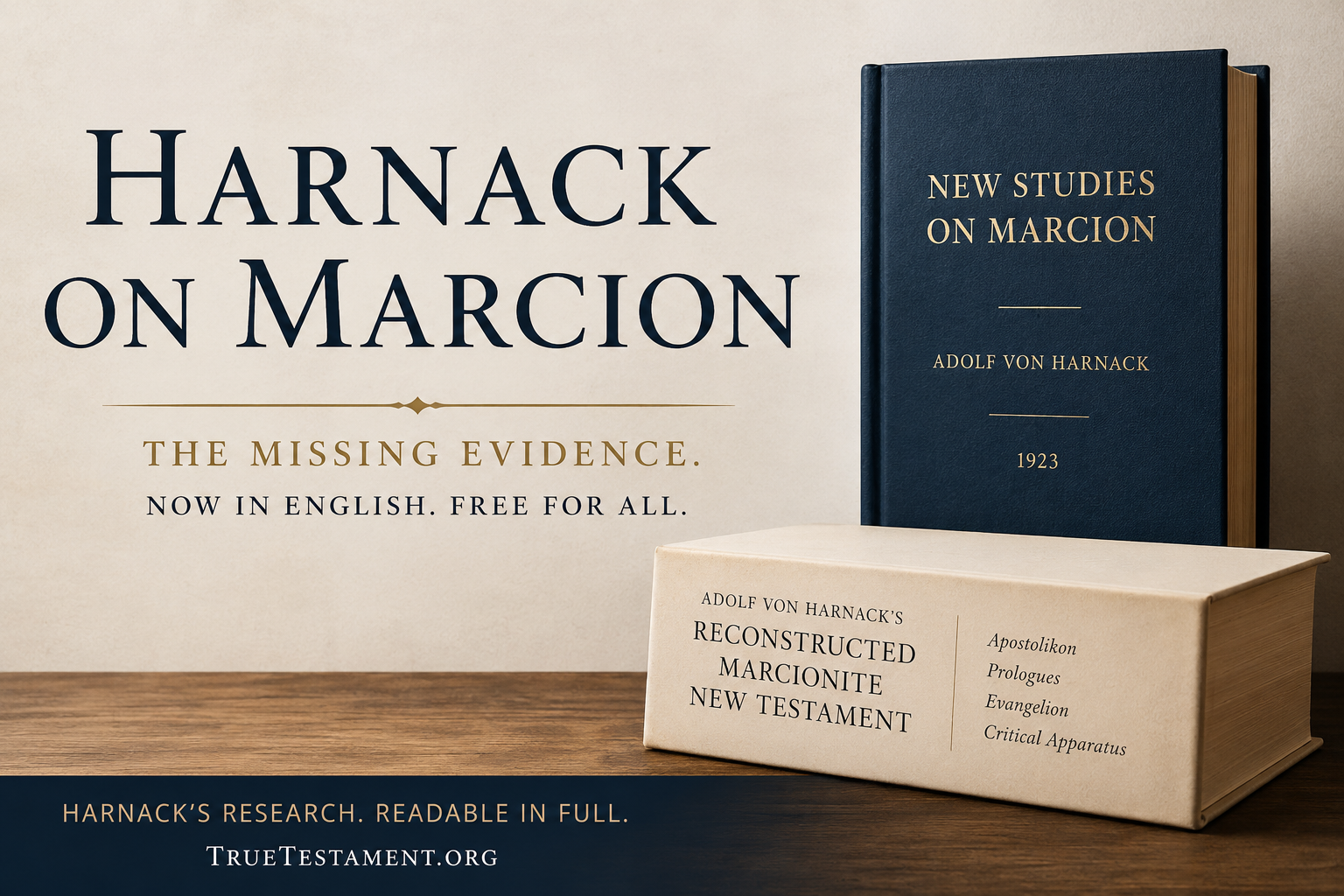
English readers have known Adolf von Harnack's name more often than they have known his evidence. For a century, almost every serious conversation about Marcion of Sinope has begun with Harnack, gratefully, critically, or both. What most of those readers could actually open in English was the story of Marcion, not the workshop behind it. The reconstructions of the Evangelion and the Apostolikon stayed in German. So did the 1923 supplement in which Harnack answered his critics. I translated those missing pieces and published them through True Testament. Both volumes are live now, and both are free at TrueTestament.org.
The first is New Studies on Marcion, the first complete English translation of Harnack's Neue Studien zu Marcion (1923), with my companion essay Answering Harnack's Wish. The second is Adolf von Harnack's Reconstructed Marcionite New Testament, the first complete scholarly English translation of the Apostolikon, the Marcionite Prologues, the Evangelion, and the critical apparatus from Marcion: Das Evangelium vom fremden Gott (1921/1924).
What Harnack actually published
Adolf von Harnack (1851-1930) was already one of Europe's best-known historians of Christianity when he turned his full attention to Marcion. In 1921 he published Marcion: Das Evangelium vom fremden Gott, usually rendered Marcion: The Gospel of the Alien God. A revised and enlarged edition followed in 1924. In 1923 he issued a shorter companion, Neue Studien zu Marcion, answering reviews of the first edition and tightening details that then entered the 1924 revision. The title of the main work announces the claim that still unsettles readers: Marcion's gospel was the proclamation of a Stranger God, the Father of Jesus Christ, distinct from the Creator of this world.
Harnack did not invent that reading. He recovered it from Tertullian, Epiphanius, Irenaeus, the Dialogue of Adamantius, and other hostile witnesses who preserved Marcion's teaching while trying to refute it. His achievement was to treat those witnesses as historical and textual evidence rather than merely repeat their verdicts. He asked a harder question than the inherited charge that Marcion had mutilated Luke and Paul. What exactly did Marcion's Bible contain, and what did he teach from it?
The most technical parts of the 1921/1924 book were the appendices, the Beilagen. There Harnack printed, passage by passage, what he thought could be recovered of Marcion's Paul and Marcion's gospel. Beilagen III and IV assembled the Apostolikon and the Evangelion from the patristic citation record. Beilage V, The Tradition Concerning Marcion's Teaching and Concerning His Church, gathered what the church writers from Justin to Augustine and Eznik reported about Marcion's doctrine and his churches. Harnack's compilation of the Antitheses, the work that framed Marcion's collection by setting statements from the Jewish scriptures against sayings of Jesus and Paul, stands in the main text as chapter V. These are not ornamental notes. They are a working ledger behind a century of textual debate.
Harnack was not the first modern scholar to attempt a reconstruction. August Hahn and Theodor Zahn had already done that work in the nineteenth century. Harnack's achievement was to join the textual ledger to a full historical and theological portrait. For much of the twentieth century, that portrait became the starting point. Scholars who praised him and scholars who attacked him were still working on a map he had drawn.
The English gap
In 1990, John E. Steely and Lyle D. Bierma published the standard English translation of Harnack's main narrative as Marcion: The Gospel of the Alien God. It is a real book and a real service. It is also incomplete in a way that changed the field's English-language memory. Steely and Bierma omitted the long appendices because of their length and complexity. They also did not provide a complete standalone translation of the Neue Studien. English readers therefore received Harnack's story of Marcion more often than Harnack's working notes. The reputation traveled farther than the evidence.
That gap is a structural barrier. When later scholars argue about whether a verse stood in Marcion's gospel, whether Tertullian is quoting or paraphrasing, or whether Epiphanius's scholia are reliable, they are still working with evidence Harnack helped organize. English students, pastors, and independent researchers were asked to live with Harnack's reputation while the reconstructions themselves remained behind a German door. I did not want to leave Harnack half-translated. The second-century sources are already difficult because they survive inside hostile Latin and Greek witnesses. If the reconstructions and Neue Studien are foundational, they need to be readable in complete form, not as rumor or a missing appendix behind a paywall.
New Studies on Marcion
New Studies on Marcion is Harnack's 1923 supplement, not a popular restatement of the 1921 monograph. He addressed reviews of the first edition, clarified his positions in relation to Walter Bauer and Hans von Soden, and supplied corrections and additions. A number of those corrections were then incorporated into the revised 1924 edition of the main work. The book is compact, technical, and late. It is Harnack still thinking, still answering, still adjusting the apparatus after the first wave of criticism had landed.
To my knowledge, this is the first complete English translation of that work. The volume includes the translated text, translator's notes, and the historical and bibliographic material needed to situate the supplement inside Harnack's broader Marcion scholarship. It also includes my companion essay, Answering Harnack's Wish. That essay is not Harnack. Harnack closed the Neue Studien with a wish about how later Christianity might hear Marcion. I answered that wish from a modern Marcionite reading of Paul and the Evangelion, not from inside the later catholic synthesis, and not by pretending Harnack was an unrecognized Marcionite. Readers who want only Harnack can read the translation and leave the companion. Readers who want the argument continued can read both.
I published the Neue Studien first because English Harnack studies most often skipped it: short enough to be treated as optional, important enough that the 1924 edition cannot be understood without it. The PDF and audiobook are free. Print is available. Read it at truetestament.org/read/new-studies-on-marcion, or take the file from truetestament.org/downloads?book=new-studies-on-marcion.
Harnack's reconstructed Marcionite New Testament
The second volume is the one English readers were missing in 1990. Adolf von Harnack's Reconstructed Marcionite New Testament translates the materials Steely and Bierma left out: the Apostolikon, the Marcionite Prologues, the Evangelion, Harnack's investigations of Marcion's text, and the associated critical apparatus. To my knowledge, these materials had not previously appeared together in a complete scholarly English translation.
Later witnesses agree on the basic shape of Marcion's collection. It had two parts: a single gospel, the Evangelion, and ten letters of Paul, the Apostolikon. The letters, in the order most often reported, began with Galatians, then 1 and 2 Corinthians, Romans, 1 and 2 Thessalonians, Laodiceans (later called Ephesians), and Colossians. Philippians and Philemon closed the set, though witnesses differ on which came last. The Pastoral Epistles were not included. A work called the Antitheses framed the collection.
Harnack did not claim to have found a hidden Marcionite manuscript. No such continuous copy survives. He gathered the quotations, notes, and accusations and tried to recover, passage by passage, what the hostile record can still yield. That is why the apparatus matters as much as the running text. A reconstruction without the notes is a smoother Bible than the evidence can support. Harnack's discontinuous presentation is no longer the only model. Dieter Roth later graded wording by degrees of certainty. Jason BeDuhn recovered content as "the first New Testament." Matthias Klinghardt and Markus Vinzent have argued, in different ways, that the Evangelion may be earlier than canonical Luke rather than a later reduction of it. M. David Litwa has returned to Marcion's Bible as a historical object in its own right. Those projects still have to face the ledger Harnack assembled.
This volume is Harnack's reconstruction in English, not mine. The True Testament in the reader on this site is a separate reconstruction. I weigh the same patristic record and make judgments when hostile sources preserve the canon unevenly. My verse decisions will not always line up with Harnack, BeDuhn, Roth, or Klinghardt. That is deliberate. Publishing his reconstructions in full is how I keep that difference honest. The PDF and audiobook are free. Print is available. Read it at truetestament.org/read/reconstructed-marcionite-new-testament, or take the file from truetestament.org/downloads?book=reconstructed-marcionite-new-testament.
How the evidence works
Almost everything known about Marcion's scriptures comes from opponents who quoted him in order to refute him. Justin Martyr, writing in the 150s, already names him as a living teacher whose message had spread widely. Irenaeus summarized and attacked his teaching. Tertullian wrote five books against him and walked through the Evangelion and the Pauline letters verse by verse. Epiphanius later compiled a list of passages. The Dialogue of Adamantius and Ephrem the Syrian add further quotations from other regions. That is not a library Marcion chose. It is the library that survived him.
The method is therefore a method of hostile witnesses. When Tertullian says Marcion "removed" a passage, the historian still has to ask whether the passage had ever been there and whether Tertullian is quoting or paraphrasing. When Epiphanius lists a scholion, the historian still has to ask how much of the note is accusation rather than text. Harnack made those questions visible enough to argue about. A field that can only repeat a heresy charge is not yet doing history. A field that can ask whether a verse stood in Marcion's gospel, how securely, and on whose testimony, has begun.
Some things can be recovered with reasonable confidence. Marcion's communities used one gospel and a Pauline letter collection. That gospel overlapped heavily with material now found in Luke. The letter collection did not include the Pastorals as later New Testaments do. Marcion's teaching distinguished the Creator from the Father of Jesus and refused to treat the Jewish scriptures as the church's first testament. His movement was large enough to frighten well-placed critics from Rome to North Africa. Some things cannot be recovered. The exact continuous wording of every chapter is gone. The Antitheses survive only in reports and fragments. Daily life in Marcionite churches is mostly lost. Legend fills those gaps if history does not mark them. One legend makes Marcion a cartoon vandal with a knife and a Bible. Another makes him the secret author of the entire New Testament. Neither is what the sources can bear.
Where Harnack must be challenged
Honesty requires saying where Harnack's research no longer stands as the only serious option. The most important debate concerns the direction of literary dependence. Harnack accepted the inherited patristic claim that Marcion edited canonical Luke, and he often interpreted differences between the two texts as dogmatically motivated excisions. That position governed much of twentieth-century scholarship. It is no longer self-evident. Ancient texts could be expanded, abridged, harmonized, and revised. Shorter readings are not automatically earlier. Klinghardt's work has forced the field to confront the reverse possibility: that the Evangelion is earlier and canonical Luke an expanded revision. BeDuhn has separately challenged the picture of Marcion as a consistently dogmatic redactor. Harnack's Lukan priority can no longer be treated as a datum. That does not erase his achievement. It continues his project while reopening one of its controlling premises.
A second challenge concerns theological projection. Sebastian Moll and others have shown how easily a modern Protestant law-and-gospel schema can be read back into Marcion. Marcion was not Luther in Pontic clothing. He was a second-century Christian arguing, from Paul and a gospel, that the Father who sent Jesus is not the Creator who rules this aeon. Harnack's portrait sometimes reflected his own Protestant concerns. Judith Lieu has shown how much of the surviving Marcion is a figure created by the rhetoric of his enemies. The remedy is not to ignore Harnack. The remedy is to read him as a historian of reception as well as a historian of Marcion, then to go past him and return to the sources.
A related distinction has to be kept clean. Rejecting the Old Testament as Christian scripture is not hostility toward Jewish people or Judaism. Marcion did not claim that the Jewish scriptures were fraudulent. He treated them as genuine testimony to the Creator while denying that they revealed the previously unknown Father proclaimed by Christ. Those scriptures belong to the Jewish tradition. They should not be appropriated or denigrated by Christians. They should be distinguished from the Evangelion and Apostolikon. Harnack placed this challenge inside a modern Protestant debate over the Old Testament, and his language must still be read within the nationalist and antisemitic climate of early twentieth-century Germany. Historical context should not collapse theological distinction into racial prejudice. Disagreement with a canon is not hatred of a people.
What these books are for
I treat Harnack as a witness, not as a final authority. The True Testament Reconstruction Project exists to make Marcion's scriptures readable, teachable, and comparable against other reconstructions. I also present those scriptures as scripture for contemporary use. That confessional purpose has to be distinguished from the historical evidence on which the reconstruction rests. Publishing Harnack in full is part of that distinction. If I am going to disagree with him, readers should be able to see what they are disagreeing with.
Read Harnack and his critics. Lieu, Moll, Roth, BeDuhn, Klinghardt, Vinzent, and Litwa are the living argument. For Marcion studies the shared starting point remains Harnack's documentation of the problem. English readers can now start from that documentation itself. Distinguish his evidence from his assumptions. His assemblage of patristic testimony is still indispensable. His conclusion that Marcion edited Luke is contested. His Protestant framing of law and gospel must be tested rather than swallowed. Use the two books as a pair. The Neue Studien shows Harnack adjusting after criticism. The reconstructed New Testament shows the workshop the 1990 English edition left behind. The companion essay in New Studies on Marcion is my answer, not his.
Harnack's research only matters as widely as it can be read. I published both volumes with the PDF and audiobook permanently free, no account required. Print is there for readers who want paper. If you want Harnack's last extended study of Marcion, start with New Studies on Marcion at truetestament.org/read/new-studies-on-marcion. If you want the reconstructions Steely and Bierma omitted, start with Adolf von Harnack's Reconstructed Marcionite New Testament at truetestament.org/read/reconstructed-marcionite-new-testament. If you want the True Testament itself, the Evangelion and Apostolikon as I reconstruct and present them for reading and use, that is a different shelf on the same site. Harnack belongs in the project not as an idol, but as the scholar whose synthesis made the modern recovery newly influential.
The unfinished task
Harnack's research remains important because it changed what counted as the question. Before him, the question was often how the church defeated the heretic. After him, the question became what Marcion's Christianity actually looked like: what scriptures it read, what God it proclaimed, and why that proclamation forced the rest of the church to define itself against him. Those are still the right questions. Later scholarship has challenged Harnack's literary chronology and theological projections and rebuilt his reconstructions with more explicit methods. None of that makes him obsolete. It makes him the foundation you build on, argue with, and outgrow after you have read him.
That is why I translated his Neue Studien and his textual reconstructions and made them freely available. Harnack's importance is not that he settled Marcion. His importance is that he made Marcion impossible to settle cheaply. A century later, that is still the gift and still the unfinished task. The English editions are now on the table. The argument can continue in the open.