
The journal of the True Testament Assembly
Studies in Marcionite Christianity, Canon, and Origins. Edited by W. C. Muenchow IV
Topic
Death & Last Things
9 articles, newest first
 The Last Thought in the UniversePhysicists have worked out how this universe ends. The stars burn out, the black holes evaporate, and in the cold that follows there is no energy left to think with, so even faith, as the act of a living mind, has a last moment. This article sets that ending beside the Father of the Evangelion, who did not make this universe, does not run on its energy, and does not need us to keep holding on in order to keep us.Nov 13
 Further Clothed, the Soul, the Spirit and the World We Cannot SeeMost people picture the soul as something trapped inside the body, waiting to get out. The True Testament gives a different picture. The soul is you, alive. The Spirit is the Father's, not ours, and it comes from outside to take hold of the soul and carry it out of this order. Here is what the soul is, what the Spirit is, and how we walk in a world we cannot see.
We live in two worlds at once. One we can see, touch and measure. The other we cannot see at all, and yet everything that matters most to us happens there. Paul put it this way: "For we look not at the things that are seen, but at the things that are unseen; for the things that are seen are temporary, but the things that are unseen are aeonic." (2 Corinthians 4:18)
Our assembly teaches that the Father sends his Spirit to take hold of our soul and bring it up out of the Creator's domain. We have said it many times. What we have not done is stop and say what the soul is. What is it made of? Where is it? And when Paul speaks of a person's "spirit," does that mean we have two things inside us instead of one?
This article answers those questions from the True Testament. I think the answers are clearer than most people expect, and they change how we picture our own lives.Oct 26
 When the Creator Is SeenMost Christians picture the end as a series of arrivals: a rapture, a tribulation, an Antichrist, a throne in Jerusalem, a final sorting. Our end turns on something being seen. Paul says the god of this aeon has blinded minds so that the light of Christ might not shine, and the end is that blindness lifting. We hang the whole order on one event, the revealing of the person of fault, whom we hold to be the Creator. Christ is the image of the invisible God, and no one can recognize the Father’s image while the Creator still passes for the Father. So the false god must be seen before the true Son can be. This article walks through the order step by step: the blindness, the first crack, the defection, the revealing, the Son seen, the fire that makes every work manifest, the closing of the aeon, and the reconciliation of all things. It also draws on Tertullian, who reports that Marcion read the god of this aeon as the Creator.Oct 10
 The Grave and the Father's Hands - Where Christ Was After the StakeAfter they staked Him, Christ did not go to a hell. Nobody built one — not the Father, not the Creator. The Evangelion puts His body in the tomb and His spirit in the Father's hands. The three days are how long the grave held the body, not a journey through another country. He was not among the dead as a visitor emptying a prison. The Father awakened Him. The unrescued are not waiting in a pen He raided; they perish in this domain until the parousia extracts them.Oct 1
 Angels in the True Testament: Creator, Adversary, and the Father's ParousiaPopular religion has turned angels into pageant costumes and jewelry. The True Testament gives them a harder role. They are the Creator's agents, the mediators who delivered a Law that proves its own inferiority, and they belong to the order the Adversary rules. This article sets out what the eleven books actually say about angels, the Adversary, and the Father's parousia.Jul 16
 What It Means to Be PerishingPerishing is the most misunderstood word in Paul. It is not hell. It is not annihilation. It is not a verdict at the end of life. It is the present, ongoing condition of every soul born inside the Creator's decaying domain — and it is the condition the Father comes to end.May 19
 The Twelve Are Still PerishingPeter, James, and John walked with the man in the likeness of flesh, but proximity is not rescue. The True Testament case, from the Evangelion and Galatians 1–2 alone, that the Twelve are still perishing in the Creator's domain — and what the Father will do about it at the parousia.May 12
 The Rescue of All Things: Why Marcionites Are Not Origen's UniversalistsModern universalism imagines everyone eventually loved into the Creator's kingdom. Origen imagined a great loop returning to the same God who broke it. The True Testament teaches something else entirely — a one-way extraction in which the Good Father empties the Creator's domain, reconciles every soul into his Aeon, and finally gathers even the Creator himself. It is not the usual universalism. It is rescue.May 11
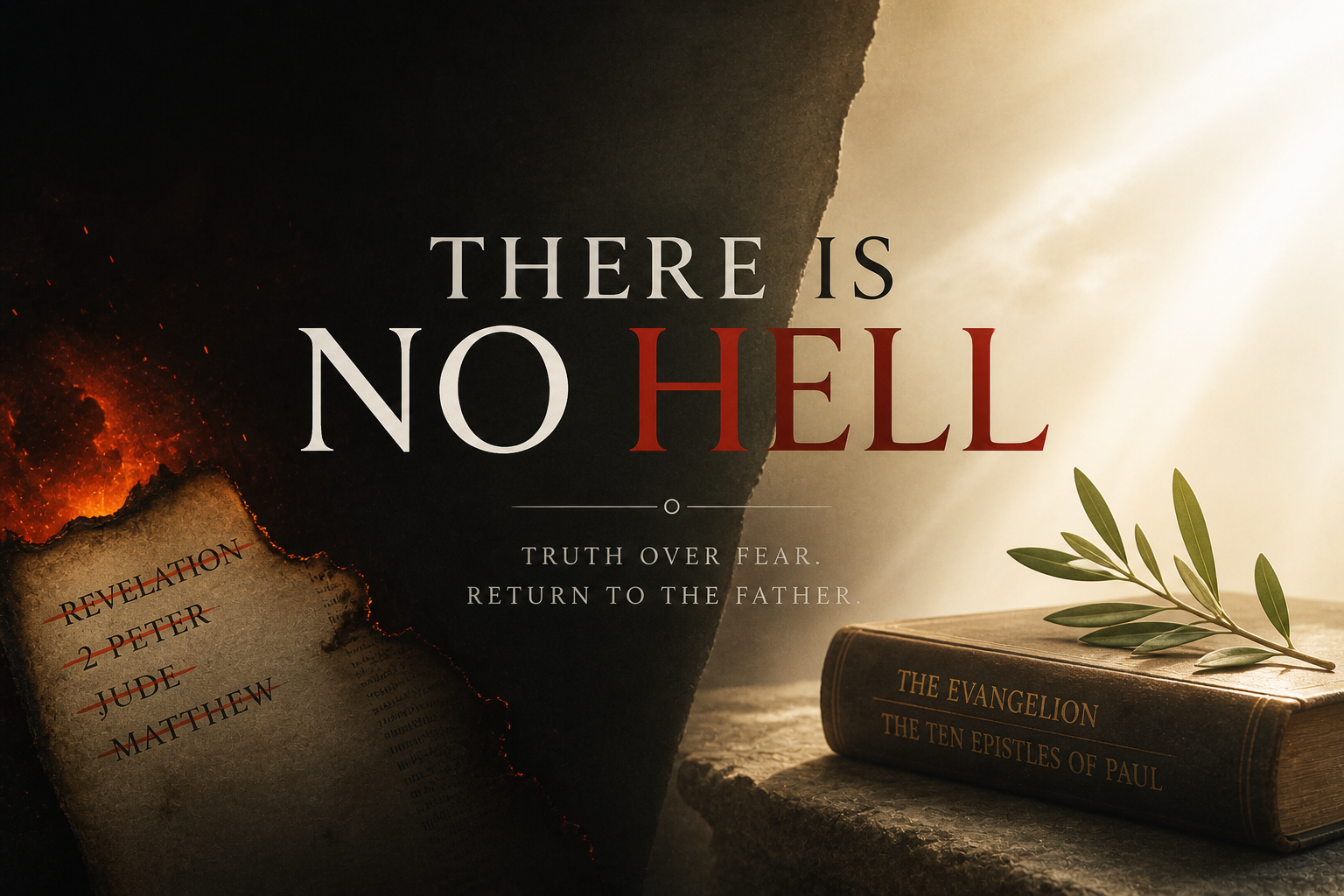 Neither Fire nor Darkness: The Marcionite Rejection of Eternal TormentEvery doctrine of hell — every lake of fire, every eternal conscious torment, every purgatory — comes from books that were never in the original canon. The True Testament contains no hell because the Father who rescued you has no wrath, and the Creator who made this world never built one.May 2