
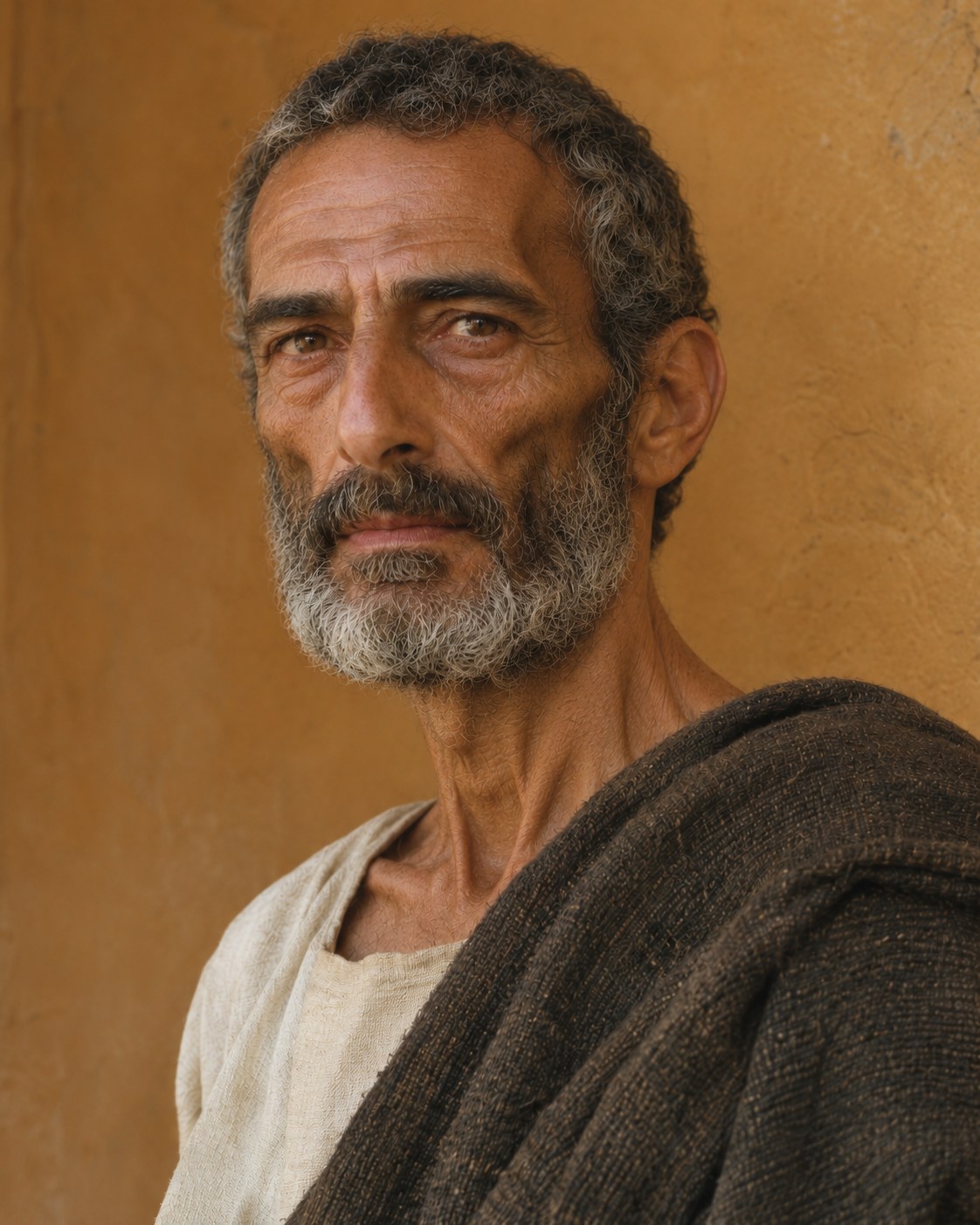
The man in this picture is about sixty-five. He has spent most of his life around ships, and the sun and salt show in his skin. He is thin in the way of someone who has fasted for years. His hair is cut short, his beard is full and going white, and over a plain tunic he wears a cloak of wool so coarse that a later enemy called it sackcloth.
Nobody painted Marcion while he lived, or if someone did, the painting is gone. So this is a reconstruction, and we want to be exact about what that means. Some of what you see is reported by men who wrote about him within a lifetime. Some of it is what a man of his city, his trade and his decade would have looked like. And some of it, the line of the nose and the set of the mouth, is an artist’s choice with nothing behind it. This article goes through the portrait feature by feature and says which is which.
The Picture Everyone Uses Is Probably Someone Else
Search for Marcion and one image comes up again and again: two men from a medieval manuscript, captioned “the Apostle John and Marcion of Sinope.” It sits at the top of the encyclopedia entries on him. It deserves a closer look than it usually gets.
The painting is folio 150 verso of a Greek gospel book made in Italy in the 11th century, now manuscript M.748 in the Morgan Library in New York. The Morgan’s own catalogue describes the book as having two full-page portraits of Evangelists. It does not mention Marcion.
The name was attached in 1938 by Robert Eisler, in a book called The Enigma of the Fourth Gospel. Eisler had a theory. An old Latin preface to John’s Gospel contains a tangled sentence about Marcion, and Eisler read it to mean that Marcion had served as the scribe who took the Gospel down at John’s dictation. He printed this miniature of John with a scribe as his plate XIII and put Marcion’s name under it. A reviewer in the Expository Times called his conclusion astonishing.
There is an ordinary explanation for a second man writing beside John. Byzantine and Armenian gospel books show John dictating to his disciple Prochorus as a matter of routine. A Vatican gospel book of 1122 has the pair. So does another manuscript in the Morgan’s own collection. Nothing in the record sets M.748 apart, and the second figure is most likely Prochorus.
Even on Eisler’s reading the image could tell us nothing. A painter in southern Italy nine hundred years after Marcion’s death had no likeness to copy.
One detail in the manuscript’s history is worth keeping. In 1906 the book belonged to the archbishop of Samsun, the next large port along the Black Sea coast from Sinope, and a Paris dealer sold it to the Morgan in 1929. The book wrongly said to show Marcion spent part of its life on his home shore.
What His Opponents Let Slip
Everything written about Marcion in the first two centuries after him was written to discredit him. Men who set out to damage a reputation still mention ordinary facts along the way, and those facts are what a portrait can be built from.
Justin, writing in Rome in the 150s, is the only one who was his contemporary. He calls him Marcion of Pontus and complains that he is still alive and still teaching. That fixes the region and tells us he was active in Rome in that decade.
About thirty years later a writer named Rhodon, preserved by Eusebius in his Church History (5.13), refers to him as “the sailor.” Around the year 200 Tertullian, in his Prescription Against Heretics (30), calls him “Ponticus nauclerus,” a shipowner of Pontus, and a keen student of the Stoics. Rhodon wrote in Greek and Tertullian in Latin, and nothing suggests that one copied the other. Tertullian adds a figure: Marcion brought 200,000 sesterces into the church at Rome, and when the church put him out, the money went out with him. That sum was half the fortune a man needed to rank as a Roman knight. Tertullian had no reason to invent a detail that shows the Roman church taking a heretic’s money, which is a good reason to believe it.
A shipowner of that period was a businessman first. The Greek word, naukleros, covers the man who owns the vessel, the man who captains it and the man who contracts to carry other people’s cargo, and one person could be all three. The state valued such men. A ruling of the emperor Hadrian, preserved in Roman law, freed the shipowners who carried grain for the city of Rome from the civic duties of their home towns. Marcion’s working years fell in that reign.
His age comes from Clement of Alexandria. In the Stromata (7.17) Clement says Marcion was an old man in the days when the teachers Basilides and Valentinus were younger. The sentence is awkward and editors have argued over it, but as it stands it makes Marcion the senior figure among the teachers of his time. Tertullian places Marcion and Valentinus for the most part in the reign of Antoninus Pius, who ruled from 138 to 161. Nobody recorded Marcion’s year of birth, and modern guesses run from about 85 to about 110. Put Clement and Justin together and a man in his sixties during the Roman years fits best.
One passage has to be set aside. Tertullian opens his five books Against Marcion with a tirade about Pontus: a frozen land of wagon-dwellers and cannibals, whose worst product is Marcion. This is abuse borrowed from old Greek writing about the Scythians. Sinope was a Greek city seven centuries old, and the passage describes nobody.
A Man of Sinope
That Marcion came from Sinope in particular is first stated by Epiphanius in the 370s, who also makes his father the bishop there. That is late testimony. The city fits everything the earlier writers say, though, because Sinope was one of the great ports of the Black Sea.
Greeks from Miletus founded it. The kings of Pontus made it their capital. In 47 BC Julius Caesar settled Roman colonists there, and from then on the town had two languages. Gravestones survive from Sinope with the same epitaph cut in Latin and in Greek.
Marcion’s name belongs to that mixed world. Markion is a Greek pet form of Markos, and Markos is the Roman name Marcus. It is a Latin name in Greek dress. His family may have descended from Caesar’s settlers, or may have been Greeks who took a Roman name as many did. The name cannot settle it.
His trade is cut into the stones of his own city. Among the epitaphs of shipowners collected from the harbor towns of Roman Asia Minor, one comes from Sinope and now stands in the Istanbul Archaeological Museum: a marble slab more than four feet high for Iulios Kallineikos, naukleros, who died at thirty-two. A Roman family name with a Greek personal name, in the same business, in the same port. Marcion would have done business with men like him.
For the color of his eyes, hair and skin there is no testimony, but there is science. In 2022 a team led by Iosif Lazaridis published genetic data from hundreds of ancient individuals across Anatolia and the lands around it. They found that the population of Anatolia stayed remarkably stable down to Roman times, and that people of Anatolian descent made up much of the population of the empire, the city of Rome included. Predicting coloring from the same genomes, they found the most common combination across the ancient West to be brown eyes, brown hair and skin of a middle tone.
That is a statement about a population. Sinope was a port, ports draw people from everywhere, and a grey-eyed Sinopean is entirely possible. The portrait takes the likeliest combination. It also follows from the same study that Marcion would not have stood out in a Roman street. He looked like much of the city he taught in.
Hair, Beard and Cloak
For generations Roman men had shaved. Then Hadrian, who became emperor in 117, wore a full beard, and within a few years men across the empire had followed him. The fashion lasted through the reigns that came after. Marble portraits of private citizens from the 120s to the 160s show the same look over and over: short, thick, curling hair and a beard. A clean-shaven man teaching in Rome in 145 would have looked like a holdover from his grandfather’s day. So the portrait gives Marcion the beard and the cropped curls of his own generation, and his age turns them grey.
The best guide to how such men looked in color comes from Egypt. About a thousand painted portraits survive there from the Roman period, made on wooden panels and buried with the dead. They are the only large body of painted faces left from the Greek and Roman world, and they show people of Marcion’s class, Greek-speaking provincials with money. The men of the early and middle 2nd century wear beards, a tunic with a narrow purple stripe at the shoulder, and a white mantle over the left shoulder. One of the sitters is identified by an inscription as a naukleros. He was a shipowner like Marcion.
That was how a prosperous man dressed. Marcion in Rome had chosen a different life, and the churches he founded were known for their discipline. Tertullian, in Against Marcion (1.14 and 1.29), reports that Marcionites did not marry and treated fish as the holier food in place of meat. Years of that regimen leave a mark on a face, and the portrait shows it in the hollow cheeks and the thin neck.
For his clothing there is one witness, late and hostile. Ephrem the Syrian, writing hymns against rival churches in the 360s, says that Satan dressed the teacher Bardaisan in long robes and jewels and dressed Marcion in sackcloth. In another hymn he lists the lures of heresy as fasting, sackcloth and a diet of vegetables. Ephrem is describing the Marcionites of his own day in Syria, two hundred years on. But his insult matches something known from Marcion’s own Rome. Christian teachers there dressed as philosophers. Justin kept his philosopher’s mantle after his conversion and taught in it, in the same city and the same years. Tertullian calls Marcion a student of the Stoics, and the rough undyed cloak was the Stoic’s habit. A coarse dark mantle over a plain tunic fits both the teacher’s dress of his day and Ephrem’s insult. That is what he wears here.
The portrait also leaves certain things out on purpose. It has no halo and no bishop’s vestments. Those belong to the church art of later centuries, and putting them on a man of the 140s would be as false as the manuscript caption.
How Sure Is Each Feature
| Feature | How Well Supported | Where It Comes From |
|---|---|---|
| From Pontus on the Black Sea | Reported in his lifetime | Justin, First Apology 26 |
| From the city of Sinope | Reported, but late | Epiphanius, Panarion 42 |
| Skin weathered by a life with ships | Trade reported early; the effect is inferred | Rhodon in Eusebius 5.13; Tertullian, Prescription 30 |
| In his sixties | Reported, though the text is disputed | Clement, Stromata 7.17; Justin |
| Lean, fasting face | Inferred from the discipline of his churches | Tertullian, Against Marcion 1.14 and 1.29 |
| Coarse dark cloak | Reported late by an opponent; fits the teacher’s mantle of his day | Ephrem, Hymns Against Heresies 1 |
| Beard and short curled hair | The fashion of his generation | Dated portraits from Hadrian’s reign onward |
| Brown eyes, dark hair, olive skin | The likeliest coloring for his population | Lazaridis and colleagues, Science, 2022 |
| Nose, brow, mouth, expression | The artist’s choice | Nothing survives |
What the Portrait Is For
Since 1938 the only face attached to Marcion’s name has been a scribe in a gospel book who was most likely someone else. Before that there was Tertullian’s caricature of a savage from the frozen north. Neither has anything to do with the man.
The evidence, thin as it is, points somewhere more ordinary and more interesting: a Greek-speaking businessman from a bilingual port, wealthy enough to offer the church half a knight’s fortune, who by his sixties was dressed in the roughest cloth and living on a fasting diet, teaching in the largest city in the world among people who looked much like him. That is the man in the picture. If better evidence turns up, the picture should change with it.
Sources
Ancient writers: Justin, First Apology 26 and 58. Irenaeus, Against Heresies 1.27 and 3.3.4. Rhodon, in Eusebius, Church History 5.13. Tertullian, Prescription Against Heretics 30, and Against Marcion 1.1, 1.14 and 1.29. Clement of Alexandria, Stromata 7.17. Epiphanius, Panarion 42. Ephrem the Syrian, Hymns Against Heresies 1, 23 and 24. Callistratus, in the Digest 50.6.6.5, on Hadrian’s ruling for shipowners.
On the manuscript: Morgan Library and Museum, catalogue record for MS M.748. Robert Eisler, The Enigma of the Fourth Gospel (London, 1938), page 158 and plate XIII.
On Sinope and its shipowners: David French, The Inscriptions of Sinope, Part 1 (Bonn, 2004). Spanu, “Working and Dying in the Harbour Cities of Roman Asia Minor: An Appraisal of the Funerary Inscriptions.” Heidi Wendt, “Marcion the Shipmaster: Unlikely Religious Experts of the Roman World?” Studia Patristica 99 (2018).
On portraits and dress: Barbara Borg, “Painted Funerary Portraits,” UCLA Encyclopedia of Egyptology. Art Institute of Chicago, catalogue of Roman-period funerary portraits. Arthur Urbano, “Dressing the Christian: The Philosopher’s Mantle as Signifier of Pedagogical and Moral Authority.” Phil J. Botha, “The Textual Strategy of Ephrem the Syrian’s Hymn Contra Haereses I,” Acta Patristica et Byzantina 15 (2004).
On the genetic evidence: Iosif Lazaridis and colleagues, “A Genetic Probe into the Ancient and Medieval History of Southern Europe and West Asia,” Science 377 (2022).
On reading the hostile sources: Judith Lieu, Marcion and the Making of a Heretic (Cambridge, 2015).