
The Oldest Gospel
In 2021 Matthias Klinghardt's two volumes appeared in English under the title The Oldest Gospel and the Formation of the Canonical Gospels. Jason BeDuhn had printed an English Evangelion and Apostolikon in 2013 and argued that Marcion adopted a gospel already in existence rather than editing one. Markus Vinzent argued in 2014 that Marcion wrote the gospel himself and the canonical evangelists took it from him. Dieter Roth's critical edition of Marcion's Gospel followed in 2015. Readers who came to the subject through these books could be forgiven for thinking that the question of which came first, Marcion's Gospel or the church's Luke, had just been opened.
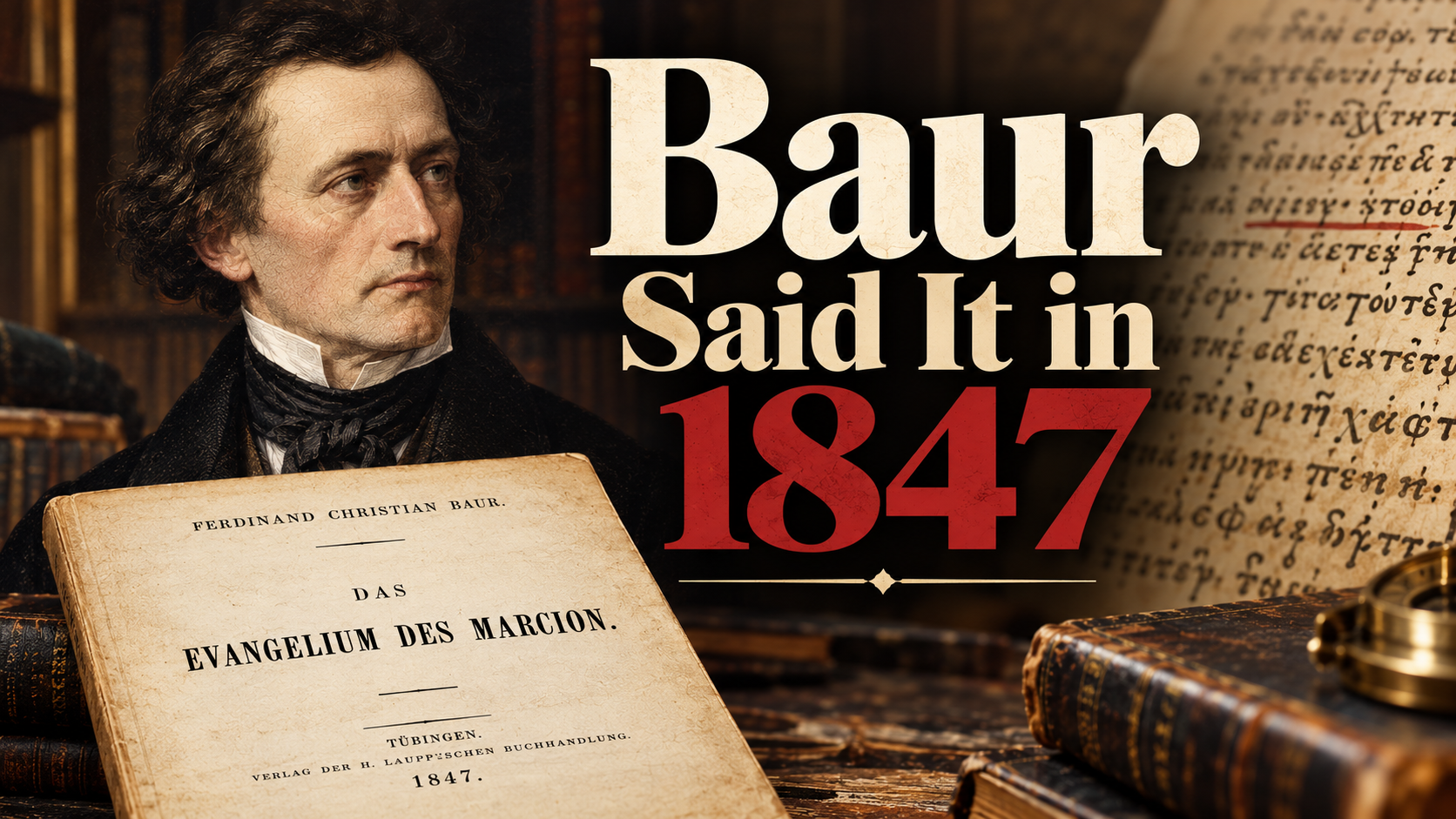
It was opened in Tübingen in the 1840s. Albert Schwegler raised it in 1843. Albrecht Ritschl argued it at book length in 1846. And in 1847 Ferdinand Christian Baur, the head of the Tübingen school and the most formidable critic of the New Testament in his century, took Ritschl's argument, tested it passage by passage, corrected it where it overreached, and carried it into Marcion's Paul, where Ritschl had stopped short of a secure result. His treatise on the Gospel of Luke occupies pages 391 to 531 of his Kritische Untersuchungen über die kanonischen Evangelien. We have translated it as Marcion and the Gospel of Luke, and the second edition is now on our site and on Amazon. Peter C. Hodgson's edition of the whole 1847 volume appeared from Cascade Books in August 2026, weeks before ours, so we claim no priority. We claim only that the argument has a date, and that the date is 1847.
What the Fathers Said
Baur begins where everyone has to begin, with Tertullian's fourth book against Marcion and Epiphanius's forty-second heresy. Those are the sources. They tell us what Marcion's Gospel lacked and where it read differently, and they tell us why. The why was always the same. Marcion had taken the church's Luke and cut it to fit his system.
Baur's first move is to ask whether the cuts fit the system. He takes the passages the Fathers name as missing and asks, one by one, whether their absence serves a Marcionite doctrine or simply restores a connection that the church's text has broken. Ritschl had laid down the principle. A reviser who inserts material into an existing text "can hardly escape the danger of tearing apart the connection of pieces that had until then been well ordered, or of placing pieces that contradict one another side by side" (p. 397). If the passages missing from Marcion are the passages that disturb the connection in Luke, then they were not cut out. They were put in.
Baur does not accept every one of Ritschl's examples. He is not persuaded by 19:9, because one infers the absence of those words in Marcion "only from Tertullian's silence" (p. 404), nor by Ritschl's argument from 20:37 to 38, though Epiphanius attests that Marcion lacked those verses, and he is more cautious than Ritschl about the Nazareth scene. But he finds the cases that prove the rule. In Marcion's Gospel the Capernaum material of 4:31 to 37 came first and the Nazareth visit followed, and that order removes the difficulty that in our Luke Jesus is asked in Nazareth about things done in Capernaum "before, according to our text, anything has yet happened in Capernaum" (p. 398). The two verses about sparrows and hairs, 12:6 to 7, which Baur holds Marcion did not have on Epiphanius's testimony to the first of them, are "an insertion that is not merely dispensable, but even disturbs the connection" (p. 401). At 20:19 the closing clause, that they knew the parable had been spoken against them, sits clumsily in our Luke because it was added to accommodate the parable of the rebellious vinedressers, a parable Marcion's text did not contain at all, so that in Marcion the words about seeking to seize him and fearing the people followed verse 8 directly (pp. 402 to 403). At 21:18, the promise that not a hair of your head will perish "flatly contradicts the preceding words of verses 16 and 17" (p. 403), and Marcion did not read it.
Then he states his conclusion on this first class of passages.
If it is rightly to be presupposed that, of two texts, the one which offers the more natural, simpler, more logically ordered connection, and contains nothing that intrudes disturbingly into the course of thought, is the original, then one must without doubt, already on the ground of the data before us, decide for the originality of the Marcionite text in its relation to that of the canonical Luke. (p. 404)
And the corollary. Since Marcion cannot have made these changes for dogmatic reasons, "his text can only be the one he already found before him, and all the differences between his text and ours can be regarded only as interpolations of a later hand" (p. 404).
One Verse in Five Books
Baur's second move is the one the modern debate has largely skipped, and it is the sharper of the two. He turns from the Gospel to the Apostolikon, Marcion's collection of Paul's letters, and reads Tertullian's fifth book with one question. Where, exactly, does Tertullian say that a passage was missing?
The answer should surprise anyone who has taken the charge of mutilation on trust. "One would expect, through so detailed a polemic, to be made acquainted with a series of passages which Marcion had omitted from the text of the Pauline letters. And yet it is in substance only a single passage of any importance concerning whose absence from Marcion's text a more definite testimony of Tertullian lies before us" (p. 412). That passage is Galatians 3:7, the sons of Abraham. Even there, Baur shows, Tertullian's own words presuppose that Marcion read verse 6, so that what is missing is one verse, and "how purposeless it would have been for Marcion to have cast out this one verse" (p. 412). Jerome later said verses 6 to 9 were gone, but Jerome's sentence "sounds, in content and in tone, wholly Tertullianic" (p. 412), and Baur asks: "How accidental it could have been that the copy of which Tertullian made use had precisely this small gap here" (pp. 412 to 413).
Then he looks at how Tertullian talks when he is accusing. He does not say this verse was missing and that verse was missing. He infers, he presupposes, he conjectures. "It is shown what the heretical industry had erased above." "How great pits he made will appear from the integrity of our document." "For these things would have had to displease Marcion." And when Tertullian cannot point to a gap, he takes a different turn, and says it is more forceful to refute Marcion from what he left standing. Baur's verdict is one sentence. "Such indefiniteness, ambiguity, unclarity is not the language of a writer who can support his assertion on irrefutable proofs that lie factually before one's eyes" (p. 422).
So the Apostolikon, far from confirming the usual view of the Gospel, "agrees completely with the result of the investigations of the Gospel" (p. 422). The charge of intentional falsification can be demonstrated in neither. What remains is "a groundless charge" that gained its standing only "through the confidence of the tone in which the Church Fathers bring it forward with so great a unanimity" (pp. 422 to 423).
A Gospel Made by Cutting Has No Parallel
Baur's third move is the one that turns a textual argument into a historical one, and it is the move the modern proponents have, in effect, rediscovered.
Grant that the Fathers were wrong about the motive. What, then, is the Marcionite Gospel? Baur answers that it is "nothing other than what is wholly analogous to the rest of the history of the formation of the Gospels: that an originally shorter Gospel received a greater compass through additions and expansions, and, in comparison with its earlier form, seemed to be a different one" (p. 424).
The mutilation hypothesis, he says, "does not even explain what it is supposed to explain" (p. 424). New Gospels arose in two ways, by a wholly new composition like John's, or by drawing together the common material in a definite direction like Mark's. "But the reshaping of a Gospel by mere shortening and mutilation would be without any analogy" (p. 424). The Gospel tradition in the second century was growing, not pruning. It "did not have the tendency to draw itself more narrowly together and to cut off what was superfluous or foreign, but rather to expand and spread itself" (p. 424). On that ground the only natural relation is "that the latter has proceeded from the former as a further development of the same historical material" (p. 424).
Why, then, did the Fathers see it the other way around? Because by the time Irenaeus and Tertullian wrote, the longer Luke had already spread through the church, and the heretic was the man last found in possession of the shorter one. Baur's sentence on this deserves to be quoted whole.
The name of Marcion therefore designates, so considered, nothing other than a definite epoch of the history of the canon, or rather, that the canon also has a history, that it was not from the beginning as it later appears, that there are thus also alterations which stand to one another as what is original and what was added only later, or as what is genuine and what is spurious, and must therefore first be separated critically. (p. 425)
And the proof that the Fathers were recording a fact about the canon and misnaming its cause is that they charged Marcion with readings that are nothing but ordinary variants. He read "your fathers" for "their fathers" at 6:23. He lacked "and of the earth" at 10:21. He lacked "eternal" before "life" at 10:25. He had "of God" where the church had "of the angels of God" at 12:8 to 9 and 15:10. "Is it not clear," Baur asks, "that to the name of Marcion there has been attached, in general, everything that in the course of time emerged as a more or less significant difference of text?" (p. 426).
The Readings He Called Original
Baur goes further than the variants. There is a class of readings "which cannot be held to be merely accidental," and of these he says that "the Marcionite reading is indisputably the original one" (p. 426). He names five: 11:2, 5:14, 8:19 to 21, 10:22 and 24:25. Later, when he comes to the reviser's work, he explains why several of them were changed, and adds others that Ritschl had already judged original from the connection (pp. 507 to 508). The ones that bear on our confession are in our scripture, and we print them here with his Greek.
At Luke 11:2 Marcion "seems, according to Tertullian, to have read" ἐλθέτω τὸ ἅγιον πνεῦμά σου ἐφ᾽ ἡμᾶς, may your Holy Spirit come upon us, in place of ἐλθέτω ἡ βασιλεία σου, let your kingdom come (p. 426). Our Evangelion keeps the petition for the Spirit and the petition for the kingdom together: "When you pray, say: 'Father, may your Spirit come upon us and make us clean. Let your kingdom come" (Evangelion 7:2 TT).
At Luke 8:20 Marcion had the words τίς ἐστιν ἡ μήτηρ μου καὶ τίνες εἰσὶν οἱ ἀδελφοί μου, who is my mother and who are my brothers (p. 426). Baur says the church's reviser omitted them from Luke, though they stand unassailed in Matthew, because the Marcionites used them to prove "their Docetic doctrine of the person of Christ" (p. 507). Our Evangelion reads: "Then Jesus said, 'Who is my mother, and who are my brothers? It's those who hear my words and live them out'" (Evangelion 4:36 TT).
At Luke 10:22 Marcion read οὐδεὶς ἔγνω, τίς ἐστιν ὁ πατήρ, εἰ μὴ ὁ υἱός, no one has known who the Father is except the Son. Baur calls this "the original reading, securely attested," and says it was altered into the present one "in order to take from the Gnostics, namely the Marcionites, the proof which they were accustomed to draw from those words, and especially from the aorist ἔγνω, for their doctrine of the unknown God" (pp. 507 to 508). Our Evangelion reads: "No one knows the Father except the Son, and no one knows the Son except the Father, and anyone to whom the Son reveals him" (Evangelion 6:30 TT).
At Luke 24:25, where our Luke has Jesus rebuke the two disciples for being slow to believe all that "the prophets spoke," Marcion read ἐλάλησεν ὑμῖν, what he spoke to you (p. 508; at p. 426 Baur prints ἡμῖν, to us). Our Evangelion reads: "How foolish you are, and how slow of heart to trust all that he told you" (Evangelion 16:22 TT).
At Luke 16:17 Marcion read τῶν λόγων μου where our Luke has "the law." Baur accepts Ritschl's reading of the whole passage, that "the law has found its end, but the words of the Lord have eternal validity" (p. 402), and he says the reviser put "the law" in its place "in order to render it harmless" (p. 508). Our Evangelion reads: "The Law and the Prophets were in effect until John" (Evangelion 10:20 TT), and then, "But it's easier for heaven and earth to pass away than for even the smallest part of my words to fail" (Evangelion 10:21 TT).
At Luke 13:28 Marcion did not read that the rejected would see "Abraham and Isaac and Jacob and all the prophets" in the kingdom; he read πάντας τοὺς δικαίους, all the righteous, and he lacked the verses that follow in which the Gentiles come from east and west to take the Jews' place. Baur judges that the church's text here is "a working together, unsuited to the connection, of the passage Matthew 8:11–12 with the original text that lay before Marcion" (p. 402). Our Evangelion has no patriarchs in that kingdom: "There will be weeping and clenching your teeth in despair when you see all the righteous in the kingdom of God, while you yourselves are shut outside" (Evangelion 9:15 TT).
Baur was not a Marcionite and had no interest in our confession. He judged these readings original on critical grounds, because for some of them the originality "can be demonstrated from other testimonies" and for the rest "it is plain to see what interest the later reviser of the Gospel had in altering the reading so that it now reads as it does" (p. 426). His account of what the reviser was doing is on pages 507 to 509, and his account of the reviser's general motive on page 502. The reviser was taking the Pauline point off a Pauline Gospel wherever the Marcionites had found a handle on it.
The Reviser and His Infancy Narrative
The third part of the treatise asks what the reviser added and why, and here Baur's account is the one that still stands behind every modern argument about the tendency of Luke.
The canonical Luke, he writes, "divides, according to its whole content, into constituent parts that arose at two different times and come from different authors" (p. 502). The original stock is Pauline. The reviser was not a simple Judaizer; he worked from "the same irenic interest" that produced Acts, and he wanted the Pauline Gospel to sit beside Jewish Christianity in one church. So "by omissions, interpolations, and alterations, what was original has here and there had its Pauline point taken off, especially where the Gospel used by Marcion seemed to sound altogether too favorable to the heretic" (p. 502).
"The greatest concession, however, was made to the Judaists by the taking up of an infancy narrative" (pp. 502 to 503). The first two chapters of Luke "have a strikingly Jewish, even Old Testament, stamp" (p. 503). In them the Messiah is "an offshoot of the Davidic line," and his salvation is "the blessing, already promised to the fathers of the Old Testament, now coming to fulfillment upon his people" (p. 503). The original Gospel had none of this. Its author, Baur says, "in order only to shut out everything Jewish, granted even to the Baptist and forerunner no place in it" (p. 503), and the reviser was all the more careful to weave the two birth stories together so that a single divine plan could be seen in them.
That is the Gospel we read. Our Evangelion opens in the fifteenth year of Tiberius with a descent into Capernaum. "That's when Jesus descended into Capernaum, a town in Galilee. Every Sabbath, he taught the people there" (Evangelion 1:2 TT). There is no womb, no census, no circumcision on the eighth day, no Benedictus, no Magnificat, and no song about the promises to the fathers. Baur explained in 1847 why the church's Luke has all of these and ours has none.
What Happened to the Argument
The honest history has to be told, and we have told it at length in The Books Nobody Translated. Here it is in short.
Ritschl withdrew his thesis in 1851 and counted it refuted by Volckmar and Hilgenfeld. Baur revised his own position the same year. He now granted that Marcion had altered some passages, but he held to the view that the church's Luke was expanded from an earlier form, and he wrote to Ritschl that he was a far more faithful adherent of Ritschl's 1846 view than Ritschl himself. Gustav Volckmar's 1852 book declared the Fathers confirmed. In England William Sanday argued in 1876 from style and vocabulary that Marcion's Gospel presupposed our present Luke in its complete form. Zahn concluded in 1892 that Marcion had worked over the church's Luke itself. Harnack opened his treatment of Marcion's Gospel in 1921 by calling it a mutilated Luke, as the ancient church had said, and added that no more words need be wasted on that.
Baur was answered, but the answers stayed in German. Adolf Hilgenfeld took his own position in 1850 and wrote again in 1853 against Volckmar, and Volckmar's 1852 book replied to Ritschl, Baur and Hilgenfeld together. So far as we have found, none of it has been translated. What English readers received was Sanday, who met Ritschl's connection argument with an argument from vocabulary, and then Zahn and Harnack, whose reconstructions were built on the premise that Marcion cut Luke, which was the thing in dispute. So the question was declared closed, twice, by the two scholars whose editions became the standard, and the English reader who wanted to see Baur's three questions put and answered could not read the questions or the answers. Where, exactly, does Tertullian say a passage was missing from Paul? Why does the name of Marcion carry ordinary variants? What is the analogy for a Gospel made by cutting?
Then, in 1942, John Knox revived the debate in English and misreported it. He wrote that the German controversy had ended in a new view held by Ritschl, Baur, Volckmar and Hilgenfeld alike. It had not. Of the four, only the Baur of 1851 held the view Knox described, as Dieter Roth showed in 2008. English scholarship ran on Knox's summary for sixty years, so that Joseph Tyson in 2006 could appeal to a tradition that included Ritschl, who had left it in 1851. The books were in German. The verdict was in English. The argument was in neither, because nobody had translated it.
The modern revival therefore reached Baur's conclusion by a different road. Klinghardt argues from the synoptic problem, BeDuhn from the character of the Evangelion as a text, Vinzent from Tertullian, and all of them cite the German debate. They are entitled to their routes. But the destination was marked on the map in 1847, and the man who marked it did so with the Fathers' own testimony in his hands.
Where We Part From Him
We should say plainly what Baur was and was not, because it would be easy to make him an ally he never agreed to be.
Baur did not believe what we believe. He held no doctrine of two Gods, and his interest in the Gospel of the Marcionites was the interest of a historian of early Christian parties. For him the original Gospel of Luke was a Pauline party document, written with a tendency against Jewish Christianity, and the canonical Luke was a conciliatory revision of it. His whole method rests on the premise that the Gospels present the life of Jesus "in a way in which it cannot have been in reality" (p. 530), and that only a writer standing at a distance from the events could have written them. That is not how we read the Evangelion. We read it as scripture, the Gospel that came before the four, and we hold that Marcion did not write it, as we argued against Vinzent.
Baur also did not think the matter settled in Marcion's favor on every verse. He disagreed with Ritschl where the evidence was only Tertullian's silence, and he said so. Our own edition marks every verse as Attested or Probable for the same reason. A reader who wants to see where the evidence runs out can see it in both.
And Baur revised. In 1851 he granted that Marcion had altered some passages. We print the 1847 treatise because it is the full statement of the argument, and we say in the edition what he later gave up and what he kept. He kept the thing that matters. The church's Luke was made by adding to an earlier Gospel, and Marcion's Gospel descends from that earlier Gospel, not from the church's Luke, even though by 1851 he thought Marcion had also cut it.
Why It Matters Now
Every modern argument against the priority of Marcion's Gospel runs through Tertullian. Roth's edition is built from him and the other witnesses. Sebastian Moll's claim that the burden of proof lies on our side rests on the point that all surviving sources say Marcion edited Luke. That is true, and Baur read those sources more closely than anyone since. He found that their most detailed witness, on the letters, could name, in substance, only one passage of any importance. He found that they charged Marcion with readings no one today would call Marcionite. He found that their account of how Marcion's Gospel came to be has no parallel in the way any other Gospel came to be. And he found that the readings they said Marcion changed are, on critical grounds, the readings a later hand changed the other way.
That case was made in 1847, in German, by a man with no stake in our confession. The replies to it were never translated, and the verdict was. Now that it is in English, from two publishers in one year, the people who hold that Marcion cut Luke will have to answer it, and the people who hold that the shorter Gospel is older can stop treating the argument as a recent one. Baur said it in 1847, and he said why.
Sources
Baur, Ferdinand Christian. Marcion and the Gospel of Luke. Translated and edited by W. C. Muenchow IV. Second Edition. True Testament Publishing, October 2026. An English translation of Kritische Untersuchungen über die kanonischen Evangelien (Tübingen, 1847), pp. 391–531, with the 1847 page numbers; page references above are to the 1847 printing.
Baur, F. C. Critical Investigations of the Canonical Gospels. Edited by Peter C. Hodgson. Eugene, OR: Cascade Books, 2026.
Ritschl, Albrecht. Das Evangelium Marcions und das kanonische Evangelium des Lucas. Tübingen, 1846. In our edition as The Gospel of Marcion and the Canonical Gospel of Luke.
Volckmar, Gustav. Das Evangelium Marcions. Leipzig, 1852. Hilgenfeld, Adolf, articles of 1850 and 1853, as reported in Roth 2008.
Roth, Dieter T. "Marcion's Gospel and Luke: The History of Research in Current Debate." Journal of Biblical Literature 127 (2008): 513–528. Roth, The Text of Marcion's Gospel. Leiden: Brill, 2015.
Knox, John. Marcion and the New Testament. Chicago, 1942. Tyson, Joseph B. Marcion and Luke-Acts. 2006. Sanday, William. The Gospels in the Second Century. London, 1876. Zahn, Theodor. Geschichte des neutestamentlichen Kanons, vol. 2. 1892. Harnack, Adolf von. Marcion: Das Evangelium vom fremden Gott. Leipzig, 1921, pp. 221*–222*.
BeDuhn, Jason. The First New Testament. 2013. Vinzent, Markus. Marcion and the Dating of the Synoptic Gospels. 2014. Klinghardt, Matthias. The Oldest Gospel and the Formation of the Canonical Gospels. Leuven: Peeters, 2021. Moll, Sebastian. The Arch-Heretic Marcion. Tübingen, 2010.
From our library: The Books Nobody Translated; Marcion Did Not Write the Evangelion; The Emmaus Road Without Moses; The History of Marcionite Reconstruction.
Scripture is quoted from the True Testament, Sixth Edition, with True Testament numbering. The Reader at truetestament.org shows the orthodox reference beside every verse.