
Turn to the eleventh chapter of Luke in almost any modern English Bible and read the Lord’s Prayer as it stands there. It is shorter than the prayer most Christians learned as children. The words “who art in heaven,” “thy will be done” and “deliver us from evil” are absent, and a note at the foot of the page typically explains that some manuscripts include them.
That shorter prayer reflects a judgment about what Luke originally wrote, and the judgment was made in a single book: the Nestle-Aland Novum Testamentum Graece, 28th edition, whose Latin title means “New Testament in Greek.” Published by the German Bible Society in 2012 and edited by the Institute for New Testament Textual Research in Münster, Germany, Nestle-Aland 28 is the standard critical edition of the Greek New Testament. It is the text from which scholars work and on which most modern translations rely. When your Bible settles how a verse of Luke should read, it is very likely following the Greek printed in this volume.
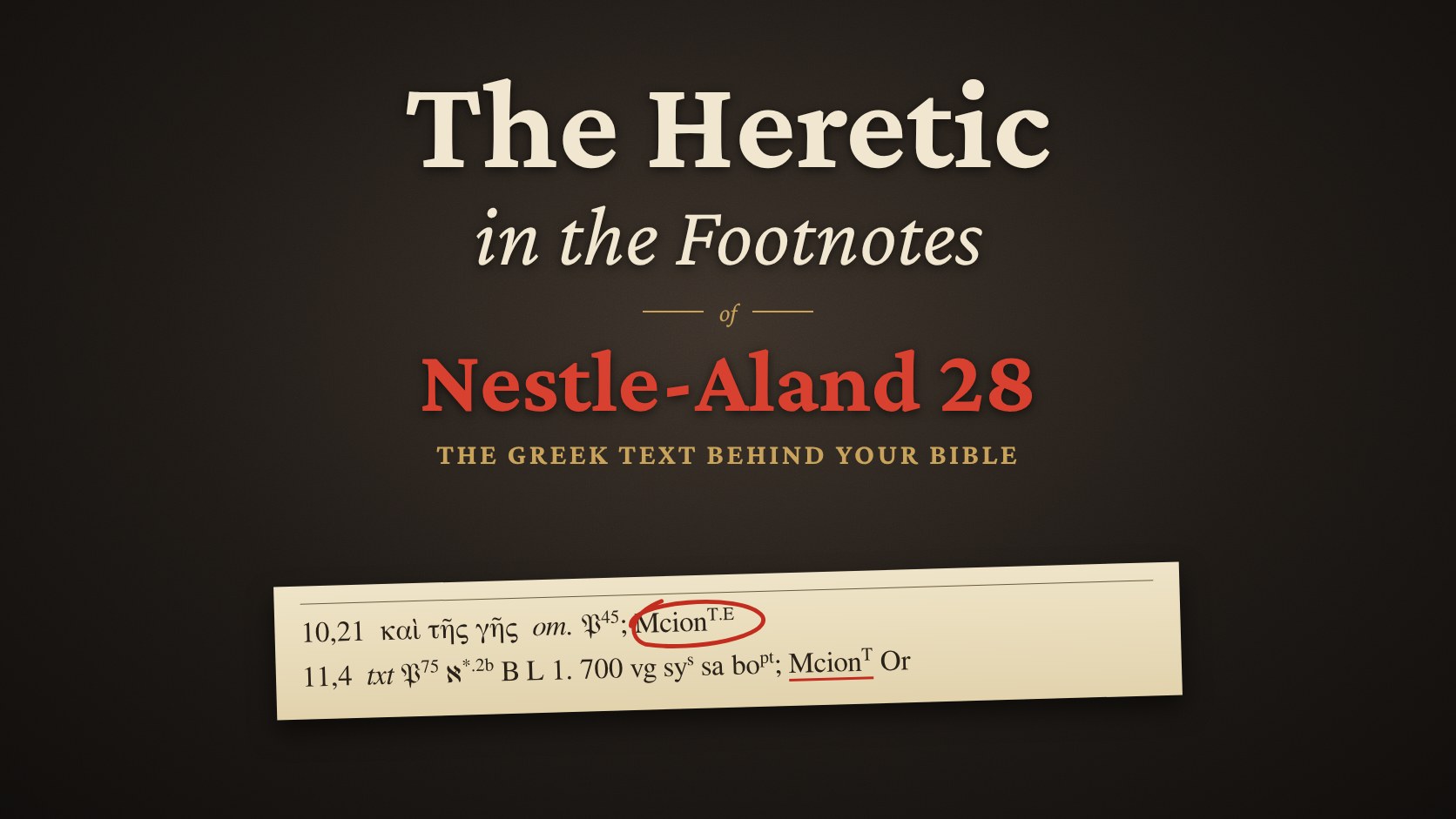
On page 230 of Nestle-Aland 28, beneath the Greek text of the Lord’s Prayer, the editors set out in small print the evidence for each word. Three times they record the witnesses for the shorter form of the prayer they have printed. Alongside Papyrus 75, one of the earliest surviving copies of Luke, and Codex Vaticanus, a Bible copied by hand in the fourth century and preserved today in the Vatican Library, one name appears on all three occasions: Marcion.
Marcion of Sinope, a shipowner from the southern coast of the Black Sea, came to Rome around the year 140 and assembled the first known collection of Christian scripture: a single Gospel and ten letters of Paul. The church condemned him as a heretic, and for more than eighteen centuries it has maintained that he produced his Gospel by mutilating the Gospel of Luke. Yet in the most authoritative edition of the Greek New Testament in the world, Marcion stands as a witness to what Luke wrote. Page 230 is not an isolated case. Nestle-Aland 28 cites him 85 times in its notes on Luke, and taken together those notes dismantle the accusation made against him.
The Charge
Around the year 180, Irenaeus, bishop of Lyon in Roman Gaul, set down the accusation that has followed Marcion ever since: “he mutilates the Gospel which is according to Luke, removing all that is written respecting the generation of the Lord, and setting aside a great deal of the teaching of the Lord, in which the Lord is recorded as most clearly confessing that the Maker of this universe is His Father” (Against Heresies 1.27.2).
The charge is a precise one. Irenaeus does not merely claim that Marcion abridged Luke. He alleges that Marcion removed the very passages in which Jesus acknowledges the Maker of this world as his Father, and that he did so for doctrinal reasons. Tertullian of Carthage, writing in North Africa around the year 207, devoted five books to refuting Marcion and repeated the same charge. Church historians have transmitted it ever since, and it survives today in a single familiar image: Marcion took a knife to Luke.
A Witness or a Forger
That accusation places Nestle-Aland 28 in a difficult position.
In a critical edition of this kind, a witness is an ancient manuscript, an early translation or an early church writer that shows how a passage read at a given time. The editors weigh these witnesses against one another to determine the original wording. By definition, a forgery cannot serve as such a witness. A court seeking the terms of a will does not consult a copy that the heir is known to have rewritten. Yet the editors of Nestle-Aland 28 consult Marcion’s Gospel to establish what Luke wrote, and in 18 places they cite him in support of the very wording they print as Luke’s.
The Editors’ Own Rule
The introduction to Nestle-Aland 28 explains why an early writer is cited at all. On page 78* (the introductory pages are numbered with an asterisk), the editors state that the early church writers are valuable “as indirect witnesses to the manuscripts they used.” They then set down their rule: “They are cited only if they can be considered reliable witnesses to the text of the manuscripts quoted.” Variations that arise from a writer’s own manner of quoting, they add, “have to be excluded from the apparatus,” the technical name for the notes printed beneath the text.
Marcion is cited under that rule. In their list of early writers the editors identify him as “Marcion according to Tertullian, Epiphanius, Adamantius,” naming the three ancient sources that report the wording of his Gospel, and they mark each citation with the source from which it is drawn so that readers may assess every entry for themselves.
By the standard Nestle-Aland 28 sets for itself, then, each of the 85 entries stands in the notes because the editors judged it a reliable witness to the wording of a manuscript Marcion possessed. A forger’s rewriting can reliably attest nothing except the forger’s own intentions. The editors were free to exclude Marcion, as they exclude a writer’s loose or paraphrased quotations. Instead they included him 85 times in Luke alone.
On the following page, 79*, they make an admission the traditional account never makes: “The problems concerning the original wording of Marcion’s text still remain unsolved.” The scholars most familiar with the evidence regard the question as open. The account still repeated in the churches treats it as settled eighteen centuries ago.
The editors would have a reply, and it deserves a fair hearing. Marcion, they might argue, copied the text of Luke available to him, and his copy remains good evidence wherever his convictions did not lead him to alter it. That reply, however, turns the question back on their own pages. If Marcion altered Luke to suit his beliefs, the alterations ought to be visible in their notes, which form the most complete record ever compiled of where his wording departs from Luke’s. We therefore examined those notes for exactly that evidence.
How to Read the Notes
Each page of Nestle-Aland 28 is divided in two. The upper portion carries the Greek text the editors judge to be original. The lower portion carries the apparatus, a dense sequence of abbreviations recording which manuscripts, translations and early writers support each reading. A reading, in this sense, is a particular wording of a verse. Few readers ever learn to interpret these notes.
Where the notes cite Marcion’s Gospel, they print “Mcion” followed by a small raised letter identifying the ancient writer who reported his wording. T denotes Tertullian. E denotes Epiphanius, bishop of Salamis on Cyprus, who wrote against Marcion around the year 375. A denotes the Dialogue of Adamantius, an anonymous written debate between a spokesman for the church and the followers of Marcion. Or denotes Origen, the third-century church teacher from Alexandria in Egypt.
We read the notes on Luke in Nestle-Aland 28 line by line, from page 194 to page 290, and recorded every place in which Marcion is named. There are 85. Each entry was then compared with the reports of Tertullian, Epiphanius and the Dialogue of Adamantius as collected in the True Testament Critical Edition, which sets out Marcion’s scripture together with the ancient evidence for every verse. In each case the ancient writer named by Nestle-Aland 28 does report Marcion’s text at that verse, and in every reading we examined closely the editors’ record agrees with what that writer says. The editors have done their work with care. The argument presented here does not depend on errors in their notes. It depends on what their notes establish.
A complete list of all 85 entries appears at the end of this article, with the page number in Nestle-Aland 28 for each, so that anyone with access to a copy can verify every line.
Lord of Heaven, and a Third-Century Papyrus
Consider first the reading that best fits Irenaeus’s charge. In Luke 10:21 Jesus offers thanks to the Father. In the church’s Luke he addresses him as “Lord of heaven and earth,” precisely the kind of language Irenaeus accuses Marcion of removing, since it presents the Father as Lord of the created world. Marcion’s Gospel, which the True Testament calls the Evangelion, does not include “and earth.” Our Evangelion reads: “I thank you and praise you, Lord of heaven, because what was hidden from the wise and educated you have revealed to the simple.” (Evangelion 6:29 TT). For centuries this verse has served as the standard example of a heretic’s deliberate cut.
On page 226 of Nestle-Aland 28, the notes list exactly two witnesses for the wording without “and earth.” The first is Marcion, as reported by Tertullian and Epiphanius. The second is Papyrus 45, a third-century copy of the four Gospels and Acts and one of the oldest surviving manuscripts of Luke. Papyrus 45 was produced and used within the church, and nothing about it is Marcionite.
The charge cannot survive this evidence. Either a copyist of the church introduced a heretic’s theology into the church’s own Gospels, or the words “and earth” were absent from the text that both he and Marcion received. Should one suppose instead that the scribe of Papyrus 45 dropped the words by accident, the conclusion is no better for the accusation: the reading presented for eighteen centuries as Marcion’s calculated cut turns out to be one a church scribe could produce without any theological motive at all. Whichever explanation is chosen, page 226 shows no knife.
The Prayer You Pray
Return now to the Lord’s Prayer on page 230. Nestle-Aland 28 prints Luke’s prayer without “our” and “who art in heaven,” without “thy will be done,” and without “deliver us from evil,” the three lines absent from your modern Bible. For each of the three, the editors list Marcion, on the testimony of Tertullian, among the witnesses for the wording they print. Our Evangelion contains none of the three lines either:
“Jesus said, “When you pray, say: ‘Father, may your Spirit come upon us and make us clean. Let your kingdom come. Give us your sustaining bread day by day. Forgive us our debts, the wrongs we owe, for we ourselves forgive everyone who owes us. And don’t let us be dragged into temptation.’”” (Evangelion 7:2 to 7:4 TT).
The dates deserve attention. Marcion’s Gospel was in use in Rome by the middle of the second century. Papyrus 75 is generally dated to around the year 200, and one scholar has argued that it was copied as late as the fourth century. Codex Vaticanus and Codex Sinaiticus, two of the oldest surviving Bibles in Greek, both belong to the fourth century. Of all the witnesses Nestle-Aland 28 cites for those three lines, Marcion’s Gospel is the oldest. The Gospel the church condemned as mutilated is the earliest text Nestle-Aland 28 cites for the form of the prayer printed in your Bible today.
The editors do not follow Marcion throughout the prayer. His opening petition, “may your Spirit come upon us and make us clean,” they confine to the notes rather than the text, observing that it also survives in two later Greek manuscripts and in the writings of Gregory of Nyssa, a bishop of the fourth century.
Eighty-Five Places
Counted from the pages of Nestle-Aland 28, the 85 entries fall into three groups.
In 18 places, Marcion is cited in support of the wording the editors print as Luke’s. Beyond the Lord’s Prayer, these include the spelling of Capernaum, the wording of Luke 4:41, 6:9, 10:11 and 10:22, and the shorter text of 12:39 and 16:18.
In 57 places, the editors print a different wording, and Marcion’s wording is shared by other witnesses. These are the passages the traditional account counts as his alterations, and the notes tell a different story. In 54 of the 57, Marcion’s wording also appears in the church’s own ancient manuscripts or translations: 33 times in Codex Bezae, a Greek and Latin Gospel book from about the year 400; 43 times in the church’s ancient Latin translations; 29 times in its Syriac translations, made for Christians who spoke the language of Syria; 14 times in Codex Sinaiticus; and 8 times in Papyrus 45. In 13 of these places, Marcion’s wording is the one found in the majority of later Greek manuscripts. The remaining 3 of the 57 are shared with Greek manuscripts copied in later centuries.
In only 10 places does Nestle-Aland 28 name Marcion as the sole manuscript witness for a wording.
In fifty-four of fifty-seven cases, then, the supposed “heretic’s alteration” proves to be wording the church’s own copyists also preserved. Either the church’s scribes copied Marcion repeatedly, in Greek, Latin and Syriac, or these readings were ordinary Gospel text of the second century, and Marcion was simply reading the Gospel he had received.
Name the Cuts
Irenaeus maintained that Marcion cut Luke to suit his beliefs. Nestle-Aland 28 records 85 places where Marcion’s wording can be set beside Luke’s. Asked to identify the cuts, it can produce only ten readings attested nowhere but in Marcion.
They are these. In Luke 16:17 his Gospel says it is easier for heaven and earth to pass away than for one tittle of “my words” to fail, where the church’s Luke has “the law.” At 21:19 it reads “you will save your lives.” At 12:14 Jesus asks who made him a judge, without the words “or divider.” At 23:2 the accusers charge that Jesus was “turning away the wives and the children.” At 11:3 it reads “your bread.” According to Epiphanius, Marcion’s Gospel did not contain the final line of 17:10, in which the servants describe themselves as unworthy. The remaining four are the absence of the word “now” twice in 6:21, a different form of “he was raised” in 24:6, the words “which I spoke to you” in 24:25, and the order of “flesh and bones” in 24:39.
Several of these affect the meaning, and this article does not conceal them. Each, however, remains a difference between two texts, and none of them reveals which text came first. The standard example of a theological cut, “Lord of heaven” in 10:21, does not appear on the list at all, because a church papyrus reads the same way.
One larger difference lies outside the notes altogether. Marcion’s Gospel did not include the birth narratives that open the church’s Luke, and Irenaeus named that difference first. It, too, is a difference between two Gospels. When a shorter Gospel and a longer one share most of their wording, two explanations are possible: material was removed from the longer, or material was added to the shorter. A number of scholars today, among them the German New Testament scholars Matthias Klinghardt and Markus Vinzent, argue that Marcion’s Gospel came first. Nestle-Aland 28 cannot settle that question on the church’s behalf. What its notes do demonstrate is that, verse after verse, Marcion’s wording is the wording of the church’s own oldest copies.
What the Editors Never Say
Tertullian, for all his five books against Marcion, acknowledged the difficulty himself: “I say that mine is true, Marcion says that his is true. I affirm that Marcion’s is corrupted, Marcion affirms that mine is corrupted” (Against Marcion 4.4.1). He resolved it by asserting that whatever was older must be true, and that his own text was the older.
Nestle-Aland 28 neither repeats Tertullian’s charge nor answers it. It treats Marcion as a witness to the text of Luke, places his readings beside the church’s oldest manuscripts, and in the Lord’s Prayer prints the very words he read. Its editors rank among the most careful scholars of the Greek text anywhere, which is precisely what makes their pages so damaging to the traditional account. Those who know the evidence best have built Marcion into the foundation of the Greek New Testament, while the churches continue to teach that he took a knife to Luke. In 2022 Dieter Roth, author of the standard modern reconstruction of Marcion’s Gospel, argued in the journal New Testament Studies that the Marcion entries in the notes of Nestle-Aland 28 on Luke should be reexamined in light of recent research. The evidence for that reexamination is already printed on these pages.
Four Questions for the Editors
If Marcion’s Gospel is a heretic’s rewriting, why does your introduction state that early writers are cited only when they are “reliable witnesses to the text of the manuscripts quoted,” and then cite him 85 times in Luke?
If Marcion mutilated Luke, why does he appear on page 230 as a witness for the three lines your edition prints as Luke’s prayer?
If “Lord of heaven” was his theological cut, why do your notes on page 226 record the same wording in Papyrus 45, one of the church’s own Gospel books?
If his Gospel is a rewriting, why do 54 of the 57 readings of his that you set aside also appear in the church’s own manuscripts and translations?
The answer to all four is printed in their own edition, and it is not the account the church has told.
What This Means for You
When you read Luke in a modern Bible, you are reading wording that was determined verse by verse from the evidence assembled in Nestle-Aland 28, and Marcion’s Gospel forms part of that evidence. In some passages, the Lord’s Prayer among them, the words of your Bible are the words he read. When you next hear that Marcion mutilated the Gospel, ask which verses are meant. The most thorough record ever compiled can identify ten differences in wording, and it cannot tell you who introduced them.
The evidence is open to anyone. In a copy of the Nestle-Aland Novum Testamentum Graece, 28th edition, the editors’ rule and their admission stand on pages 78* and 79* of the introduction, and the small word “Mcion” can be found in the notes on pages 226 and 230. The Gospel Marcion read, with the evidence for every line, is set out verse by verse in the True Testament and the True Testament Critical Edition.
Every Entry, Page by Page
The table below lists every place where the notes of Nestle-Aland 28 name Marcion in Luke. Where the editors placed his witness in parentheses, to indicate support with minor differences, the table says “close but not word for word.”
| Luke | Page in Nestle-Aland 28 | Reading | Marcion’s Witness | How Nestle-Aland 28 Uses It |
|---|---|---|---|---|
| 4:23 | 194 | Spelling of Capernaum (Kapharnaoum) | Tertullian and Adamantius | Supports the text Nestle-Aland 28 prints as Luke |
| 4:31 | 194 | Spelling of Capernaum (Kapharnaoum) | Tertullian and Adamantius | Supports the text Nestle-Aland 28 prints as Luke |
| 4:41 | 195 | No “the Christ” after “You are” | Tertullian | Supports the text Nestle-Aland 28 prints as Luke |
| 5:14 | 198 | “that it may be a testimony for you” | Tertullian and Epiphanius, close but not word for word | Not printed by Nestle-Aland 28; also in Codex Bezae, Latin translations |
| 5:24 | 199 | Adds “take up” | Tertullian | Not printed by Nestle-Aland 28; also in Codex Sinaiticus, Codex Bezae, later Greek manuscripts |
| 5:24 | 199 | “pallet” (krabatton) | Tertullian | Not printed by Nestle-Aland 28; also in Codex Bezae, Latin translations, later Greek manuscripts |
| 5:24 | 199 | Adds “and” | Tertullian | Not printed by Nestle-Aland 28; also in Codex Sinaiticus, Codex Bezae, later Greek manuscripts |
| 5:34 | 200 | “can the sons...” | Tertullian, close but not word for word | Not printed by Nestle-Aland 28; also in Codex Sinaiticus, Codex Bezae, Latin translations, Coptic translations |
| 5:34 | 200 | “to fast” | Tertullian, close but not word for word | Not printed by Nestle-Aland 28; also in Codex Sinaiticus, Codex Bezae, Latin translations |
| 5:38 | 200 | “they put” | Adamantius | Not printed by Nestle-Aland 28; also in Codex Sinaiticus, Codex Bezae, Latin translations, Syriac translations |
| 5:38 | 200 | Adds “and both are preserved” | Adamantius | Not printed by Nestle-Aland 28; also in Codex Alexandrinus, Codex Bezae, most later Greek manuscripts, Latin translations, Syriac translations |
| 6:5 | 201 | Word order “the Son of Man... also of the sabbath” | Epiphanius | Not printed by Nestle-Aland 28; also in Codex Alexandrinus, Codex Bezae, most later Greek manuscripts, Latin translations, Syriac translations |
| 6:9 | 202 | “if” | Tertullian | Supports the text Nestle-Aland 28 prints as Luke |
| 6:9 | 202 | “destroy” | Tertullian | Supports the text Nestle-Aland 28 prints as Luke |
| 6:16 | 202 | Spelling of Iscariot (Iskariōtēn) | Epiphanius | Not printed by Nestle-Aland 28; also in Codex Sinaiticus, Codex Alexandrinus, Codex Washingtonianus, most later Greek manuscripts |
| 6:20 | 203 | “theirs is the kingdom” | Tertullian | Not printed by Nestle-Aland 28; also in Codex Washingtonianus, Latin translations, Syriac translations, Coptic translations |
| 6:21 | 203 | No “now” (twice) | Tertullian | Found only in Marcion |
| 6:21 | 203 | Variant form of “you will be filled” | Tertullian | Not printed by Nestle-Aland 28; also in Codex Sinaiticus, Latin translations, Syriac translations, Coptic translations, Origen |
| 6:21 | 203 | “you will laugh” variant | Tertullian | Not printed by Nestle-Aland 28; also in Codex Washingtonianus, Latin translations, Syriac translations, Coptic translations |
| 6:22 | 203 | A shorter wording | Tertullian | Not printed by Nestle-Aland 28; also in later Greek manuscripts |
| 6:25 | 203 | No “now” | Tertullian | Not printed by Nestle-Aland 28; also in Codex Alexandrinus, Codex Bezae, most later Greek manuscripts, Latin translations, Syriac translations, Irenaeus |
| 6:26 | 204 | “men” without “all” | Tertullian | Not printed by Nestle-Aland 28; also in Codex Bezae, Syriac translations, later Greek manuscripts |
| 6:31 | 204 | Adds “you also” | Tertullian, close but not word for word | Not printed by Nestle-Aland 28; also in Codex Sinaiticus, Codex Alexandrinus, Codex Bezae, Codex Washingtonianus, most later Greek manuscripts, Latin translations |
| 6:36 | 205 | No “therefore” | Tertullian | Not printed by Nestle-Aland 28; also in Codex Sinaiticus, Codex Vaticanus, Codex Washingtonianus, Latin translations, Syriac translations, Coptic translations, later Greek manuscripts, Clement of Alexandria |
| 6:37 | 205 | “so that” construction | Tertullian | Not printed by Nestle-Aland 28; also in Codex Alexandrinus, Codex Bezae, Codex Washingtonianus, Latin translations, Syriac translations, Coptic translations, Cyprian |
| 6:37 | 205 | “so that” (second clause) | Tertullian | Not printed by Nestle-Aland 28; also in Codex Bezae, Codex Washingtonianus, Latin translations, Syriac translations, Coptic translations |
| 6:38 | 205 | “for with the same measure” | Tertullian | Not printed by Nestle-Aland 28; also in Papyrus 45, Codex Alexandrinus, most later Greek manuscripts, Latin translations, Syriac translations |
| 7:36 | 210 | “reclined” | Epiphanius | Supports the text Nestle-Aland 28 prints as Luke |
| 7:38 | 210 | “wet” (ebrexe) | Epiphanius | Not printed by Nestle-Aland 28; also in Codex Bezae, Latin translations, Syriac translations |
| 8:3 | 211 | Adds “and” | Tertullian | Not printed by Nestle-Aland 28; also in Codex Bezae, Latin translations |
| 8:3 | 211 | “served him” (not “them”) | Tertullian | Not printed by Nestle-Aland 28; also in Codex Sinaiticus, Codex Alexandrinus, Latin translations, Syriac translations, Coptic translations, later Greek manuscripts |
| 8:46 | 216 | “gone out” (exelthousan) | Epiphanius | Not printed by Nestle-Aland 28; also in Codex Alexandrinus, Codex Bezae, Codex Washingtonianus, most later Greek manuscripts |
| 9:1 | 217 | Adds “apostles” | Adamantius | Not printed by Nestle-Aland 28; also in Codex Sinaiticus, Latin translations, Syriac translations, Coptic translations, later Greek manuscripts |
| 9:2 | 217 | No object “the sick” | Adamantius | Not printed by Nestle-Aland 28; also in Codex Vaticanus, Latin translations, Syriac translations |
| 9:6 | 218 | “went through the cities and villages” | Adamantius | Not printed by Nestle-Aland 28; also in Latin translations, Coptic translations |
| 9:16 | 219 | “over them” | Epiphanius | Not printed by Nestle-Aland 28; also in Codex Bezae, Latin translations, Syriac translations |
| 9:22 | 220 | “after three days” | Adamantius; Epiphanius close but not word for word | Not printed by Nestle-Aland 28; also in Codex Bezae, Latin translations |
| 9:22 | 220 | “rise” (anastēnai) | Adamantius | Not printed by Nestle-Aland 28; also in Codex Alexandrinus, Codex Bezae, later Greek manuscripts |
| 9:35 | 221 | “beloved” (not “chosen”) | Tertullian and Epiphanius | Not printed by Nestle-Aland 28; also in Codex Alexandrinus, Codex Washingtonianus, most later Greek manuscripts, Latin translations, Syriac translations |
| 10:11 | 225 | No “on you” | Tertullian | Supports the text Nestle-Aland 28 prints as Luke |
| 10:21 | 226 | No “and of the earth” | Tertullian and Epiphanius | Not printed by Nestle-Aland 28; also in Papyrus 45 |
| 10:22 | 227 | No added “turning to the disciples he said” | Tertullian | Supports the text Nestle-Aland 28 prints as Luke |
| 10:24 | 227 | A shorter wording | Tertullian | Not printed by Nestle-Aland 28; also in Codex Bezae, Latin translations |
| 10:27 | 227 | Shorter form of the love command | Tertullian | Not printed by Nestle-Aland 28; also in Codex Bezae, Latin translations |
| 11:2 | 230 | No “our... who art in heaven” | Tertullian and Origen | Supports the text Nestle-Aland 28 prints as Luke |
| 11:2 | 230 | “your Holy Spirit come upon us and cleanse us” | Tertullian, close but not word for word | Not printed by Nestle-Aland 28; also in later Greek manuscripts, Gregory of Nyssa |
| 11:2 | 230 | No “your will be done” | Tertullian and Origen | Supports the text Nestle-Aland 28 prints as Luke |
| 11:3 | 230 | “your bread” | Origen | Found only in Marcion |
| 11:4 | 230 | No “deliver us from evil” | Tertullian and Origen | Supports the text Nestle-Aland 28 prints as Luke |
| 11:11 | 231 | Form of the question | Epiphanius, close but not word for word | Supports the text Nestle-Aland 28 prints as Luke |
| 11:11 | 231 | No “bread... stone” clause | Epiphanius | Supports the text Nestle-Aland 28 prints as Luke |
| 11:11 | 231 | “or” | Epiphanius | Supports the text Nestle-Aland 28 prints as Luke |
| 11:38 | 234 | “began to debate within himself” | Tertullian, close but not word for word | Not printed by Nestle-Aland 28; also in Codex Bezae, Latin translations, Syriac translations |
| 11:41 | 234 | “will be” | Tertullian, close but not word for word | Not printed by Nestle-Aland 28; also in Papyrus 45, Codex Bezae, Latin translations, later Greek manuscripts |
| 11:48 | 235 | “not to agree” | Tertullian | Not printed by Nestle-Aland 28; also in Codex Bezae, Latin translations |
| 12:1 | 236 | A different word order | Tertullian and Epiphanius | Not printed by Nestle-Aland 28; also in Papyrus 45, Codex Sinaiticus, Codex Alexandrinus, Codex Bezae, Codex Washingtonianus, most later Greek manuscripts, Latin translations, Syriac translations, Coptic translations |
| 12:5 | 236 | “to cast” | Tertullian and Epiphanius | Not printed by Nestle-Aland 28; also in Papyrus 45, Codex Bezae, Codex Washingtonianus, Clement of Alexandria |
| 12:14 | 237 | “judge” only (no “or divider”) | Tertullian | Found only in Marcion |
| 12:27 | 238 | “neither spin nor weave” | Tertullian, close but not word for word | Not printed by Nestle-Aland 28; also in Codex Bezae, Latin translations, Syriac translations, Clement of Alexandria |
| 12:31 | 239 | “kingdom of God” | Epiphanius | Not printed by Nestle-Aland 28; also in Papyrus 45, Codex Alexandrinus, Codex Bezae, Codex Washingtonianus, most later Greek manuscripts, Latin translations, Syriac translations |
| 12:39 | 239 | Shorter text | Tertullian | Supports the text Nestle-Aland 28 prints as Luke |
| 12:47 | 240 | “having done” | Adamantius | Not printed by Nestle-Aland 28; also in Papyrus 45, Codex Bezae, Irenaeus, Origen |
| 12:51 | 240 | “to cast” | Tertullian | Not printed by Nestle-Aland 28; also in Latin translations, Syriac translations, Coptic translations, later Greek manuscripts |
| 12:51 | 240 | “but” | Tertullian | Not printed by Nestle-Aland 28; also in Papyrus 45, Codex Bezae, later Greek manuscripts |
| 16:12 | 252 | “what is mine” (not “yours”) | Tertullian | Not printed by Nestle-Aland 28; also in Latin translations, later Greek manuscripts |
| 16:17 | 253 | “one tittle of my words” (not “of the law”) | Tertullian | Found only in Marcion |
| 16:18 | 253 | No “everyone” | Tertullian | Supports the text Nestle-Aland 28 prints as Luke |
| 16:20 | 253 | No “there was” | Adamantius | Supports the text Nestle-Aland 28 prints as Luke |
| 16:20 | 253 | No “who” | Adamantius | Supports the text Nestle-Aland 28 prints as Luke |
| 16:22 | 254 | “in Hades” | Adamantius | Not printed by Nestle-Aland 28; also in Codex Sinaiticus, Latin translations |
| 16:25 | 254 | “here” | Adamantius and Epiphanius | Not printed by Nestle-Aland 28; also in later Greek manuscripts |
| 16:31 | 254 | “goes to them” | Adamantius | Not printed by Nestle-Aland 28; also in Codex Washingtonianus, Latin translations, Syriac translations |
| 17:10 | 256 | Last line of the verse lacking (the servants call themselves unworthy) | Epiphanius | Found only in Marcion |
| 19:26 | 264 | “what he seems to have” | Tertullian | Not printed by Nestle-Aland 28; also in Syriac translations, later Greek manuscripts |
| 20:35 | 270 | “are about to” | Tertullian | Not printed by Nestle-Aland 28; also in Codex Bezae, Codex Washingtonianus, Latin translations, Syriac translations |
| 21:19 | 272 | “you will save” | Tertullian | Found only in Marcion |
| 22:14 | 275 | “the twelve apostles” | Epiphanius | Not printed by Nestle-Aland 28; also in Codex Sinaiticus, Codex Alexandrinus, Codex Washingtonianus, most later Greek manuscripts, Latin translations, Syriac translations, Coptic translations |
| 23:2 | 280 | A shorter wording | Epiphanius | Not printed by Nestle-Aland 28; also in Codex Alexandrinus, Codex Washingtonianus, most later Greek manuscripts, Latin translations |
| 23:2 | 280 | Adds “and destroying the law and the prophets” | Epiphanius | Not printed by Nestle-Aland 28; also in Latin translations |
| 23:2 | 280 | Adds “and turning away the wives and the children” | Epiphanius | Found only in Marcion |
| 23:45 | 285 | “and the sun was darkened” | Epiphanius (apparently) | Not printed by Nestle-Aland 28; also in Codex Alexandrinus, Codex Washingtonianus, most later Greek manuscripts, Latin translations, Syriac translations, Origen |
| 24:6 | 287 | “he was raised” form | Epiphanius | Found only in Marcion |
| 24:7 | 287 | “how many things” (hosa) | Tertullian and Epiphanius | Not printed by Nestle-Aland 28; also in Codex Bezae, Latin translations, Syriac translations |
| 24:25 | 289 | “which I spoke to you” | Tertullian, Adamantius and Epiphanius | Found only in Marcion |
| 24:39 | 290 | Word order of “flesh and bones” | Tertullian and Epiphanius | Found only in Marcion |
Sources
Novum Testamentum Graece, edited by the Institute for New Testament Textual Research under the direction of Holger Strutwolf, 28th revised edition (Stuttgart: Deutsche Bibelgesellschaft, 2012), introduction, pages 78* to 81*, and apparatus to Luke, pages 194 to 290.
Irenaeus, Against Heresies 1.27.2.
Tertullian, Against Marcion, book 4. Epiphanius, Panarion 42. The Dialogue of Adamantius. All quoted from the translations in the True Testament library.
Dieter T. Roth, “The Testimony for Marcion’s Gospel in NA28: Revisiting the Apparatus to Luke in the Light of Recent Research,” New Testament Studies 68 (2022), 52 to 60.
Brent Nongbri, on the date of Papyrus 75, in Journal of Biblical Literature 135 (2016).
The True Testament and the True Testament Critical Edition.