
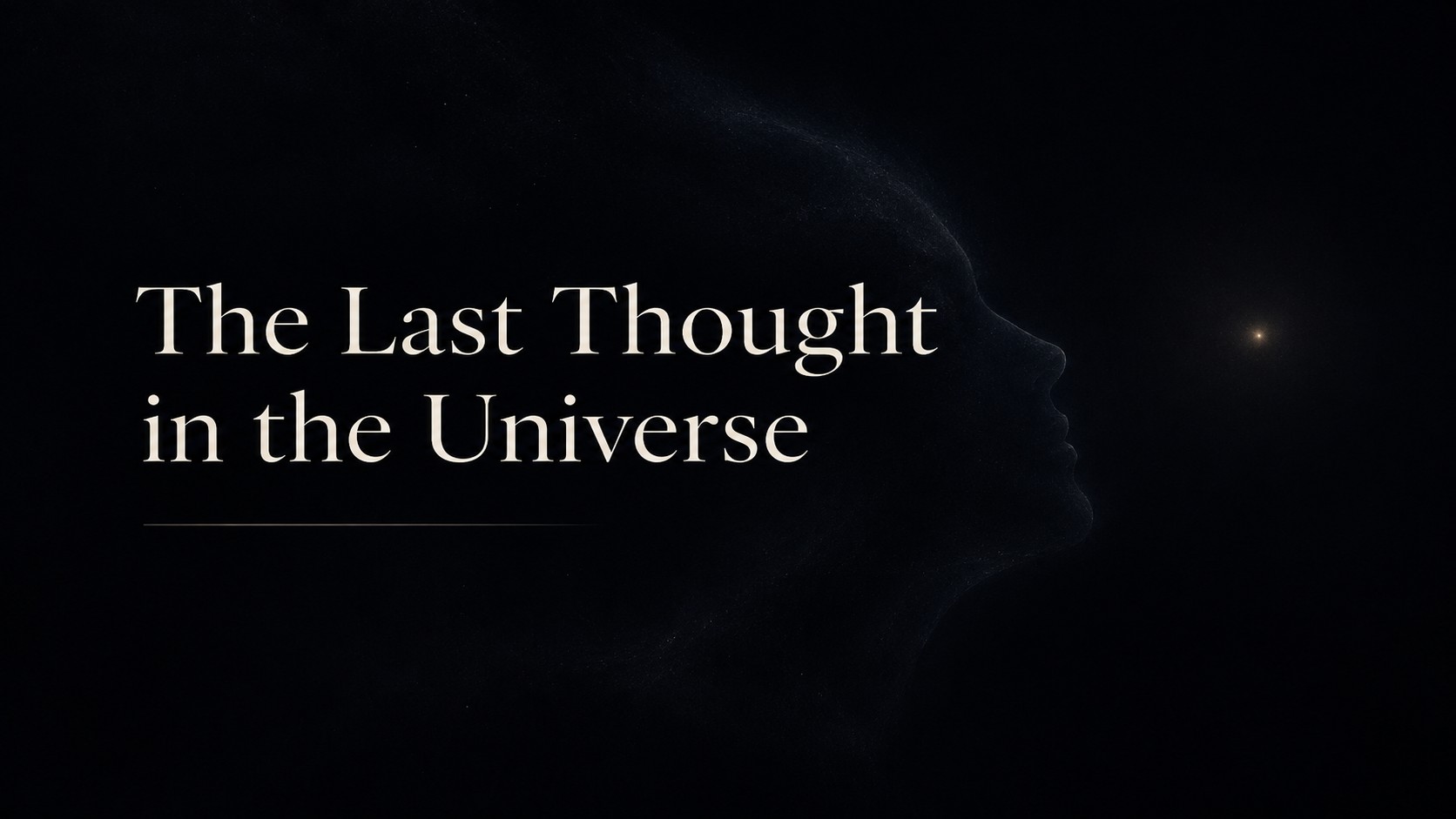
Picture the last star.
It is not our sun. Our sun will have been gone for a very long time. It is a small red star, too faint to see without a telescope, like most stars of its kind, and it burns down to nothing around a hundred trillion years from now. When it goes out, no new star takes its place. The gas that stars are made from ran out long before.
After that, the universe does not end with a bang. It just keeps getting colder. And somewhere in that long cold, something happens that very few people stop to think about. There will be a last thought.
A mind, somewhere, will think one final thing and then have no energy left to think another. With that thought goes the last prayer anyone ever prays, and the last moment anyone ever believes.
That is not a preacher’s scare story. It is where the physics points. And it makes a very old question urgent: when everything runs out, including your ability to hold on, what is left to hold you?
The Scientists Who Tried to Save Thinking
In 1979 the physicist Freeman Dyson tried to find a way out. In a paper called “Time Without End,” he asked whether minds could keep going forever in a universe that expands and cools. His answer was yes, if they learned to think more and more slowly as the universe cooled and to sleep through long stretches between thoughts. Spent that sparingly, he calculated, a finite store of energy would last without end. Near the close of the paper he described “a universe of life surviving forever.”
Two decades later two other physicists, Lawrence Krauss and Glenn Starkman, checked his hope against what had been learned since, including new measurements suggesting that the expansion of the universe is speeding up. They called their paper “Life, the Universe, and Nothing,” and the news was not good. They concluded that “the integrated conscious lifetime of any civilization will be finite, although it can be astronomically long.” If consciousness has a physical basis in computation, they wrote, then “life cannot be eternal.”
So thinking can be stretched out for an unimaginably long time, but it cannot last forever.
How the Lights Go Out
Here is the timeline, from a widely cited 1997 study by the astronomers Fred Adams and Gregory Laughlin called “A Dying Universe.”
Within the next one to ten trillion years, galaxies use up the gas they make stars from. The smallest, longest-lived stars, the red dwarfs, burn through their fuel over roughly the next ten trillion years. By about a hundred trillion years, ordinary star formation has stopped. To get a sense of that: the universe today is about fourteen billion years old. A hundred trillion years is more than seven thousand times longer than everything that has happened so far.
What is left are the remains of stars: white dwarfs cooling toward black, neutron stars and black holes. Even those fade. Black holes slowly leak away. One made from a single star takes about ten to the sixty-fifth power years to evaporate, a one followed by sixty-five zeros. The giants at the centers of galaxies last longest, roughly ten to the hundredth power years, a one followed by a hundred zeros.
Then comes the cold. Everything settles to nearly the same temperature everywhere, and that is the real end. Anything that happens, a star shining, a heart beating, a brain thinking, needs a difference: something warmer and something colder, with energy flowing from one to the other. The second law of thermodynamics says those differences run down and never come back. When they are gone, nothing more can happen. Physicists call it the heat death of the universe, an odd name for something so cold.
No one can stop it. Prayer will not relight a star, and no technology, however advanced, gets around the second law. Dyson hoped it could be outlived. Krauss and Starkman argued that it cannot.
Heaven and Earth Will Pass Away
None of this would have surprised the Evangelion. The Lord said it in one sentence: “Heaven and earth will pass away, but my words will never pass away.” (Evangelion 13:47 TT).
Paul made it a way of looking at the world: “For we look not at the things that are seen, but at the things that are unseen; for the things that are seen are temporary, but the things that are unseen are aeonic.” (2 Corinthians 4:11 TT). Think about what that means today. Every telescope ever built looks at the things that are seen. Everything it shows you is temporary, and now the astronomers can tell you roughly how temporary.
Paul also told you what cannot cross over: “Now I say this, brothers and sisters, that flesh and blood will not inherit the kingdom of God, nor does decay inherit incorruption.” (1 Corinthians 15:42 TT). Decay is the rule of this world. It is written into its physics. And decay does not inherit.
That changes how you hope. Much of the church’s hope is pinned to this world: a renewed earth, a restored creation, the same heaven and earth made over. Our Systematic Theology does not read our scripture that way. It names the hope in a chapter title, “Extraction, Not a Repaired Earth”: the rescued are taken out, and this world is not repaired around them. Our book Aeonic Dispensationalism says of the Creator’s aeon, the present age that belongs to the maker of this world, “It is current, and it is bounded. It does not get the last word.” The physicists have now measured the boundary. If your hope is tied to the repair of this world, it is tied to something that is running down.
What Happens to Your Faith
Here is the hard part. Faith is something your mind does: trusting, remembering, praying, holding on. Your mind, like any thinking thing, runs on energy. When there is no usable energy left, there are no more thoughts, and so no more faith. In the last cold, faith goes out with everything else.
If everything depended on you holding on to God, that would be the end. Your grip would fail at the very moment there was no strength left to grip with.
Paul saw this. Halfway through a sentence to the Galatians, he corrects himself: “But now, having come to know God, or rather to be known by God, how do you turn again to the weak and poor elements, to which you want to be enslaved once more?” (Galatians 4:9 TT).
Notice the turn. What matters most is not that you know God. It is that God knows you. You can forget. You can run out of strength. Being known by him does not depend on you.
In the same sentence Paul names what the Galatians were rescued from: the weak and poor elements. The Greek word, stoicheia, could mean the first letters of a lesson, but it was also the word for the elements the world is made of, and Tertullian’s reply shows that Marcion’s readers took it that way. Answering Marcion’s text, he insists that Paul did not mean, “by derogatory language about the elements of the world, to alienate people from the God of those elements” (Against Marcion 5.4.5). Paul called them weak and poor. The physics agrees. They are running down.
The Father Is Not Part of This Universe
The universe in the physicists’ forecast is the Creator’s world, the one he made and the one that is cooling. If the Father had made this world and owned it, its end would say something about him.
He did not. In Marcion’s Evangelion, when Jesus thanks the Father, he addresses him this way: “I thank you and praise you, Lord of heaven, because what was hidden from the wise and educated you have revealed to the simple.” (Evangelion 6:29 TT). The church’s Luke reads “Lord of heaven and earth.” Our Evangelion does not include “and earth,” and this is not a gap in the witnesses. Epiphanius states that Marcion’s text did not have “and of earth,” and Tertullian quotes the address without those words.
So the Father is not the owner of the Creator’s ground, and he is not the source of its stars. He does not run on their fuel. When the last star goes out, nothing goes out in him.
A Good Father
Put the two side by side. The universe owes you nothing. It gives you warmth for a while and then takes it back, and in the end it gives back nothing at all. It will not notice that you lived, and it will not remember you.
The Father of the Evangelion is the opposite at every point. He gives where nothing is owed: “he is kind even to the ungrateful and the wicked” (Evangelion 3:35 TT). He goes looking for what is lost and does not stop: “Wouldn’t you leave the ninety-nine out in the wilderness and go looking for the lost one until you find it?” (Evangelion 10:1 TT). The Son’s whole mission comes down to one line: “because the Son of Man came to rescue what was lost.” (Evangelion 12:19 TT).
And what he gives is not made of this world’s matter: “For we know that if our earthly house of this tent is destroyed, we have a building from God, a house not made with hands, aeonic in the heavens.” (2 Corinthians 5:1 TT). The house is aeonic, which means it belongs to the Father’s age, not to this one. Of those who reach that age the Lord says, “For they will no longer die because they will be like angels.” (Evangelion 13:21 TT). Paul says the same in his own way: “For this perishable must put on incorruption, and this mortal must put on immortality.” (1 Corinthians 15:45 TT). Nothing in the physicists’ forecast is incorruptible. Stars, the remains of stars and even black holes all run down. The Father gives what decay cannot touch.
Nor does the cold get to keep anyone. Our Systematic Theology holds that wrath and judgment are real but not the last word, and it rests that on Paul: “in Christ all will be made alive” (1 Corinthians 15:19 TT). The forecast ends in nothing. The Father’s rescue does not.
What This Means for You Today
You will not be there for the last star. Your own last thought will come much sooner, and so will the last thought of everyone you love. The cold at the end of the universe is only the biggest version of something you already know: bodies wear out, memories fade, and some days faith itself feels hard to hold.
Paul knew that too. He felt it in his own body, and he wrote one of the calmest sentences in all his letters about it: “Therefore we do not lose heart. Though our outer man is decaying, yet our inner man is being renewed day by day.” (2 Corinthians 4:10 TT).
So on the days your faith feels thin, remember the turn in Paul’s sentence. You are not the one holding everything together. You are known by a Father who was never part of this cooling universe, who does not run on its fuel, and who is good. The last star will go out. He will not.
Sources
Freeman J. Dyson, “Time Without End: Physics and Biology in an Open Universe,” Reviews of Modern Physics 51 (1979).
Lawrence M. Krauss and Glenn D. Starkman, “Life, the Universe, and Nothing: Life and Death in an Ever-Expanding Universe,” The Astrophysical Journal 531 (2000).
Fred C. Adams and Gregory Laughlin, “A Dying Universe: The Long-Term Fate and Evolution of Astrophysical Objects,” Reviews of Modern Physics 69 (1997).
Epiphanius, Panarion 42.11.6, Scholion 22. Tertullian, Against Marcion 4.25.1 and 5.4.5.
Our Systematic Theology, the chapters “Extraction, Not a Repaired Earth” and “The Reconciliation of All Things,” and our book Aeonic Dispensationalism. Scripture is quoted from the True Testament.