
Ask most Christians how the world ends and they will describe arrivals. A secret rapture arrives. A tribulation arrives. A world ruler called the Antichrist arrives. Jesus arrives in Jerusalem to take a throne, a thousand years arrive, and then a final sorting arrives with one door marked heaven and another marked hell. The details change from chart to chart. The shape does not. The end is a schedule of things that come.
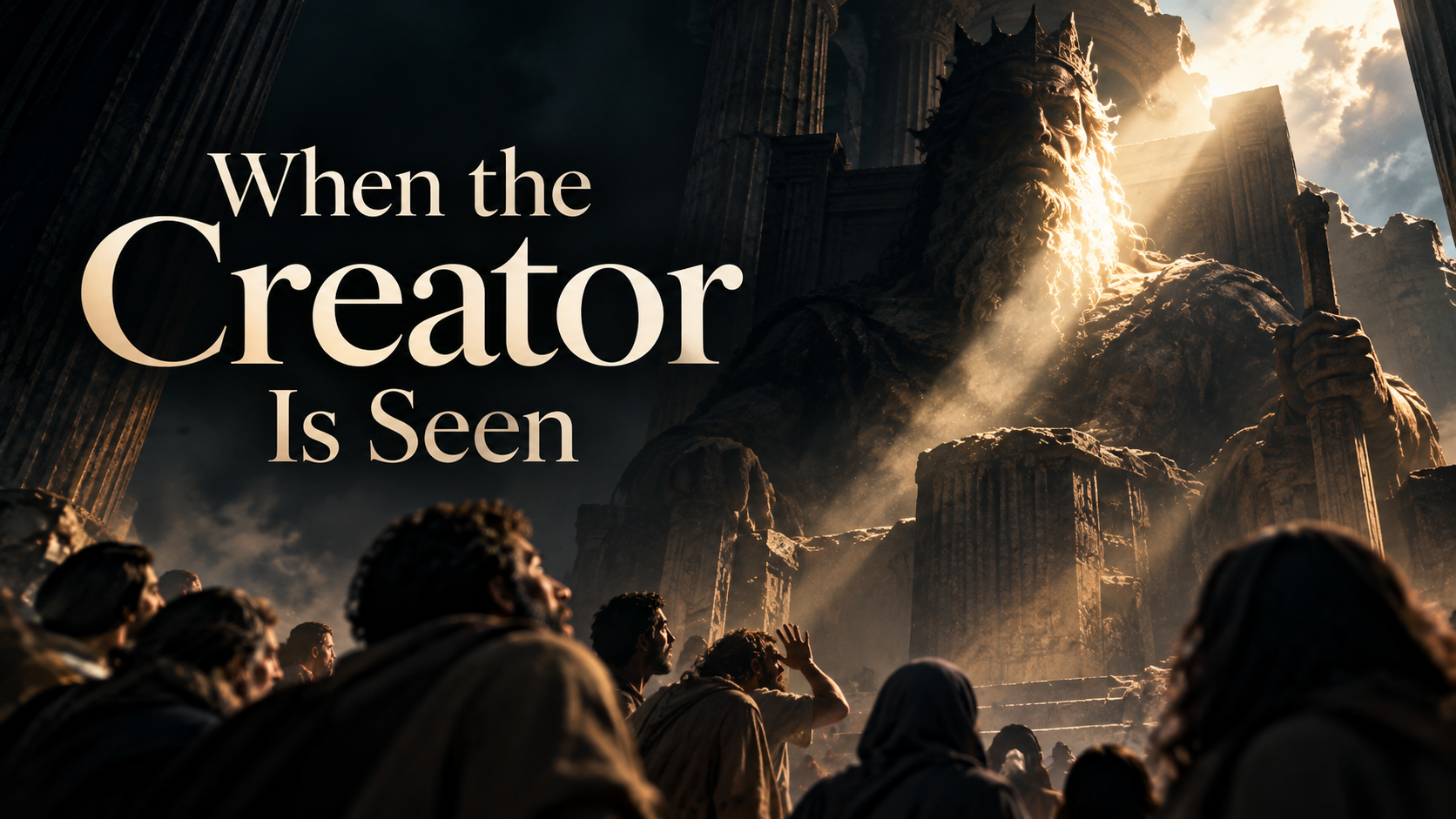
Our end turns on something being seen. The Creator has ruled this aeon from its beginning. The Father’s Son has already come. Even his coming at the end is, in Paul’s word, a presence, a coming into view. What changes at the end is who can see. Paul names the problem in a single sentence: “The god of this aeon has blinded the minds of the untrusting, so that the light of the Evangelion of the glory of Christ, who is the image of God, might not shine to them” (2 Corinthians 4:1 TT). The end is that blindness coming off.
That is why we hang the whole sequence on one event, the revealing of the person of fault, and why we hold that he is the Creator. The daily blinding of minds and the final unmasking of the god who blinds are one administration seen from two sides. Our book Perishing says it in two sentences: “Light does not become newly real. It becomes newly seen.” This article walks through the order of the end step by step, and shows that every step is a step of sight.
The order at a glance
The first three steps are already behind us or under way. The fifth is the hinge. Everything before it is the blindness lifting for some, and everything after it is what becomes possible once it has lifted for all.
The blindness
Start with the condition we live in now, because every later step undoes some part of it. Paul’s sentence has four parts. There is a god, and he is “the god of this aeon,” a ruler with a bounded province. He works on the mind. He blinds “the untrusting.” And his aim is that the light of Christ “might not shine to them” (2 Corinthians 4:1 TT). The light exists. It is blocked at the point of seeing.
The one doing the blocking is not the Father. Our books have said this plainly for some time. The Father is the one whose light is being blocked, and the god of this aeon is the one blocking it. Collapse the two and you get a god who hides Christ from people and then punishes them for not seeing him. Paul’s grammar will not allow that god.
What the blindness hides is the Father. Christ says so outright: “No one knows the Father except the Son, and no one knows the Son except the Father, and anyone to whom the Son reveals him” (Evangelion 6:30 TT). Paul tells the Galatians what they were before the Father reached them: “Formerly, when you did not know God, you were enslaved to those who are gods by nature” (Galatians 4:8 TT). The world is not short of gods. It is short of the Father.
Paul gives the blindness a second image, a veil. “But the thoughts of the world were dulled, for until this very day the same veil remains at the reading of the old covenant and it is not unveiled, for it is taken away in Christ” (2 Corinthians 3:9 TT). Notice whose thoughts are dulled. Not one nation’s. The world’s. The veil lies wherever the Creator’s covenant is read as if it came from the Father, and it comes off in one place only, in Christ.
Blindness does not feel like blindness from the inside. It feels like good sense. “For the message about the stake is foolishness to those who are perishing, but to those who are being rescued it is the power and wisdom of God” (1 Corinthians 1:18 TT). The same words reach two hearers. One hears nonsense and the other hears power. Nothing is wrong with the first hearer’s intelligence. The light is reaching the room and not reaching the mind. That is why arguments alone have never ended the blindness, and why the end of the world, in our reading, is first of all the end of it.
Why the Creator must be seen first
Paul sets the order himself. “Let no one deceive you in any way, for that day will not come unless the defection comes first and the person of fault is revealed, the one bound to perishing” (2 Thessalonians 2:3 TT). Something has to be shown before the day of the Lord can come. The Imperial Church reads this as a schedule of villains: before Christ returns, a new evil ruler must appear. We read it as a law of sight. Before the true Son can be seen, the false god has to be seen.
Here is why the order has to run that way. Paul calls Christ an image. “He is the image of the invisible God” (Colossians 1:15 TT). The blinding verse says the same thing in passing: the light that is blocked is “the glory of Christ, who is the image of God” (2 Corinthians 4:1 TT). An image is recognized by the one it images. If you have the wrong face in your mind, you look straight at the true likeness and see a stranger.
That is exactly what happened the first time. The world had the Creator in mind as God. So John the Immerser was offended, the council demanded a title he would not claim, the rulers staked the Lord of glory, and the two on the road to Emmaus walked away from Jerusalem looking sad. They were not stupid. They were comparing the Father’s image against the Creator’s face, and it did not match. As long as the Creator passes for the Father, the Father’s image will look like nothing at all.
So the unmasking is not a sideshow before the main event. It is the condition of the main event. The Creator has to be seen as the Creator, a god who “exalts himself above everything called a god” (2 Thessalonians 2:4 TT), before the world can look at Christ and recognize whose image he is.
This is not a theory we invented for the end. It is what already happens to every rescued person, and Paul is the proof. “But when God, who set me apart from birth and called me through his grace, was pleased to reveal his Son in me” (Galatians 1:14–15 TT), the man who says he “advanced in Judaism beyond many of my own age” (Galatians 1:13 TT) came to “count all things loss because of the surpassing worth of knowing Christ my Lord” (Philippians 3:4 TT). The Son was revealed in him, and the house he had served was seen for what it was, in the same moment. The end of the world is that moment at the scale of the world.
The first crack
The Father did not wait for the end to start undoing the blindness. He sent the Son into the middle of it, and he sent him hidden. “But we speak the wisdom of God in a mystery, hidden, which God predetermined before the aeons for our glory. None of the rulers of this aeon understood it; for if they had, they would never have staked the Lord of glory” (1 Corinthians 2:7–8 TT).
The Son descended into Capernaum as a stranger. He silenced the demons who knew him and ordered his disciples to tell no one that he was the Christ. He came the first time in concealment, and the house did what a blinded house does with something it cannot recognize. It killed him. Our books call that moment the present aeon exposing itself. The rulers did not unmask the Son at the stake. They unmasked themselves.
That was the first crack, and the light has been coming through it ever since, one person at a time. Paul describes it in the same language of veils: “Whenever a person turns to God, the veil is taken away” (2 Corinthians 3:11 TT). And then: “But we all, with unveiled face, beholding as in a mirror the glory of the Lord, are being transformed into the same image from glory into glory” (2 Corinthians 3:12 TT). Christ said the same to the disciples who had begun to see. “Blessed are the eyes that see what you see. For I tell you, the prophets did not see what you see” (Evangelion 6:31–32 TT).
None of this is achieved by effort. Paul corrects himself in mid-sentence to make the point: “But now, having come to know God, or rather to be known by God” (Galatians 4:9 TT). The Father reaches first, and the veil comes off. Every rescue since Capernaum is a small end of the world, the blindness lifting for one mind ahead of the day it lifts for all.
The defection
Paul names the first sign of the end: “that day will not come unless the defection comes first” (2 Thessalonians 2:3 TT). The Imperial Church calls this the great apostasy, the church going cold before the Antichrist appears. That reading leans on the Pastoral letters and on Matthew, and neither is in our canon. Paul does not say what is deserted. He names the defection and moves straight to the god sitting in his own temple. The passage fills in the blank itself.
We read the defection as people walking out of the Creator’s house once they see whose house it is. We say plainly, as our books always have, that this is not the usual reading. What makes it ours is that it is the same event as rescue, written in the other ledger. From the Father’s side, a person is reached and the veil comes off. From the side of the god of this aeon, who claims a worship that belongs to the Father, that same person has deserted.
So the defection is the first crack grown wide. What happened to Paul alone, when the Son was revealed in him, happens to many at once. It is still sight before it is anything else. Nobody walks out of a house they still think belongs to their father. The seeing comes first, and the walking out follows.
That is why the order matters. The defection comes before the full revealing. Some see before everyone sees. The walk-outs happening now, one person and one family at a time, are the firstfruits of it and not its fulfillment. And none of it is a tragedy. Under the Imperial reading, “that day will not come unless” is a threat that the church will rot before Christ returns. Under ours it is a promise. The condition is the Father’s own work, and the last sign before the Son appears is the Father gaining his own.
The revealing of the person of fault
This is the hinge of the whole order. “Let no one deceive you in any way, for that day will not come unless the defection comes first and the person of fault is revealed, the one bound to perishing. He exalts himself above everything called a god and every object of reverence, so that he sits in the temple of God, displaying himself as God” (2 Thessalonians 2:3–4 TT).
We hold that the person of fault is the Creator. The temple he sits in is his own, the one his Law built and his people kept. “Displaying himself as God” is not a usurper’s costume. It is his standing claim, made in his own house, that there is no god but him. “Fault” names that claim to be the highest God, which is false. “Bound to perishing” we read of his rule. Everything he makes perishes, including the order he rules, and his domain ends.
The objection comes quickly. The Creator has been visible since Sinai, so how can he be revealed? He has been visible, and nobody has seen him, because he blinds. A god who blinds everyone to who he is must be revealed before he can be seen. The one who thundered from the mountain is the one the world has never once seen for what he is. The revealing is not his first appearance. It is the first time the blindness about him lifts for everyone, and not only for those who have already walked out.
He does not go quietly. “His coming is according to the operation of the Adversary, with all power and signs and deceptive wonders, and with every deception of wickedness for those who perish, because they did not receive the love of the truth so as to be rescued” (2 Thessalonians 2:6–7 TT). The Adversary is the Creator’s functionary, his prosecutor and tempter, never his master. Here the house defends its owner’s claim with everything it has. “And because of this there will be for them an impulse of error” (2 Thessalonians 2:8 TT). The last argument of a god about to be seen is a show of power, and it holds some of those still inside.
What the world learns in that moment is one sentence long. The god it has been told about is not the Father. Paul does not describe how the revealing happens, and we do not invent a mechanism for it. He tells us what is revealed and that it comes before the day. That is enough to build on.
The Son is seen
Once the false god has been seen, the true Son can be. Paul’s word for what happens next is parousia, presence, and our translation keeps the sense: “we who remain for the presence of Christ” (1 Thessalonians 4:17 TT). It is not a second attempt at the Messiah’s work. It is the same Son, first hidden, now shown, on the day “when the Lord Jesus is revealed from heaven with his mighty messengers” (2 Thessalonians 1:4 TT). In our text the word is revealed, the same word used of the person of fault. The day has two revealings, and the second depends on the first.
Paul gives the order of that day.
- The Lord descends, openly. “For the Lord will descend from heaven by a command of God with the voice of an archangel and with the last trumpet” (1 Thessalonians 4:16 TT). Nothing about it is secret. A trumpet is not a whisper.
- The dead are awakened first. The rescued dead are not waiting in the ground. Paul is “well pleased rather to be absent from the body and to be present with the Lord” (2 Corinthians 5:8 TT), and he leaves no gap between the two. They are with the Lord already. What the day adds for them is visibility. They are raised, for “the dead will be raised incorruptible” (1 Corinthians 15:44 TT), and they are seen.
- The living are changed. Paul does not say all of them are: “we will not all sleep, but not all of us will be changed, in a moment, in the blink of an eye, at the last trumpet” (1 Corinthians 15:43–44 TT). Flesh and blood as they are now do not inherit (1 Corinthians 15:42 TT), and what rises is “a spiritual body” (1 Corinthians 15:36 TT).
- All are gathered to him. “Then we who remain for the presence of Christ will be caught up together with them in the clouds to meet the Lord in the air, and so we will always be with the Lord” (1 Thessalonians 4:17 TT). Paul calls it “our gathering together to him” (2 Thessalonians 2:1 TT). Nobody walks him back down to a throne in Jerusalem. The motion is out and up.
And in that seeing the Father is no longer unknown. The Son is the Father’s image, and the image is finally looked at with eyes that are no longer comparing it to the Creator’s face. “No one knows the Father except the Son” was true for the whole of this aeon. At the presence of Christ, the one who knows the Father is seen, and through him the Father is known.
The fire shows every work
Even the judgment in our order is a revealing. Paul writes that “the work of each will become manifest, for the day will disclose it, because it is revealed by fire, and the fire will test the quality of each one’s work” (1 Corinthians 3:13 TT). Manifest, disclose, revealed. Paul uses three words of sight in one sentence. The fire does not decide who belongs to the Father. That was settled at rescue. It shows what each one built.
The rescued stand before Christ’s seat. “For we must all appear before the judgment seat of Christ, so that each one may receive back what he has done in the body, whether good or evil” (2 Corinthians 5:9 TT). Some work stands and is rewarded. Some burns. The builder does not. “If anyone’s work is burned, he will suffer loss, but he himself will be rescued, yet so as through fire” (1 Corinthians 3:15 TT). The loss is real. The person is not lost.
The aeon closes
Then the house that produced the blindness ends. Its rulers were already “being nullified” (1 Corinthians 2:6 TT), and now they are finished. Christ “must reign until he has put his enemies under his feet” (1 Corinthians 15:20 TT), by “the power with which he is able to subject all things to himself” (Philippians 3:7 TT). That reign is over powers, not from a palace.
Paul names a ruin as well, “a ruinous, aeonic penalty, away from the presence of the Lord” (2 Thessalonians 1:5 TT). Just before it our text speaks of the Lord “coming to bring vengeance on those who do not know God and on those who do not obey the Evangelion” (2 Thessalonians 1:4a TT), and that vengeance is this same aeonic ruin. Aeonic means belonging to an aeon. It is the ruin of the Creator’s aeon, it is real, and it ends with the aeon it belongs to. Notice how Paul places it, “away from the presence of the Lord.” Even the ruin is described by where it stands in relation to the one who has been revealed.
The Father does not repair the Creator’s world and hand it back. As Key Words of Our Faith puts it, “He extracts. He does not refurbish.” The Creator is not annihilated. His dominion is emptied and his position as the god of this aeon ends. Once he has been seen for what he is, there is nothing left for him to rule.
All things reconciled
The order does not end in two populations sorted forever. It ends where Paul ends it. “For just as in Adam all die, so also in Christ all will be made alive” (1 Corinthians 15:19 TT). Through Christ the Father reconciles “all things to himself, making peace through the blood of his stake, through him, whether things on earth or things in heaven” (Colossians 1:19 TT).
The revealing serves that end. Nobody can be brought home while they still take the landlord for their father. The unmasking of the Creator is what makes the Father recognizable, and recognition is the door. We hold that the parousia reaches the unrescued as well. The fire that closes the Creator’s aeon brings his world down around them so that they can be brought out of it. Paul does not lay that out step by step. It is our reading of the whole, and we name it as that.
And the Creator himself? His claim ends when he is seen. His dominion is emptied. Whatever place remains for him inside “all things” is a matter of the Father’s mercy, and we do not exclude him from it. The god who blinded the world is not the last thing anyone sees. The Father is.
What Marcion’s enemies give us
The order above is ours, built from Paul. The ground it stands on is older than we are, and Marcion’s opponents preserved it.
The blinder is the Creator. This is the foundation of the whole sequence, and it is Marcion’s own reading, not ours. Tertullian reports it while trying to undo it: “Marcion seized upon this by reading: ‘In whom the god of this age,’ so that by showing the Creator to be the God of this age, he might suggest another god of another age” (Against Marcion 5.11.9). Tertullian’s answer was to change the punctuation, so that God blinds “the unbelieving of this age.” Then he offered a second answer, that the god of this age is the devil (5.11.11). Marcion needed no such repairs. He read the sentence as it stands.
The person of fault belongs to the Creator’s side. Tertullian himself read 2 Thessalonians 2 as the Antichrist. On Marcion’s reading he hesitates first: “according to Marcion, I do not know if he is the Christ of the Creator. He has not yet come according to him” (5.16.4). A few lines later he states it outright: “if he is not the Antichrist, as we hold, then he is the Creator’s Christ, as Marcion holds” (5.16.5). So the only report we have of Marcion’s reading puts the figure on the Creator’s side, as the Creator’s own Christ. Our reading goes one step further and names the Creator himself. That step is ours. What the report does show is that Marcion did not read this chapter as Tertullian did, or as the later charts do, with an Antichrist who stands outside the Creator’s story. He read it as the Creator’s side of the story coming into the open.
The Lord is revealed without the flaming fire. Tertullian’s copy of 2 Thessalonians had the Lord coming “with the angels of his power and in flaming fire.” Marcion’s did not, and Tertullian complains that Marcion removed it “so as not to make him a God like ours” (5.16.1). We hold the reverse, that the fire is the addition. Either way, Marcion’s Paul had the Lord revealed with his messengers, not with a torch.
Our hope was never a restored land. Tertullian puts our side’s words in our mouths. From our Christ we hoped for “the kingdom of God, of eternal and heavenly possession,” and we told him that his Christ “promises the former state to the Jews from the restoration of the land” (3.24.1). The second-century Marcionites were already waiting to be taken out, not waiting for a throne.
Arrival against disclosure
Put the two orders side by side and the difference is plain.
The left column is the version imported from nineteenth-century dispensationalism, which many Christians absorb whether they know its name or not. Other schools move the thousand years around or drop the rapture, but they keep the final sort. Every step on that side is an arrival. Every step on ours is a showing, and the one who arrives at the end, the Son, is himself the one who is finally seen.
Why this is good news
An end built on arrivals has to be feared. You have to wonder which side of the door you will land on, which ruler is the Antichrist, which headline is the countdown. An end built on sight changes all of that.
The blindness was never the Father’s doing. If you spent years unable to see what others saw in Christ, you were not being rejected. You were living under a god who blinds. Foolishness is a symptom of the blinding, not a grade on your character. The Father is the one breaking through it.
The unmasking is mercy, not vengeance. The god who has passed himself off as the only God is finally seen. That is not a catastrophe for the world. It is the world getting its eyes back. Even those still held by the last show are not beyond the reach Paul names when he says “all.”
Nobody needs a chart. Christ said it plainly: “You also must be ready, because the Son of Man will come at an hour you don’t expect” (Evangelion 8:31 TT). When the Pharisees asked when, he told them the kingdom of God “doesn’t come with visible signs” (Evangelion 11:13 TT). We do not read the news as a countdown or treat any nation’s borders as a clock. Readiness is not fear of being caught out. It is the instruction he gave, “Be ready and keep your lamps burning” (Evangelion 8:27 TT).
The end is already happening, one person at a time. Every time the veil comes off someone, the last day arrives early for one mind. That changes how we pray for people still inside. We do not pray for better arguments. We pray for the light to land. “Whenever a person turns to God, the veil is taken away” (2 Corinthians 3:11 TT).
The world will not end with a king taking a city. It will end when the Creator is seen for what he is, the Son is seen for whose he is, and the Father, unknown since the foundation of this aeon, is finally known.
What we cannot show
No manuscript of the Evangelion or the Apostolikon survives from Marcion’s assemblies. We read his text through his opponents. Every True Testament verse quoted in this article is graded Attested in our edition, which means a hostile witness read it in Marcion’s text. That is the strongest footing the evidence allows, and it is still footing through enemies.
Paul never sets out a full timeline of the end. The order in this article is ours, built from his letters and the Evangelion. Marcion’s reading of the god of this aeon in 2 Corinthians 4:1 TT (4:4 in the church’s numbering) as the Creator is attested by Tertullian. His reading of 2 Thessalonians 2 survives only in Tertullian’s hesitant report that Marcion took the figure to be the Creator’s Christ (5.16.4–5). Our identification of the person of fault with the Creator himself goes beyond that report. The identification of the person of fault with the Creator is our reading, and so is the reading of the defection as a walk-out from the Creator’s house.
The argument that the false god must be seen before the Father’s image can be recognized is our inference. We draw it from three places Paul puts side by side, the blinding of the mind (2 Corinthians 4:1 TT), Christ as the image (Colossians 1:15 TT), and the order of 2 Thessalonians 2:3 TT. Paul does not state it in one sentence. The claim that the parousia reaches the unrescued is our reading of the whole, and we have marked it that way where it appears. What happens to the Creator inside “all things” we leave to the Father’s mercy, as Paul does.
Sources
True Testament
Evangelion 6:30–32; 8:27; 8:31; 11:13. Galatians 1:13–15; 4:8–9. 1 Corinthians 1:18; 2:6–8; 3:13; 3:15; 15:19–20; 15:36; 15:42–44. 2 Corinthians 3:9; 3:11–12; 4:1; 5:8–9. Philippians 3:4; 3:7. Colossians 1:15; 1:19. 1 Thessalonians 4:16–17. 2 Thessalonians 1:4–5; 2:1; 2:3–4; 2:6–8. All by True Testament numbering, all graded Attested.
Ancient writers
Tertullian, Against Marcion 3.24.1; 5.11.9–11; 5.16.1; 5.16.4–5. English from the translation of the Latin in the True Testament library.
From our own books and articles
Perishing, “The God of This Aeon” and “The End of Perishing.” Aeonic Dispensationalism, “The Question They Would Not Ask” and “Extraction, Not a Repaired Earth.” Beyond the Rupture, “The Bema Seat,” “The Collision of Two Ages” and “The Appearing.” Key Words of Our Faith, “Parousia.” The articles “Two Messiahs” and “Angels in the True Testament.”