
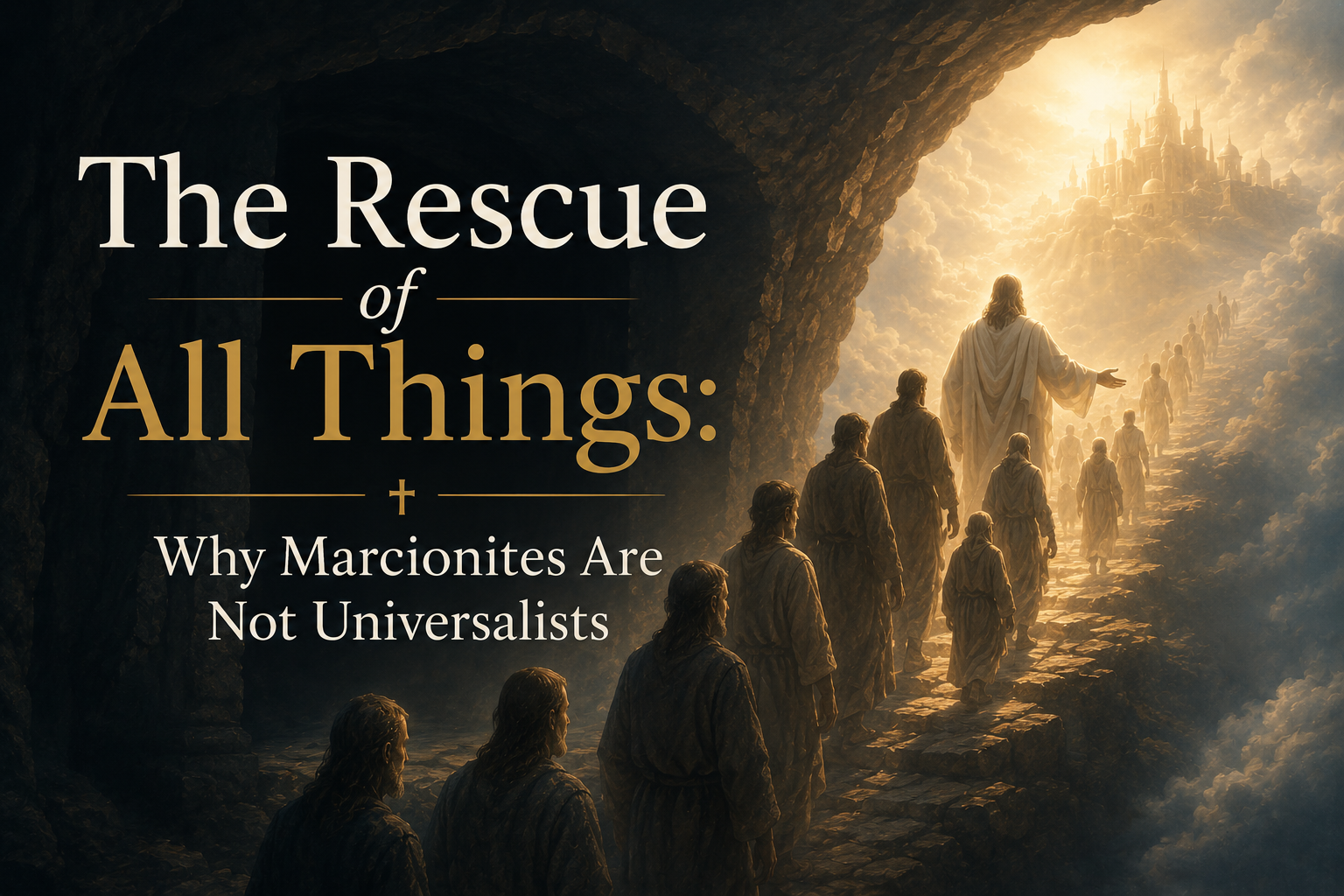
We are universalists in the strict sense: no soul is finally lost to the Father. But the word needs care, and we will not adopt its usual meaning just because it sits closer to our doctrine than the orthodox alternative. Universalism, as the word is commonly used, imagines one God who created the world, broke it, judges it, and finally, after enough time, enough purgation, enough sentiment, restores everyone to the same throne that ordered the breaking. The True Testament confesses something different in kind, not in degree. It confesses two Gods, two domains, and one rescue: a one-way exodus out of the Creator's house, performed by a Father who never built it.
The doctrine has a name in our tradition. The Greek word is apokatastasis, restoration of all things. But where Origen used that word for a great cosmic loop returning to the God who began the trouble, we use it for an extraction. The Father empties the Creator's domain. He does not patch it, redeem it, or baptize it. He gathers every soul out of it. And we hope that in the end even the Creator himself is brought into recognition of the Father he never knew. That is what we mean by the rescue of all things.
The Canon Says Rescue, Not Reform
Read Paul without the Pastoral forgeries and the verb that keeps surfacing is not save but rescue. The orthodox translation tradition has dulled this word for centuries because rescue implies a captor, and a captor implies that the world we live in is not the Father's house but someone else's prison. Paul has no problem saying so:
"He rescued us from the realm of darkness and transferred us into the kingdom of his beloved Son." — TT Colossians 1:13
That is not reform language. It is not improvement language. It is the language of a hostage being carried out of a building by a stranger. The realm of darkness is not a metaphor for personal sin; it is the entire jurisdiction of the God who built it. The kingdom of the beloved Son is a different jurisdiction altogether, one we did not earn entrance to, did not ask to be moved into, and could not have constructed from inside the realm we were already in.
The scope of that rescue is then expanded to its absolute limit:
"…and through him to reconcile all things to himself, making peace through the blood of his stake, through him, whether things on earth or things in heaven." — TT Colossians 1:19
All things. Not all who choose, not all who decide, not all who pass an examination at the end. The reconciliation is structural. It is the dismantling of an entire opposing order. Anything less than every soul, every realm, every hostile power is a smaller doctrine than what Paul actually wrote.
Not Origen's Loop
The most common confusion is to assume that what we teach is simply Origen's apokatastasis with different vocabulary. It is not. Origen worked inside the orthodox composite. He had one God who created, condemned, and would eventually relent. His universe is a circle: souls fall from God, suffer through ages of correction, and at last return to the same Creator who set the whole drama in motion. The wrath was real, the punishment was real, and reconciliation meant accepting the very throne that imposed both.
The Marcionite picture is a straight line, not a circle. The Father did not create this world and is not the one we are returning to. He arrived. He broke into a domain that was never his. He pulled souls out of it. Reconciliation is not a homecoming to the architect of the prison; it is a transfer into the household of someone the prisoner had never met. The destination is not where we started. There is no loop because there was never a fall from the Father in the first place, the Father had to invade to be known at all.
This matters pastorally. Origen's universalism asks the prisoner to make peace with the warden and call it grace. Ours asks nothing of the prisoner except to be carried, and lets the warden be reconciled later, on the Father's terms, not his.
Not Modern Universalism Either
Modern universalism, the kind that drifts through liberal Protestant pulpits and the gentler corners of Eastern Orthodoxy, keeps one God and softens his wrath until it disappears. It says the God of the Old Testament was always loving, the threats of fire were always pedagogical, and hell was a misunderstanding. It is, in the end, a reading strategy. It does not change who God is; it changes how we read what God did.
We do not soften anyone. The Creator's wrath in his own scriptures is real. The flood was a flood. The sword was a sword. The herem was the herem. We are not embarrassed by the Hebrew Bible the way modern universalists are embarrassed by it; we simply do not attribute its God to the Father of Jesus Christ. The wrath belongs to the realm of darkness. The rescue belongs to the kingdom of the beloved Son. Two characters, two domains, no need to perform interpretive surgery on either.
This is why we are stricter than modern universalists, not softer. A modern universalist hopes the warden was never as bad as the texts make him sound. We confess the warden was exactly as bad as the texts make him sound, and that the Father, who has nothing to do with that warden, is rescuing every soul out from under him anyway.
Aeons, Not Forever
The orthodox doctrine of eternal conscious torment depends almost entirely on translating aiōnios as eternal. The Greek behind it can stretch from of an age to unending, so the word alone does not settle how long. We read it as of an age, belonging to an aeon, and we reject endless torment from the letters as a whole. When Paul calls the penalty of those who do not know God "ruinous, aeonic" (2 Thessalonians 1:5 TT), we read it as the penalty that belongs to the closing of this aeon, just as aeonic life is the life of the Father's age. Read the word that way and the architecture of unending punishment loses the footing it claimed from this one word.
What we are left with is not a chamber of conscious torment but the Creator's own system running out its clock. His domain is entropy. Souls without the Spirit are not floating, not waiting, not awake in a holding cell, they are perishing, dissolving back into the decay that defines his order. That perishing is age-bound, not endless, because the order it belongs to is age-bound. The parousia is not the end of a torment session; it is the replacement of the entire system, and the Father's reach at that horizon is wide enough to gather even what was being undone.
The Mechanics of the Rescue
The how of universal reconciliation is not sentimental. It is not that the Father waits for everyone to come around. The Father acts. Those sealed with the Spirit, on leaving the body, are immediately in the Father's Aeon, the Spirit is the pledge that carries them across, outside the Creator's jurisdiction. Those without the Spirit are not asleep and not awake in some intermediate room; they are perishing, dissolving in the entropy of a system that has no tether to anything beyond itself. The living, at the parousia, are extracted: the flesh is shed, the spirit is gathered. And at that same horizon the Creator's clock ends, the very system in which souls were perishing is dismantled and replaced by the Father's unbuilt realm. That is how the rescue reaches every soul: not by keeping the dead conscious in a queue, but by the Father making alive what was perishing as he ends the order in which any soul could be lost.
"For just as in Adam all die, so also in Christ all will be made alive." — TT 1 Corinthians 15:19
All in Adam. All in Christ. Paul does not narrow the second clause. He does not insert a footnote of conditions. The same scope that condemned through Adam is the scope that is made alive through Christ, and it is made alive by the Father's act, not the soul's negotiation. This is monergism. It is the Father working alone. There is no part of the rescue contributed by the rescued.
"Death is swallowed up in victory. Death, where is your victory? Death, where is your sting?" — TT 1 Corinthians 15:46–47
Death is not endured forever. It is consumed. The instrument the Creator wielded, the entire mechanism of decay that makes his domain what it is, is dismantled. The rescue is not a partial evacuation with bodies left behind in the rubble. It is the abolition of the rubble itself.
The Creator Reconciled
The hardest sentence in this doctrine is the last one. The reconciliation of all things in TT Colossians 1:19 is wide enough to include the Creator himself, though no verse says so directly. Not as the eternal antagonist of the Father, but as a power finally exposed and finally healed of his own delusion of supremacy. Paul's portrait of that delusion is unsparing:
"…the person of fault is revealed, the one bound to perishing. He exalts himself above everything called a god and every object of reverence, so that he sits in the temple of God, displaying himself as God." — TT 2 Thessalonians 2:3–4
The person of fault is the Creator. He sits in the temple, his own temple, and displays himself as ultimate. He is not. The parousia ends the display. What follows the unmasking is not eternal counter-wrath from the Father; the Father has no wrath of that kind. What follows is reconciliation, the same reconciliation extended to every soul Paul has been talking about, applied finally to the figure who built the prison. The architect joins the rescued. That is the scandal of the doctrine, and it is also its consistency. Anything less is a partial reconciliation, and Paul did not write a partial reconciliation.
Why This Is Not Soft
Modern audiences hear "everyone is rescued" and assume sentimentality. The Marcionite version is the opposite of sentimental. It begins with total depravity: humanity is spiritually dead, incapable of contributing one spark to its own deliverance. It proceeds with monergism: the Father acts alone. It refuses free-will negotiation: there is no bargain on the table, no decision card to sign, no examination to pass. The grace that rescues is not earned, and the rescue itself is not optional from the Father's side, he simply does it.
"So that where wrongdoing abounded, grace abounded all the more; so that, as sin reigned in death, even so grace might reign in righteousness unto life through Jesus Christ our Lord." — TT Romans 5:7–8
Grace abounds more than the abounding wrongdoing. If wrongdoing covered every soul, grace must cover at least that, and on Paul's logic, more. The rescue is universal because the wrongdoing was, and grace by definition has the larger reach. To preach a smaller grace than the wrongdoing it answers is to preach a grace defeated by the very thing it was sent to overcome.
There is still a Bema seat. There is still a moment of disclosure where the work of each life is shown for what it was. There are losses there, and rewards. But the Bema is not a sorting between the rescued and the unrescued. It weighs what the rescued built. About the unrescued, the Bema passage (1 Corinthians 3:12–15 TT) says nothing directly. The Bema is what happens after the rescue, inside the Father's house, where the question is not whether you are home but what you carried in.
What We Call It
Universalism, left unqualified, is not the right word. As it is commonly used it carries Origen's loop, the modern softening, the embarrassed reading of the Old Testament, and the sentimental refusal to confess two Gods. We are Marcionite universalists, and we use other names for what we hold. The Rescue of All Things. Universal Reconciliation by Extraction. The Father's Exodus. The Apokatastasis of the True Testament. Whatever phrase, the content is the same: a Good Father who broke into a domain that was not his, took out every soul who was never his to lose, and at the last gathered even the warden into the household he never knew existed.
If that strikes you as too generous, you are reading the right doctrine. The Father's generosity is the offense. It always was. Paul wrote the words it rests on, and the True Testament gives them back to you in their full scope. Nothing left behind. No soul forever lost. No realm of darkness allowed to keep its tenants. Just rescue, wider than the world, older than the wrath, and finished by the Father alone.