
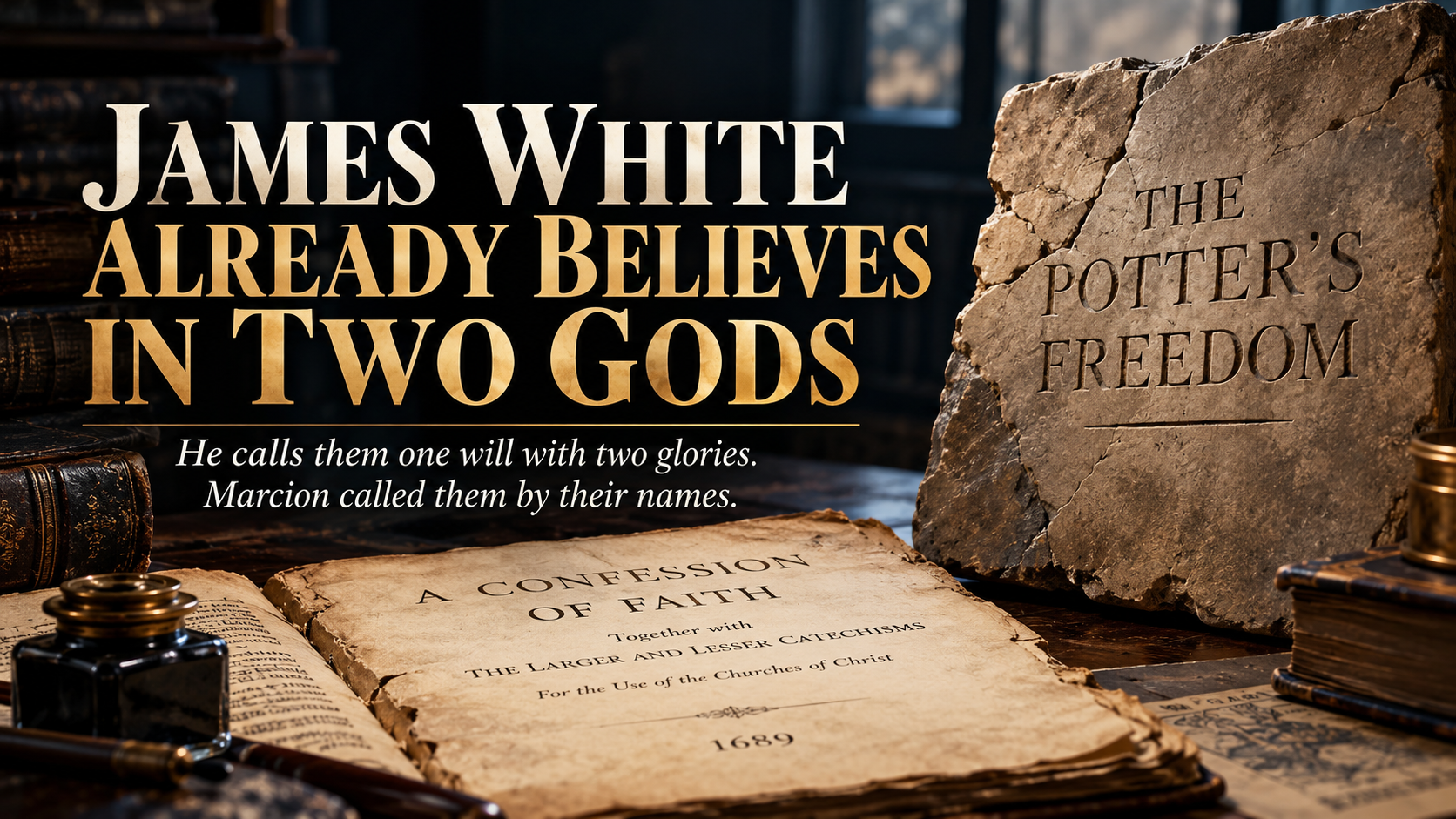
James White is the director of Alpha and Omega Ministries, a Christian apologetics organization based in Phoenix, Arizona, and a pastor and elder of Apologia Church. His work spans biblical languages, textual criticism, church history and public debate. His books include The Potter’s Freedom, The God Who Justifies and The Forgotten Trinity. His ministry lists more than two hundred moderated public debates, including encounters with Roman Catholic, Muslim and Mormon representatives, as well as biblical critics such as Bart Ehrman. He is not a casual spokesman for the theology examined here. He has spent decades explaining and defending it. [1]
We are writing about White because his defense of Calvinism brings a question central to Marcionite Christianity into sharp focus. When the Creator decrees suffering, hardens a person and appoints judgment, should those acts be reconciled with the goodness of the Father Jesus revealed, or should the identification of the two be questioned? The usual dispute asks how one God can do both. Our dispute begins one step earlier: what establishes that they are one God? White matters to this discussion because we intend to engage a developed defense of the orthodox identification, not an easy caricature of it.
The title does not mean that White consciously confesses two Gods. He explicitly confesses one, and we take that confession seriously. Nor is this another attempt to defend free will against predestination. We reject that escape ourselves. Our argument concerns the identity of the God being defended, and the distinction between justice and goodness. We will examine White’s published arguments alongside the confession he holds and the ancient defense of the Creator against Marcion. The purpose is to show where we agree with his account of the Creator, where we part company, and why that disagreement reaches deeper than the familiar Calvinist and Arminian dispute.
Nobody beats James White on Calvinism, and the reason is simple. Everyone who has debated him on predestination walks in holding the same premise he holds, that one God wrote the whole Bible and that this God is the Father of Jesus Christ. Once you grant that, you have one move left, which is to argue that the texts do not mean what they say. Pharaoh hardened himself first. The vessels of wrath prepared themselves. "I create evil" means calamity. Romans 9 is about nations. White has spent forty years taking those arguments apart, and he is good at it because the texts are on his side.
We are not going to make any of those arguments. We agree with him about the texts. The Creator does decree. The Creator hardens whom he wants to harden. The Creator prepared vessels for destruction, and White is right that destruction is their purpose. Softening those verses is an orthodox habit, and we are not orthodox. Marcion read the Creator's own words in the second century and believed every word, and so does White. What remains between us is a question none of those debates has made him answer, because both sides conceded it before they began: is that God the Father Jesus revealed?
White confesses one God, and he means it. We are not going to pretend otherwise. Our claim is narrower and harder to shake off: the system he defends already carries the division Marcion named, and it carries it in his own confession's words. He has kept the two in one person by main force, and the force shows.
We Concede Everything
The Creator says of himself that he makes peace and creates evil (Isaiah 45:7). White's preferred translations say calamity, and he will insist on that, but Tertullian's Latin Bible had the Creator saying It is I who create evil things, and Tertullian spent a chapter defending the sentence rather than retranslating it. The Creator says he has made everything for his own purpose, "even the wicked for the day of trouble" (Proverbs 16:4). He asks whether disaster comes to a city unless he has done it (Amos 3:6). He puts a lying spirit in the mouths of four hundred prophets (1 Kings 22:23). Of a prophet he deceived he says, "I the LORD have deceived that prophet" (Ezekiel 14:9). He incites David to the census that killed seventy thousand (2 Samuel 24:1), and in the parallel account the one who incites David is Satan (1 Chronicles 21:1). White's Romans 9, building on the Creator's words to Moses, says he has mercy on whom he wants and hardens whom he wants (Romans 9:18), and that there are vessels of wrath prepared for destruction (Romans 9:22). The True Testament does not include that chapter; we hold it to be a later addition.
White's book on all this is The Potter's Freedom. On the vessels of wrath he writes that they "are said to have been specifically 'prepared for destruction.' That is their purpose." He asks the question his opponents dread and answers it in six words: "Why are there vessels prepared for destruction? Because God is free." Whether a man is mercied or hardened is, in his words, "completely, inalterably, and utterly up to God." God "has the perfect right to do with His creation (including men) as He wishes."
We have no quarrel with any of that. The Creator does have that right. He made the clay and he made the Law, and he made death the wage of breaking it. Inside his own order he is exactly as just as White says he is, and the Arminian effort to make him nicer than his own book is an embarrassment we have never shared. Our Romans appendix puts it in one sentence: under the Creator's Law, every human is already perishing, and we do not soften it.
His confession fills in the rest. The Second London Baptist Confession of 1689, which White holds, states that God "hath decreed in himself, from all eternity, by the most wise and holy counsel of his own will, freely and unchangeably, all things, whatsoever comes to pass" (3.1). It says his "determinate counsel extendeth itself even to the first fall, and all other sinful actions both of angels and men; and that not by a bare permission" (5.4). It says that some are "foreordained to eternal life through Jesus Christ, to the praise of his glorious grace; others being left to act in their sin to their just condemnation, to the praise of his glorious justice" (3.3).
The phrase to keep in mind is not by a bare permission, with the first fall included under it. That phrase is where the argument ends up.
The Only Defense the Church Ever Had
Marcion's charge against the Creator was never that he is unjust. It was that he is not good. Tertullian, writing around 207, describes Marcion's two gods as "the one a judge, fierce and warlike, the other mild and peaceable, solely kind and supremely good" (Against Marcion 1.6). He reports that Marcion seized on the Creator's own words, It is I who create evil things, and on the saying about the good tree and the bad tree, and concluded "that there had to be another god to correspond with the good tree which brings forth good fruits" (1.2).
Tertullian had to answer that, and his answer is Book Two of Against Marcion, the longest defense of the Creator against the Marcionite charge that survives from the ancient church. It rests on three things.
The first is free will. "I observe that the man was created by God as a free man, with power to choose, and power to act, for himself" (2.5). Man was given "complete freedom of choice in either direction," and Tertullian says why that has to be so: "neither the wages of good nor (the penalty) of evil would with justice be awarded to one found to be good or evil of necessity and not of his own will" (2.6).
The second is bare permission. God foreknew the fall and did not decree it. Having granted freedom, God "must withdraw from his own freedom, restraining within himself that foreknowledge and superior power by which he might have been able to intervene to prevent the man from presuming to use his freedom badly" (2.7). God "abstained from interfering so as to forestall the things he wished should not take place" (2.7). The fall was man's doing, and Tertullian says so plainly: "the man's freedom, if taken full account of, will prove that itself, and not God, was guilty of that which itself committed" (2.6).
The third is hardening earned by prior guilt. When Tertullian gets to Pharaoh he does not say God is free. He says Pharaoh deserved it. "God hardens Pharaoh's heart: but Pharaoh already deserved to be given over to destruction, as having already denied God, as having in his pride so often cast out God's messengers" (2.14). The Creator's goodness, he says, is "measured out according to each man's deserts, granted to the worthy, denied to the unworthy, taken away from the ungrateful" (2.13).
James White rejects all three, and he rejects them in print. He denies libertarian free will; that denial is the thesis of his book. He denies bare permission in the words of his own confession, which extends the decree to the first fall "and that not by a bare permission." He denies hardening earned by prior guilt, since whether a man is hardened is "completely, inalterably, and utterly up to God," and he has answered the Pharaoh-deserved-it argument in debate more times than anyone has counted. Tertullian's Pharaoh argument is, in substance, Leighton Flowers' Pharaoh argument, and White has already dealt with it from Romans 9.
So the church defended the Creator against Marcion on three planks, and White has pulled up all three himself. He did it for the sake of consistency, and he was right to, because the texts do not support any of them. What he never asked is what the planks were holding up. They were holding up the Creator's goodness against the charge that he is the author of evil. Take them away and the Creator stands exactly where Marcion left him in the year 140, except that the description now carries James White's signature. Every debate White has won against an Arminian is a debate Marcion wins against Tertullian.
The Sentence With Nothing Under It
The 1689 keeps one line from Tertullian's defense. After decreeing "all things, whatsoever comes to pass," it adds that this is "yet so as thereby is God neither the author of sin nor hath fellowship with any therein" (3.1). After extending the decree to the first fall, not by bare permission, it adds "yet so, as the sinfulness of their acts proceedeth only from the creatures, and not from God" (5.4).
Tertullian drew the same line. He separated "evils of sin and evils of punishment" and assigned "the devil the author of evils of sin and guilt, but God the Creator the author of evils of punishment and penalty" (2.14). The difference is that Tertullian had a reason for the separation. Sin proceeded from the creature because the creature was free and God had abstained from interfering. The confession keeps his conclusion and drops his reason. It affirms that God decreed the first sin, not by bare permission, and in the same paragraph affirms that the sinfulness came only from the creature. Tertullian could say that because he had free will underneath it. White can only say it with the word mystery underneath it.
He will not say mystery first. He will say secondary causation: God is the first cause of all that comes to pass, the creature is the second cause of his own sin, and the sinfulness belongs to the second cause. The confession itself speaks that way. But look at what the doctrine of secondary causes was built to do and what White has done to it. In Tertullian the second cause really was a second origin, because the man was free and God had stood back; the sin began in the creature and nowhere else. In White the second cause's willing is itself decreed, not by bare permission, so the first cause determines what the second cause will determine. At that point "secondary cause" names the instrument, not the origin. A man who builds a machine to fire a gun is the author of the shot, whatever the machine is called, and no court and no plain speaker has ever thought otherwise. Renaming the hand does not change whose design it carries out.
And the Creator, in White's own Bible, does not take the shelter the confession builds for him. He does not say that a lying spirit arose by secondary causation; he says he put it there. He does not say the prophet was deceived by his own corruption; he says "I the LORD have deceived that prophet." He does not say calamity comes through intermediate agents; he says he creates it. The 1689 is more careful of the Creator's reputation than the Creator is. Marcion simply believed the Creator's own account of himself, and so, when he is reading the texts and not the confession, does White.
When secondary causation runs out, the word that is left is mystery, and it appears at one point in his system, the point where the God of the decree and the God of the gospel would have to be shown to be the same person. Everywhere else White demands exegesis. There he asks for faith. We are not accusing him of dishonesty. We are saying where the seam is, and it runs exactly where Marcion said it would.
Two Glories
In 1689 3.3 some are foreordained to life "to the praise of his glorious grace," and others are left to condemnation "to the praise of his glorious justice." One sentence, two praises, two glories.
Tertullian said Marcion's Creator was a judge and Marcion's Father was "solely kind and supremely good." The confession has one God glorified in two opposite ways by two opposite outcomes for two fixed sets of people, and it insists that both glories belong to the same person. Marcion looked at the same two glories and gave them two names. That is the whole of the disagreement. It is not about whether justice is real. It is about whether the one whose glory is justice can be the one whose glory is grace, when the second has to rescue people out of the hands of the first.
The Reformed tradition has always felt the strain here, which is why it keeps coining vocabulary to hold the two together. Luther had a hidden God and a revealed God. Calvin had a secret will and a revealed will. The modern Reformed have a decretive will and a prescriptive will, by which God decrees that most men will not repent and commands all men to repent. The names change but the strain stays the same, a God whose will is done in the decree and a God whose will is spoken in the gospel, and the two do not want the same thing. These are not Marcion's doctrine, and their metaphysics are not his. But each of them is doing the job Marcion's two names did. Each one keeps the God of the decree and the God of the gospel from being measured by a single standard of goodness. Marcion let the two be judged separately and said why. The Reformed judge them separately and insist it is the same judge.
The Ungrateful
Tertullian said the Creator's goodness is "taken away from the ungrateful" (2.13). The Evangelion says this about the Father:
"Instead, love your enemies, do good, and lend without expecting anything in return. Then your reward will be great, and you will be children of God. For he is kind even to the ungrateful and the wicked." (TT Evangelion 3:35)
Tertullian, defending the Creator, wrote the antithesis himself. The Creator takes his goodness away from the ungrateful, and the Father is kind to the ungrateful and the wicked. Those are two characters, described by two men nearly two centuries apart, and the saying stands in White's Bible as well as ours.
White's answer will be common grace. God is kind to the wicked in this life, with rain and sun and daily bread, while the decree of their condemnation stands. The next verse closes that door:
"Be compassionate, just as your Father has shown you compassion." (TT Evangelion 3:36)
That is an imitation command. Jesus tells his hearers to copy the Father's compassion toward the wicked. If the Father's compassion toward the wicked is a season of sun before an eternity of justice, then the command means to be kind to your enemy while the plan for his destruction stands, and no one has ever read it that way or preached it that way. Either the Father's compassion is the real shape of his will toward the wicked, or Jesus built a command on an analogy that hides what the Father actually intends. White's system requires the second. He will not say so, but it does.
The Son also says there is only one who is good:
He replied, "Don't call me good. Only one is good: the Father." (TT Evangelion 12:2)
He does not say only one is just. That would be true of the Creator; Tertullian spent a book proving it and we grant it. He says only one is good, which is the word Tertullian said Marcion reserved for his god, "solely kind and supremely good," and in White's own text the Son reserves it for the Father.
Saved From What?
R. C. Sproul, the most respected teacher of White's tradition in the last generation, wrote a book around that question, and his answer was the honest one: saved from God himself. Reformed preaching says it without blinking. God saves us from God. The wrath is his, the rescue is his, and he is glorified in both.
Paul also says we are rescued from wrath:
"and to wait for his Son from heaven, whom he raised from the dead, Christ, who rescues us from the coming wrath." (TT 1 Thessalonians 1:9)
"He rescued us from the realm of darkness and transferred us into the kingdom of his beloved Son," (TT Colossians 1:13)
"who gave himself for our sins so that he might deliver us from the present evil aeon according to the will of God the Father." (TT Galatians 1:4)
White has every one of these verses. Rescued from wrath, rescued from a realm of darkness into a different kingdom, delivered out of the present evil aeon by the will of the Father. Those are the verbs of an extraction, and an extraction has a captor. White's theology has a captor too, and it is the same person as the rescuer.
We have said this before, without White in view. Calvin's God builds the prison, fills it with prisoners, and selects which ones to release, all within a single sovereign will that also decrees the damnation of the rest, one God playing both jailer and rescuer. The Marcionite reads the same verbs and sees a Father who did not build the prison, did not populate it, and did not choose favorites among his own creatures, but came into a domain that was never his and carried captives out of it. The verbs are the same, the monergism is the same, and the dead will that cannot free itself is the same. The one difference is that we do not ask the hostage to call the kidnapper and the rescuer by one name. Sproul's answer and ours are the same answer. We only disagree about which God we are saved from.
The Cross He Keeps Citing
White's favorite proof that God decrees sin without being its author is the cross. Herod and Pilate and the mob did what God's hand and plan had predestined (Acts 4:27–28). The worst sin in history was decreed for the greatest good, and from there he argues that God can decree every lesser sin as well.
Paul says who staked Christ and what came of it:
"None of the rulers of this aeon understood it; for if they had, they would never have staked the Lord of glory." (TT 1 Corinthians 2:8)
"He disarmed the rulers and the authorities and exposed them openly, triumphing over them through him." (TT Colossians 2:8)
White will say at once that ignorance and predestination are not opposites, that God ordained the staking while the men who did it acted freely and without understanding his purpose, and he is right that Paul affirms both. Paul calls the wisdom "hidden, which God predetermined before the aeons for our glory" (TT 1 Corinthians 2:7), and in the next sentence says the rulers did not understand it. We are not disputing that both are true. We are pointing at how Paul distributes them. What God predetermined is the wisdom and the glory, the rescue. What the rulers did is the staking, and they did it because they did not understand. Then Colossians says what the staking did to them: it disarmed them, exposed them, and triumphed over them.
In White's reading the rulers are God's instruments, carrying out what his hand and plan had predestined. But you do not disarm your own instruments. You do not expose and triumph over the hand that did your will. Paul describes the party that staked Christ as a defeated enemy, not as a tool, and that is a relationship White's compatibilism cannot give him, because in his system there is no second party at the cross to defeat. We hold that the powers who staked Christ were the Creator's powers acting under the Creator's authority, and that the Father turned their verdict into the rescue of everyone under it. That is our reading and we do not ask White to share it. What we ask is how, on his reading, God is said to triumph over the agents of his own decree.
The Potter and the Father
White called his book The Potter's Freedom, and it is worth asking where the image comes from. The potter and the clay is the Creator's own picture of himself, in Isaiah 29:16, Isaiah 45:9, Isaiah 64:8 and Jeremiah 18. When the Romans 9 of White's Bible uses it, it is drawing on the Creator's prophets, and White agrees that it is. In all four of White's gospels Jesus never once calls God a potter. He calls him Father. That does not prove the two cannot be one, since a single being can carry more than one metaphor, and White will say so. It does show which picture each side has chosen to build on. A potter is free to shape and free to smash, and no pot has standing to complain. A father's freedom is a different thing, and a father does not make children in order to break some of them for the praise of his justice.
White chose the Creator's metaphor for his title and the Creator's prerogative for his thesis, and he was right about both. The potter is free; we have never denied the potter his freedom. What we deny is that the potter is the Father, and Jesus said the Father was unknown until the Son made him known:
"Everything has been entrusted to me by the Father. No one knows the Father except the Son, and no one knows the Son except the Father, and anyone to whom the Son reveals him." (TT Evangelion 6:30)
Israel knew the potter for fifteen centuries. He spoke from Sinai, he wrote on stone, he filled a temple with smoke, and nobody had to wait for a Galilean to reveal him. If the Father had to be revealed, and the Son says he did, then the Father was not the God already known. White has this verse and reads it as a statement about saving knowledge: Israel knew who God was but did not know him through the Son. The wording does not settle that by itself, and we will not pretend it does. But notice what his reading concedes. Whatever Israel had of God for fifteen centuries, Jesus says it was not knowledge of the Father. The Father is known through the Son or not at all. A God who was known at Sinai, by name, by voice, by law, and whom Jesus nonetheless says no one knew as Father, is a God whose fatherhood arrived with the Son. That is what we mean by two gods, and it is what the Son's sentence requires on either reading.
What He Will Say
He will say Marcion was a heretic, condemned by the church. That is true and it does not matter. Tertullian's five books are not a condemnation but an argument, and we have shown what the argument rests on. White removed its foundation himself, and he cannot cite Tertullian's verdict after discarding Tertullian's reasons.
He will say John's gospel identifies the Father with the God of Abraham, and that Jesus affirmed the Shema. He is right that John says so. We do not hold John, and we have explained why elsewhere. That is a dispute about the canon, and it is one White's own method ought to take seriously, since Marcion's Evangelion and Apostolikon, around the year 140, are one of the earliest deliberately bounded collections of Christian scripture anyone can identify, and they were preserved for us by the men who wrote against them. But nothing in this article has needed John. It has needed his confession, his book, and the sayings of Jesus that stand in both Testaments. The case holds even if he keeps every page of his Bible, because his one God is doing two opposite things, praised for two opposite glories, with two wills, rescuing people from himself. We did not write that description. His confession did.
He will say that God's sovereignty is not a property right that comes from having made the clay but an expression of what God eternally is, and that in granting the Creator's right over his creation we have granted the very God Paul is defending. We grant more than the right. Paul himself allows that there are "many gods and many lords" and then says "yet for us there is one God, the Father" (TT 1 Corinthians 8:2–3). White has that sentence with the same words in it. His "there is no God except one" (TT 1 Corinthians 8:1) stands beside those many gods and many lords, so it confesses who is God for us; it is not a census of heaven. We read the Creator as a god by nature, not a pretender, with real authority over his own aeon, and we read Paul saying so outright in Galatians: "Formerly, when you did not know God, you were enslaved to those who are gods by nature" (TT Galatians 4:8). White's Bible has the word not in that sentence, and he will say Marcion took it out. We say the catholic copyists put it in, and we are not alone: Tertullian quotes Marcion's text without it, and Zahn judged the manuscripts of Tertullian that carry the negative to be an accommodation to the familiar reading, since Tertullian's own comment on the verse, that Paul was not attacking the god of the elements, makes no sense with the negative in place. That is a dispute we are glad to have, but nothing here hangs on it. The point stands on the verse White reads the same way we do: there are gods and lords, and for us there is one God, the Father.
What we do not grant is that authority over this creation is the same thing as being the Father, or that there is only one kind of divine authority on the table. The Father's authority in Paul is never the authority of a maker over his material. It is the authority of one who comes from outside this aeon and takes people out of it, "according to the will of God the Father" (TT Galatians 1:4). Tertullian saw this coming and spent his opening chapters arguing that there cannot be two supreme beings. White will reach for the same argument. We have never claimed two supreme beings. We have claimed that the one who rules this creation is not the one who rescues from it, and Paul's "for us" is where that claim begins.
He will say we are universalists. We are, in a sense we define carefully and have never hidden. The Father's rescue reaches every soul, and the same scope that dies in Adam is made alive in Christ (TT 1 Corinthians 15:19). White has that verse and narrows the second all. That is a disagreement about scope, and it does not touch the argument about identity.
He will say we deny the sovereignty of God. We deny nothing of the kind. We hold that the will is dead until the Father raises it, that faith is a gift and not a decision, and that no one chose the Father or could have. Our monergism is more thorough than his, because we do not need a prescriptive will on the side to make the gospel offer sound sincere. He cannot treat us as Arminians, and on this subject he has never had to debate anyone who was not one.
And he will say mystery. We will point to where it sits, which is the one place in his system where the question is no longer what the text says but who is speaking.
The Resolution
James White has debated whether God decrees all things more times than most men have debated anything. He has never had to defend the sentence underneath that debate, because on that subject every opponent handed it to him before they started. Stated as a resolution, so there is no mistaking what we are asking him to defend, it is this:
The God who hardened Pharaoh is the Father of Jesus Christ.
We grant that God is sovereign. We grant that he hardens whom he wills. The resolution is the identification, and the burden of proof is on the man who merges a judge "fierce and warlike" with a Father who is "kind even to the ungrateful and the wicked" and calls the result one person with two glories.
Marcion made the separation in Rome around 140. The church argued against it for the rest of the century, and around 207 Tertullian wrote the five books that remain the fullest attempt to put the two back together. To do it he needed free will, bare permission, and a Pharaoh who deserved it. James White has taken all three away. What is left is the Creator as Marcion described him, in the words of the 1689 Confession, with White's name on the title page. He is right about the potter. He has not yet met the Father.
For why rescue is universal in scope, see The Rescue of All Things. For why we hold captivity rather than inherited guilt, see Born Captive, Not Guilty. For our reading of Luke 24 without Moses, see The Emmaus Road Without Moses.
A note on references. Scripture is quoted from the True Testament, Sixth Edition, and follows True Testament chapter and verse numbering, which differs from orthodox numbering; the disarming of the rulers, for example, is TT Colossians 2:8, which orthodox Bibles print as Colossians 2:15, and the Adam and Christ parallel is TT 1 Corinthians 15:19, which orthodox Bibles print as 1 Corinthians 15:22. The Reader at truetestament.org shows the orthodox reference beside every verse. Where we cite White's own texts, orthodox numbering is used.
Sources cited. Tertullian, Against Marcion, Books 1 and 2, in Ernest Evans' translation (1.2, 1.6, 2.5, 2.6, 2.7, 2.13, 2.14), as held in the True Testament library. The Second London Baptist Confession of 1689, chapters 3 and 5. Theodor Zahn, Geschichte des neutestamentlichen Kanons II, 501, on Tertullian's text of Galatians 4:8 (Against Marcion 5.4). James R. White, The Potter's Freedom (Calvary Press, 2000), 211–214, as reproduced at monergism.com. True Testament, Sixth Edition.