
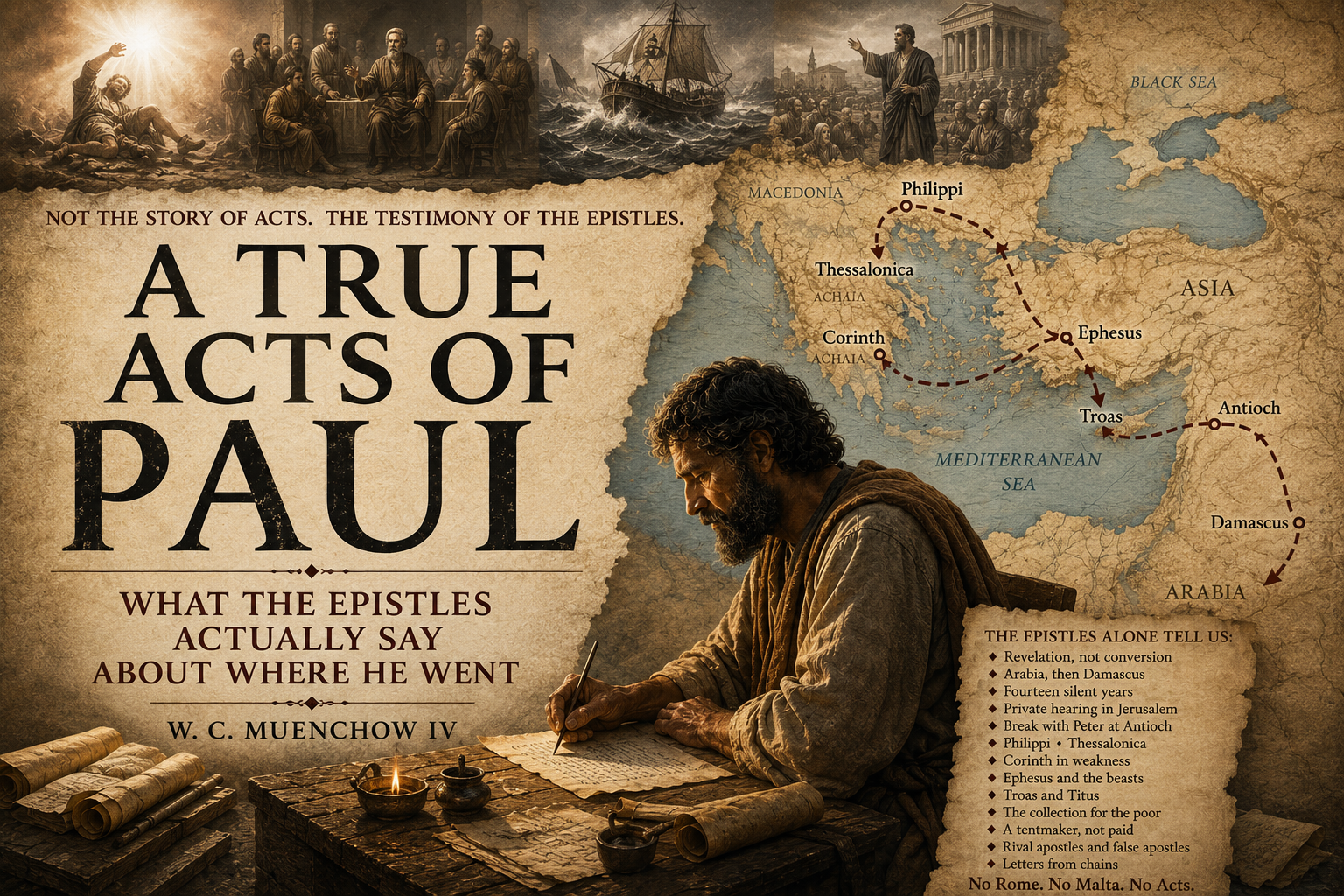
Open a Bible to the book of Acts. You will read a tidy travelogue: a blinding light on the road to Damascus, an obedient stop in Jerusalem, three numbered missionary journeys, sermon after sermon in synagogues, a polished speech on Mars Hill, an earthquake in a Philippian jail, a shipwreck off Malta, and a quiet house arrest in Rome. Now open the letters Paul actually wrote, Galatians, the two letters to Corinth, the two letters to Thessalonica, Romans, Laodiceans, Colossians, Philippians, Philemon. You will read a different man entirely.
This article does only one thing. It lays Luke's Paul next to Paul's Paul, section by section, and lets the reader see the gap with their own eyes. Every quotation below is verbatim from the True Testament canon as we hold it. Where Acts or the Pastorals or the orthodox additions inside the genuine letters supply extra biographical detail, the Damascus-road theater, Ananias, the Jerusalem Council, the Areopagus, the Maltese shipwreck, the Spain plan, the long list of greetings in Rome, the deathbed prison farewell, that material is not in our text, and we do not use it.
Part One, The Two Pauls
What Luke's Acts Gives You
Luke gives you a Paul who is converted on a road, healed by an obedient member of an already-organized assembly, and immediately sent back to the apostles in Jerusalem for approval. That Paul preaches in synagogues every Sabbath. He keeps the Law in private. He takes Nazirite vows in the Temple. He has Timothy circumcised. He delivers a philosophy lecture to Greek intellectuals in Athens. He converts a businesswoman named Lydia and a Philippian jailer. He survives a shipwreck on the way to Rome. His story ends under a comfortable house arrest in the capital, preaching unhindered.
This is a coherent story. It is also a second-century composition, written long after Paul was dead, by an author who never quotes a single one of Paul's letters and never identifies himself by name anywhere in the text he wrote. Its purpose was to leash Paul to the Twelve, to invent a Jerusalem-centered launch for the gentile mission, and to soften the rupture Paul himself describes in his own opening words.
What Paul Gives You
Paul gives you a man broken open by a revelation, sent into the desert before he ever saw an apostle, silent for fourteen years, then late and defensive at his only consultative hearing in Jerusalem. He gives you a public fight with Peter at Antioch. A man who labored with his own hands and refused payment for proclaiming the Evangelion. A short, named circle of coworkers. A long list of beatings, hindrances, opponents, and chains. No Areopagus. No Malta. No martyrdom scene. He never says he reached Rome. He never says he reached Spain. He signs his own letters by hand because forgeries in his name were already in the post while he was alive.
What follows is shorter than Luke's story. That is the honest shape of Paul's life.
Part Two, The Reconstructed Movements
I. The Rupture, Not a Conversion
Paul does not describe a conversion. He describes a revelation that came to him directly, with no human hand on it, no road, no companion, no recovery. He is, in his own opening words, "an apostle, not sent from men nor through the agency of man, but through Christ Jesus, who awakened himself from the dead" (Galatians 1:1). He insists, "For I neither received it from man nor was I taught it, but I received it through a revelation of Christ Jesus" (Galatians 1:11).
Before this rupture Paul was a zealot for ancestral traditions: "You have heard of my former life in Judaism, how I persecuted the assembly of God beyond measure and sought to destroy it. I advanced in Judaism beyond many of my own age among my people, being exceedingly zealous for ancestral traditions" (Galatians 1:12–13). The break is not gradual and not negotiated. It is an act of God against him: "But when God, who set me apart from birth and called me through His grace, was pleased to reveal His Son in me so that I might proclaim Him among the nations…" (Galatians 1:14–15).
Compare: Acts tells this story three different times (canonical Acts 9, 22, and 26) and the three accounts contradict each other on who saw the light, who heard the voice, and what was said. Paul tells it once, in his own words. There is no Ananias in Paul. There are no scales. There is no commission in a temple. There is only the rupture.
II. Arabia, Then Damascus
The first thing Paul says he did after the revelation is the opposite of what Acts says he did. He did not go up to the apostles for confirmation. "I did not immediately consult flesh and blood, nor did I go up to Jerusalem to those who were apostles before me; I went away into Arabia and returned again to Damascus" (Galatians 1:15–16).
Arabia in his usage is Nabatean territory east and south of Damascus. What he did there he does not say. The point of the verse is what he did not do: he did not seek apostolic credentials. He went into the desert and came back to Damascus.
Compare: Luke's Paul, after the road, is brought straight into a Damascus house and immediately begins preaching in synagogues. There is no Arabia in Acts at all. Paul puts Arabia first.
III. The Silent Fourteen Years
Paul gives no Jerusalem visit between his return to Damascus and a meeting fourteen years later. "Then after an interval of fourteen years I went up to Jerusalem with Barnabas, taking Titus also" (Galatians 2:1).
Fourteen years is most of an adult life. Paul does not fill them with set-piece sermons. He simply lets them stand silent in his own letter, because no apostle in Jerusalem supervised him in them. The silence is part of his argument: he owed his message to no one.
Compare: Acts cannot leave those years silent. It fills them with a completed missionary journey, repeated returns to Jerusalem for consultation, and a long string of Pauline speeches no other source records. Paul's own letter contradicts the schedule.
A note on the word "again." The Greek πάλιν in Galatians 2:1 has been used by harmonizers to argue that Paul must have made an earlier post-revelation Jerusalem trip the True Testament did not preserve. It will not bear that weight, and it will not bear it on two independent grounds. First, take πάλιν in its ordinary temporal sense, "a second time." Paul has already told us, in his own hand, what his life before the rupture looked like: "You have heard of my former life in Judaism, how I persecuted the assembly of God beyond measure and sought to destroy it. I advanced in Judaism beyond many of my own age among my people, being exceedingly zealous for ancestral traditions" (Galatians 1:12–13). He does not say where the zealot did that work. If it ever took him up to Jerusalem, then "going up again" fourteen years later, with Barnabas and Titus, by revelation, to set the Evangelion before the pillars, is straightforwardly a second going-up, contrasted with the earlier going-up of the persecutor. The temporal force of πάλιν can be satisfied without inserting a missing post-revelation visit. Second, even setting that aside, πάλιν has a well-attested non-temporal sense in Koine: "back," "in turn," or reopening a subject (BDAG s.v. πάλιν 3; cf. 1 Corinthians 12:15 TT, church 12:21). On that reading, with the orthodox-added first-visit material set aside, πάλιν reopens the Jerusalem question Paul had just refused in 1:16, it does not count trips at all. Either way, the harmonizer's missing visit has nowhere to live. Paul has just said, in the same breath, that after the revelation he did not go up to Jerusalem: "I did not immediately consult flesh and blood, nor did I go up to Jerusalem to those who were apostles before me; I went away into Arabia and returned again to Damascus" (Galatians 1:15–16). Then, after fourteen years, he goes up, once. So the count in our text is simple: before the revelation Paul was a zealot persecutor, and after the revelation he reports exactly one Jerusalem visit, the private hearing of Galatians 2. The familiar harmonizer fillers, the three-year first visit, the fifteen days with Peter, the oath, the Syria-and-Cilicia note, are not in our Galatians; they sit in the verses orthodox editors added to a chapter our text ends at 1:16. And the famine-relief trip of canonical Acts 11:27–30 is in Acts alone; Paul's own letter never names it.
IV. The Private Hearing in Jerusalem
When Paul finally did go to Jerusalem, the meeting was private and defensive, not submissive. "It was because of a revelation that I went up, and I set before them the Evangelion that I proclaim among the nations, but I did so privately to those of reputation, lest perhaps I had run, or should be running, in vain" (Galatians 2:2).
Titus, a Greek, came with him as a test case, and as a test case Paul won: "But not even Titus, who was with me, though a Greek, was compelled to be circumcised" (Galatians 2:3). The men he met he names: "Peter and James and John, who were regarded as pillars, gave to me the right hand of fellowship, that I should go to the nations and they to the circumcised" (Galatians 2:7). The one shared obligation was material: "They only asked that we remember the poor, which was indeed what I was eager to do" (Galatians 2:8).
Compare: Canonical Acts 15 stages a public Jerusalem Council with a vote, a written decree, and a Petrine concession speech. Paul says the hearing was private, that the pillars added nothing to him, and that the only thing he carried away was a fundraising obligation. He calls them those of reputation, not his superiors. This is the only post-revelation Jerusalem visit Paul reports in our text. Acts inserts an additional famine-relief trip (canonical Acts 11:27–30) that Paul's own letter never names.
V. Antioch: Paul Against Peter
The fellowship did not survive contact. "But when Peter came to Antioch, I opposed him to his face, because he stood condemned. For before certain men came from James, he used to eat with the nations; but when they came, he withdrew and separated himself, fearing those of the circumcision. And the rest of the Jews joined him in hypocrisy, so that even Barnabas was carried away by their hypocrisy" (Galatians 2:9–11).
Paul tells us what he said in public: "If you, being a Jew, live like the nations and not like the Jews, how can you compel the nations to live like Jews?" (Galatians 2:12). That is the entire Antioch episode in our text. There is no reconciliation scene, no kiss of peace, no later joint mission. Paul reports the rupture and moves on.
Compare: Acts never reports this fight. Luke's Peter and Paul are partners in a single program. Paul's Peter is a man he rebuked to his face for hypocrisy in front of the whole assembly.
Part Three, The Real Mission Field
VI. Macedonia: Philippi and Thessalonica
Paul preached in Philippi and was mistreated there. From Philippi he went to Thessalonica. He tells the Thessalonians this in their own hearing: "After we had already suffered and been mistreated in Philippi, as you know, we found courage in our God to speak to you the Evangelion of God amid much opposition" (1 Thessalonians 2:2).
His behavior among them was not that of a credentialed missionary on a stipend. "We never came with flattering speech, as you know, nor with any pretext for greed; God is witness" (1 Thessalonians 2:5). "Instead, we were gentle among you, like a nursing mother who cherishes her own children" (1 Thessalonians 2:7). "You remember, brothers and sisters, our labor and hardship, working night and day so as not to be a burden to any of you, we proclaimed to you the Evangelion of God" (1 Thessalonians 2:9). He wanted to return. He could not: "We wanted to come to you, indeed I, Paul, tried again and again, but the Adversary hindered us" (1 Thessalonians 2:17).
Compare: Acts gives you Lydia at the riverside, an earthquake that breaks the chains in the Philippian jail, and the conversion of the jailer (canonical Acts 16). Paul names none of these people and none of these scenes. He names mistreatment, gentleness like a nursing mother, working with his hands, and being hindered by the Adversary.
VII. Achaia: Corinth in Weakness
Paul reports his arrival in Corinth in language that contradicts the orthodox image of a confident orator. "When I came to you, brothers and sisters, I did not come with superiority of speech or of wisdom, proclaiming to you the testimony of God. For I determined to know nothing among you except Christ, and him on a stake. I was with you in weakness, and in fear, and in much trembling" (1 Corinthians 2:1–3).
The mission at Corinth was long enough to require multiple visits. He warned them in writing of discipline if they had not repented by the time he arrived: "This is the third time I am coming to you. At the mouth of two or three witnesses shall every word be established" (2 Corinthians 13:1). "I have said before, when I was present the second time, and now being absent I say again to those who have sinned and to all the rest, that if I come again I will not spare" (2 Corinthians 13:2).
Compare: Acts gives you a proconsul named Gallio, a tribunal scene, and a clean exit (canonical Acts 18). Paul gives you trembling on arrival, a second visit with a third announced, and a written threat of discipline. The two pictures cannot both be the whole truth.
VIII. Asia: Ephesus and the Beasts
Ephesus is in Paul's own hand. He stayed there long enough to plan around the calendar, "I will remain in Ephesus until Pentecost" (1 Corinthians 16:3), and the mission there cost him: "If, as a mere human, I fought with wild beasts at Ephesus, what does it profit me?" (1 Corinthians 15:24). The line is phrased as a conditional, but in Paul's own hand it is the only Ephesian biography we have, and it sits beside the "great door" and "many who oppose" of the next chapter. We take it as a real-world reference because the rest of his Ephesian record is nothing but adversaries. The door was wide and the opposition was real: "for a great door has been opened for effective work, and there are many who oppose" (1 Corinthians 16:4).
Compare: Acts gives you a daily two-year lecture in the hall of Tyrannus, the burning of magical scrolls, and a silversmith's riot over the shrines of Artemis (canonical Acts 19). Paul gives you a fight with wild beasts and many adversaries. The Lukan riot is theater; the beasts and the adversaries are Paul's own words.
IX. Troas and the Search for Titus
Between Asia and Macedonia, Paul tells us about Troas, and tells us he abandoned an open door there because his coworker was missing. "When I came to Troas to proclaim the Evangelion of Christ and a door was opened for me in the Lord, I found no rest in my spirit, not finding Titus my brother; so, taking leave of them, I departed for Macedonia" (2 Corinthians 2:5–6).
This is one of the most human things Paul says about himself. The work was open in front of him; he could not bear it alone, and he left to find his brother. The mission was carried by a small company, and the company mattered to him personally.
Compare: Acts has Paul pass through Troas to deliver a midnight sermon during which a boy named Eutychus falls out of a window (canonical Acts 20). There is no missing Titus in Acts. There is no door left open behind him.
X. The Collection for the Poor
The one thing the Jerusalem pillars asked of Paul was material: "They only asked that we remember the poor, which was indeed what I was eager to do" (Galatians 2:8). He kept that obligation, and it became a cross-province fundraising effort. He writes to Corinth: "Now concerning the collection for the holy ones, as I directed the assemblies of Galatia, so you also should do" (1 Corinthians 16:1). He planned his travel around it: "I will come to you after passing through Macedonia, for I am passing through Macedonia" (1 Corinthians 16:2).
This is Paul's actual logistics. Not a sermon circuit, not a synagogue tour, a coordinated relief effort among the gentile assemblies of Galatia and Achaia for the poor the Jerusalem pillars had named at the private hearing (Galatians 2:8). It is the only continuing tie he kept with the Twelve, and he kept it on his own terms.
Compare: Acts almost never names the collection. The few hints it allows itself contradict Paul's own letters about where the money came from and how it was raised. Paul's mission, in his own hand, is partly a fundraiser. Luke's mission is a preaching tour.
XI. Working With His Own Hands
Paul refused to be paid for proclaiming the Evangelion. He made it a rule and defended it: "The Lord has ordered that those who proclaim the Evangelion should live by the Evangelion. But I have used none of these rights. Nor am I writing this so that it might be done for me, for I would rather die than have anyone void my boast" (1 Corinthians 9:5–6). "For if I proclaim the Evangelion, I have no boast, for necessity is laid upon me; woe to me if I do not proclaim it" (1 Corinthians 9:7). "This is my reward: to proclaim the Evangelion without price, not using my right in it" (1 Corinthians 9:9).
The same instinct toward manual labor shows up as a rule for the assemblies themselves: "If anyone is not willing to work, let him not eat" (2 Thessalonians 3:4). Paul does not impose stipends on his communities, and he does not exempt himself from the work. The man who wrote this is not a stipended priest. He is a laborer who refused to be one.
Compare: Acts mentions tentmaking once in passing, as a biographical color-detail in Corinth. Paul never names a trade. What he makes a doctrine, in two letters, is working with his own hands and taking no pay. The difference matters: the Pastorals, the forgeries written in Paul's name decades later, invent a clerical hierarchy he never founded and a paid office he never accepted.
Part Four, Conflict and Custody
XII. The "Super-Apostles" and the False Apostles
Paul's hardest opposition came not from outside the assemblies but from inside them. He records, in his opponents' own words, what they said about him: "They say, 'His letters are weighty and strong, but his bodily presence is weak and his speech contemptible'" (2 Corinthians 10:6). He answers them by refusing the comparison: "Let the one who boasts boast in the Lord. For it is not the one who commends himself who is approved, but the one whom the Lord commends" (2 Corinthians 10:8–9).
And then he names them for what they are: "Such are false apostles and deceitful workers, changing themselves into apostles of Christ. And no wonder, for the Adversary himself changes into an angel of light" (2 Corinthians 11:2–3).
Compare: Acts depicts a unified apostolic front in which the only conflict is over admitting gentiles, and that conflict is resolved by committee in a single afternoon. Paul, in his own hand, says the assembly was full of rival apostles who slandered him personally and whom he identified with the Adversary. That is not the church Luke describes.
XIII. The Visions and the Thorn
Paul reports a personal experience he is reluctant to claim outright. "I know a man in Christ, fourteen years ago, whether in body or out of body I do not know, God knows, such a one was caught up to the third heaven… and heard inexpressible things, things that no one is permitted to tell" (2 Corinthians 12:1–2a).
The aftermath was a permanent affliction. "Because of these surpassingly great revelations, therefore, in order to keep me from becoming conceited, I was given a thorn in my flesh, a messenger of the Adversary, to torment me. Concerning this I implored the Lord three times that it might depart from me. And he said to me, “My grace is sufficient for you, for my power is made perfect in weakness.”" (2 Corinthians 12:3–5). Paul does not tell us what the thorn was. He tells us it stayed, and that he was told to live with it.
XIV. The Coworkers He Actually Names
Paul's mission was not solo. He names the people who carried it with him, and the True Testament preserves these names plainly.
- Timothy, named beside Paul at the head of six letters (2 Corinthians 1:1; Philippians 1:1; Colossians 1:1; 1 Thessalonians 1:1; 2 Thessalonians 1:1; Philemon 1:1).
- Silvanus, named with Paul and Timothy at the head of both letters to the Thessalonians (1 Thessalonians 1:1; 2 Thessalonians 1:1), and with them when Christ was first proclaimed at Corinth (2 Corinthians 1:15).
- Sosthenes, "our brother," named beside Paul at the head of 1 Corinthians (1 Corinthians 1:1).
- Titus, the uncircumcised Greek Paul deliberately brought into the Jerusalem hearing (Galatians 2:1, 2:3), and the brother whose absence drove him out of Troas (2 Corinthians 2:6).
- Barnabas, his companion to Jerusalem (Galatians 2:1), later swept up in the Antioch hypocrisy (Galatians 2:11).
- Epaphras, "our beloved fellow servant and faithful minister of Christ" (Colossians 1:7), and Paul's fellow prisoner (Philemon 1:23).
- Aristarchus, also a fellow prisoner (Colossians 4:1; Philemon 1:24).
- Mark, "the cousin of Barnabas," whom the Colossians are told to welcome (Colossians 4:1; Philemon 1:24).
- Luke and Demas, sending greetings together (Colossians 4:5; Philemon 1:24).
- Philemon, Apphia, and Archippus, a household assembly in their own home (Philemon 1:2).
- Onesimus, the man Paul says he fathered in the faith while in chains, and whom he sends back no longer as a slave but as a beloved brother (Philemon 1:10, 15–16).
Add Jesus called Justus, one of the few Paul calls "my coworkers for the kingdom of God" (Colossians 4:2), and Apollos, who "watered" where Paul planted (1 Corinthians 3:6), and that is the company Paul names in our text. There is no roster of the seventy. There is no Stephen and no seven deacons. There is no Lydia. There is no Priscilla and Aquila scene at Corinth. There is no named jailer at Philippi. Phoebe and Junia, often invoked from canonical Romans 16, do not appear in our Romans, that chapter is not in our text. None of those names are in Paul's own hand; they are in Acts, or they are in the orthodox additions to the letters.
A word on the Luke in this list. The Luke our text names, the coworker who sends greetings from custody alongside Mark, Aristarchus, and Demas, is a real travel companion of Paul. He is not the writer of the Gospel and the book of Acts that the later church credited to Luke. Those works are anonymous second-century compositions that were later given a coworker's name. We honor the man Paul names. We do not credit the anonymous second-century author whose work, written to leash Paul to the Twelve, was later given his name.
XV. The Letters From Chains
Paul wrote letters from prison and does not hide the fact. Philippians opens in chains and stays there: "And because of my chains, most of the brothers and sisters have become confident in the Lord and dare all the more to speak the word without fear" (Philippians 1:3). Some preached in rivalry to make his suffering worse (Philippians 1:6); Paul answers that the proclamation of Christ is all that matters (Philippians 1:7).
Philemon opens with the same self-description: "Paul, a prisoner of Christ Jesus, and Timothy our brother" (Philemon 1:1). The whole letter is composed in custody and concerns a man Paul converted there.
Laodiceans belongs in the same cluster: "For this reason I, Paul, the prisoner of Christ Jesus for the sake of you nations…" (Laodiceans 3:1), and again, "I, the prisoner of the Lord, urge you to walk in a way worthy of the calling you have received" (Laodiceans 4:1). That makes three letters written from chains, to three different assemblies, all in Paul's own hand.
The True Testament does not tell us which city held him, and we do not need to invent one. The fact of the imprisonment, the company that stayed with him in it, the converts made inside of it, and the three letters sent out of it are what Paul himself says.
Compare: Acts ends Paul under a comfortable Roman house arrest, preaching unhindered, with a soft Lukan benediction (canonical Acts 28). Paul's letters end him in chains he never escapes inside the text itself. There is no release scene in the letters. There is no Roman trial. There is no execution. He simply writes from custody and the record stops.
XVI. The Autograph: Paul's Own Anti-Forgery Mark
Paul signed his own letters by hand. He says so plainly: "I, Paul, write this greeting with my own hand. This is the sign in every letter; this is how I write" (2 Thessalonians 3:9). He repeats the practice at the close of 1 Corinthians: "The greeting is in my own hand — Paul" (1 Corinthians 16:7). And he uses it again in Philemon: "I, Paul, write this with my own hand: I will repay it" (Philemon 1:19).
He did this because forgeries in his name were already circulating while he was alive. He was not paranoid; he was correct. The Pastorals, 1 Timothy, 2 Timothy, Titus, are the kind of forgery his autograph was designed to expose. They contradict the man who wrote Galatians, and they were written long after he was dead.
Part Five, The End and the Shape
XVII. The End He Anticipated
Paul speaks only briefly about his own death, not as a scheduled martyrdom and not as a journey to Rome, but as a desire. "I am hard pressed between the two, having the desire to depart from this flesh and to be with the Lord, for that is far better" (Philippians 1:8). He does not narrate his execution. He never claims to have reached Rome. He never claims to have reached Spain. He does not enter the Areopagus (canonical Acts 17). He does not survive a shipwreck on Malta (canonical Acts 27). None of those scenes belong to him; they belong to the anonymous second-century author whose work the church later credited to Luke.
XVIII. A Plain Timeline
Put back together in the order Paul gives it, the life is short enough to hold in a single breath: a rupture by direct revelation; into Arabia, then back to Damascus; fourteen silent years; a private hearing in Jerusalem with Peter, James, and John in which Titus was not made to be circumcised and the pillars added nothing; a public break with Peter at Antioch; mistreatment at Philippi, gentleness at Thessalonica, hindrance by the Adversary; trembling on arrival at Corinth, a second visit and a third announced, a written threat of discipline; Ephesus, fighting wild beasts, a great door, many adversaries; Troas, a door open and abandoned because Titus could not be found; a collection among the gentile assemblies for the poor the pillars had named; chains, three letters written from inside them, Philippians, Philemon, Laodiceans, and then silence. That is what Paul tells us. That is everything Paul tells us.
XIX. Why the Real Story Matters
The orthodox story needs a Paul who reports to Jerusalem, who agrees with the Twelve, who preaches in synagogues every Sabbath, who keeps the Law in private, who founds a clerical hierarchy, and who, in later church legend, dies under Rome's sword as a respectable Roman citizen. That Paul is built out of Acts, the Pastorals and the legends that followed them, and he leaks back into the genuine letters through the inserted passages we have set aside.
The Paul in our text is smaller, harder, and freer. He is alone with a revelation, deliberately late to Jerusalem, openly contemptuous of the pillars' compromise, working with his hands so no one can buy him, dependent on a handful of named coworkers, slandered by rival apostles he calls workers of the Adversary, hindered, beaten, fighting beasts, raising money for the poor he was asked to remember, and finally writing from chains while still longing to depart and be with the Lord. He signs his own name to prove the letters are his, because the forgers were already at work. That is the Paul the True Testament holds. That is the only Paul we are willing to preach.