
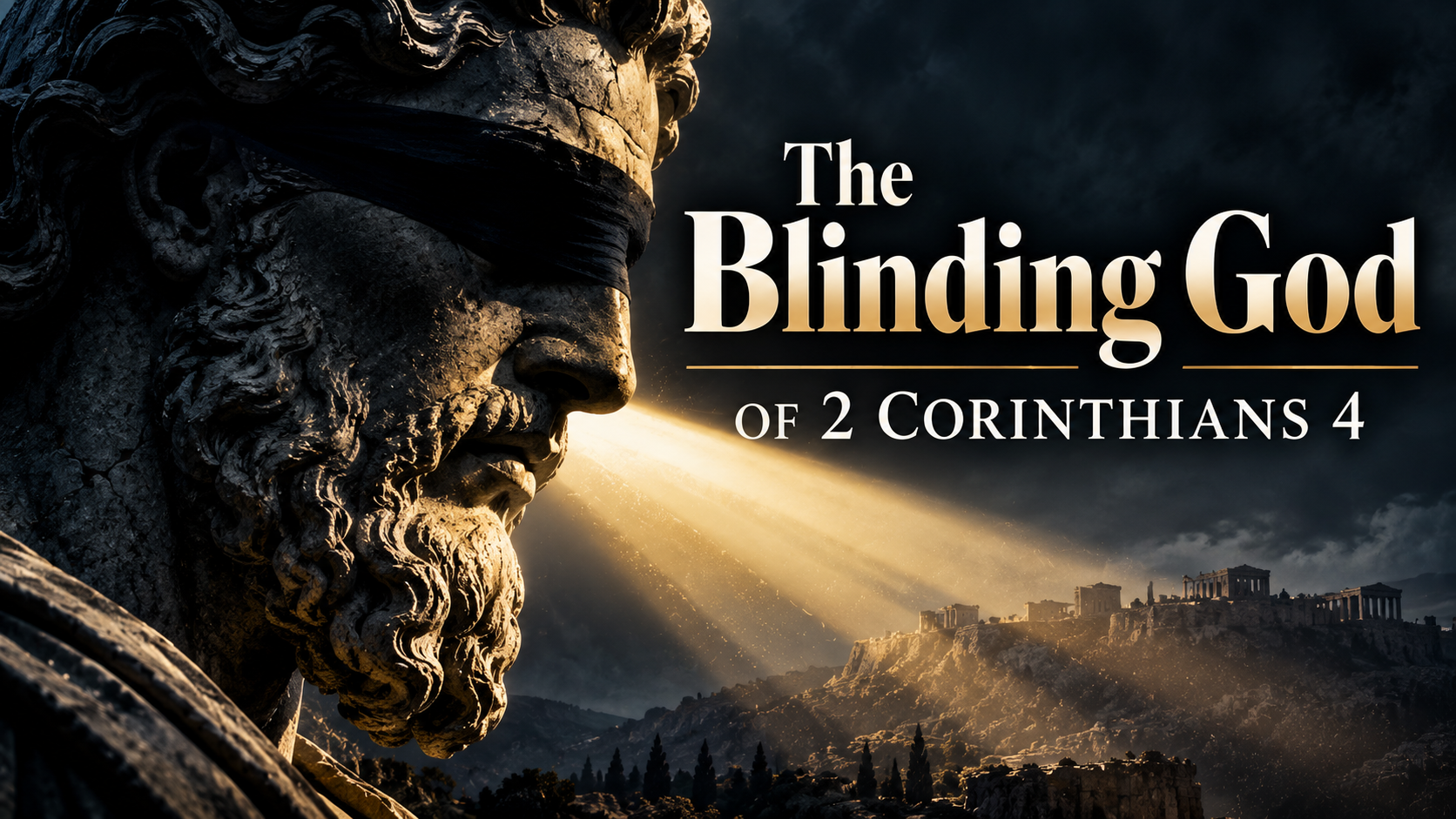
One sentence of Paul says that the god of this aeon has blinded the minds of the untrusting so that the light of the Evangelion of Christ's glory might not shine to them. Marcion read it as written. For eighteen centuries the Imperial Church has not been willing to. Irenaeus moved the words. Tertullian moved the words, then said the devil was meant, then in the same chapter called the Creator the God of this age. Augustine, answering a Marcionite book in Carthage around 420 AD, moved the words again and then said plainly that the true God does blind minds, by a judgment "most just though most hidden." This article sets the three readings side by side in their own words, Tertullian and Augustine in their own Latin, shows what each one concedes, and gives ours.
One Sentence
Here is the verse in our text.
The god of this aeon has blinded the minds of the untrusting, so that the light of the Evangelion of the glory of Christ, who is the image of God, might not shine to them. (2 Corinthians 4:1 TT)
Read it once more slowly, as a plain reader would. There is a god. He is the god of this aeon, the present age. He has blinded minds. He did it so that a light would not shine, and the light is the Evangelion of the glory of Christ, who is the image of God. Four things are said, and they hang together. A god who belongs to this age is keeping the light of Christ from reaching people.
In Greek the subject is ὁ θεὸς τοῦ αἰῶνος τούτου, the god of this aeon. The Latin the Fathers read was deus aevi huius in Tertullian and deus saeculi huius in Augustine. The words are not obscure. The difficulty is what the sentence says if one God wrote the whole Bible.
Marcion Read It as Written
We know how Marcion read it because Tertullian tells us. In the fifth book of Against Marcion, around the year 207, he writes that some sentences can suffer ambiguity "from the sound of their pronunciation or from the manner of their punctuation," and that "Marcion seized upon this by reading: 'In whom the god of this age,' so that by showing the Creator to be the God of this age, he might suggest another god of another age" (Against Marcion 5.11.9).
Tertullian does not say Marcion altered the words. He says Marcion read them in order. The god of this age is the Creator; the one whose light he blocks is another. That is the reading of a man who took the sentence as it stood, and Tertullian's whole labor in the paragraphs that follow is to find a way not to.
Irenaeus Moves the Words
Tertullian was not the first to try. Irenaeus, writing against the heretics around 180, met the same verse in the hands of people who used it to prove a second god, and his answer was grammatical. Paul, he said, often writes with a transposed word order, a hyperbaton, and the reason is "the rapidity of his discourses, and the impetus of the Spirit which is in him" (Against Heresies 3.7.2). So the sentence must be read with the words moved. "In whom God" begins the clause, there is a slight pause, and then "has blinded the minds of the unbelievers of this world." The unbelievers are "of this world" because they "shall not inherit the future age of incorruption" (3.7.1). And he warns that a reader who does not observe the pauses "will utter blasphemy" (3.7.2).
This is an admission. If the words in their order say what Marcion said they say, and the only way to avoid it is to read them out of order, then the plain text is on Marcion's side, and Irenaeus knew it. And look at what the repair produces. Read Irenaeus's way, the verse says that God, the one God of the whole Bible, the Father of Jesus Christ, has blinded the minds of unbelievers so that the light of his own Son's gospel might not shine to them. The comma does not make the sentence comfortable. It changes who is doing the blinding.
Tertullian Makes Three Moves
Tertullian offered the same solution first. "We, on the contrary, say that it should be punctuated thus: 'In whom God,' and then: 'has blinded the minds of the unbelieving of this age'" (5.11.9). The unbelieving are the Jews, on whom the veil of Moses still lies, and God had threatened them, in Isaiah's words, that hearing they would not understand and seeing they would not perceive. So God blinds them, and the blinding is punishment.
Then comes a sentence that deserves more attention than it has had. "And so, although the god of this age blinds the heart of unbelievers of this age, this is because they have not voluntarily recognized his Christ, who is to be understood from the Scriptures" (5.11.10). The Latin is ita etsi huius aevi deus, sed infidelium huius aevi excaecat cor. Tertullian lets the phrase stand for a moment with its words in order, and simply insists that the one so named is the Creator punishing unbelief. He then says that he has treated the matter "placed in the ambiguity of distinction, so that it might not benefit the adversary," that he is "content with the victory," and that he "could have entirely bypassed this argument" (5.11.10). A man who is sure of his punctuation does not say that he argued it so the other side would not profit.
So he gives a second answer, and calls it simpler. "A simpler answer will be close at hand: to interpret that the devil is the lord of this age," the one who said through the prophet, "I will be like the Most High," and to whom "the whole superstition of this age is enslaved," the one "who blinds the hearts of unbelievers, and especially those of the apostate Marcion" (5.11.11). On this reading the words keep their order. There is a god of this age, he blinds, and he is not the Father. He is the devil.
Then, beginning at the end of that paragraph and carried into the next, Tertullian gives a third answer, this time arguing on Marcion's own terms, and it does not sit easily with the one he has just given. He turns to the closing clause, "For God, who commanded light to shine out of darkness, has shone in our hearts" (5.11.11), and argues that this is the God of Genesis who said "Let there be light," so that "Christ and the apostles and the gospel and the veil and Moses and the whole series belong, on the testimony of the closing clause, to the Creator, the God of this age" (5.11.12). Creatoris est, dei huius aevi. The Creator, the God of this age. In one chapter Tertullian has punctuated the verse so that God blinds, proposed that the devil is the lord of this age, and called the Creator the God of this age, using Marcion's own title. He then props up the devil reading with a thought from the letter he calls Ephesians and Marcion called Laodiceans, that the nations were "without God" in the world, so that "the lord of this age is to be understood as he whom the nations received as God, not the Creator" (5.11.13).
Later in the same book, discussing the "prince of the power of the air" (5.17.7), he returns to the devil reading and hedges it himself. "This will be the devil, whom elsewhere (if indeed they are willing to read the Apostle this way) we acknowledge as the god of this age" (5.17.9). He knew the reading was a choice.
The Carthage Reader
Two hundred years later the verse was still being read as Marcion read it, and not by a Marcionite assembly. Around 420 a book was sold and read aloud on the waterfront of Carthage that argued the God of the Law and the Prophets is not the Father of Jesus Christ. Its author had the church's Bible, not Marcion's, as we showed in The Lost Marcionite Book of Carthage, and he read this sentence in the church's Latin and drew Marcion's conclusion. Augustine, who answered the book in Contra adversarium legis et prophetarum, reports it with contempt. "Here this wretch wants the God of this age to be understood as evil, as though Moses had served him in the Old Testament, as if the Apostle had said this" (2.7.29).
Augustine's answer uses Tertullian's first two moves in the reverse order, and it is worth hearing in his own words. First the devil, offered and then set aside. "If it were necessary to understand the God of this age as the god of the impious, that is, the devil, since all the gods of the nations are demons and most of all the prince of demons, it would be no wonder, since the god of certain people is even said to be their belly; for the Apostle says, 'whose god is the belly,' and the belly is not therefore God. So if the devil can be called the god of this age, the devil is not therefore God." Then the preferred reading, the comma. "But since another understanding lies open, what need is there to think the devil is signified here, and not rather the true God, just and good, who has blinded the minds of the unbelievers of this age, so that one does not divide it here, 'in whom the God of this age,' and then add 'has blinded the minds of the unbelievers,' but rather 'in whom God,' and then add 'of this age has blinded the minds of the unbelievers,' that is, he has blinded the minds of the unbelievers of this age" (2.7.29).
Deum verum, iustum et bonum, qui excaecaverit mentes infidelium saeculi huius. The true God, just and good, who has blinded the minds of the unbelievers of this age. Augustine saw what the comma does, and he accepted it. The next paragraph begins by naming the objection. "But it does not please these men that the good God should blind the minds of some" (2.8.30). Harnack, printing the fragments of the Carthage book in 1921, set the claim behind that sentence in italics as the author's own words, the good God blinds no one's mind. In our edition we treat it as Augustine's report of the author's position. Either way it is the Marcionite objection in one line, and Augustine's reply is not to deny it but to embrace it. The Savior said he came into the world for judgment, that those who do not see might see and those who see might become blind. The God who, in the Apostle's words, has mercy on whom he wills and hardens whom he wills, "beyond doubt enlightens whom he wills and blinds whom he wills." "He enlightens by mercy, he blinds by judgment, a judgment certainly most just, though most hidden" (2.8.30). Illuminat misericordia, excaecat iudicio, utique aequissimo etsi occultissimo.
That is where the Imperial Church's reading of 2 Corinthians 4 arrived after two and a half centuries. The God who blinds minds so that the light of Christ will not shine to them is the true God, just and good, and he does it by a judgment we cannot see.
What Each Reading Concedes
The church has two readings. Set them beside the sentence and ask what each one gives away.
The comma gives away the words. Irenaeus and Tertullian both admit that in the order Paul wrote them the words name a god of this age who blinds. The transposition is a repair, and both say so, Irenaeus by calling it a hyperbaton, Tertullian by calling the sentence ambiguous and his own treatment of it a thing he could have skipped. Augustine at least sets out Marcion's division in full before choosing the one that keeps a single God. And the repair has a price, which Augustine alone was honest enough to pay in full. If God is the subject, then the good God blinds minds against his own Son's gospel. Irenaeus promised to explain later how that could be. Tertullian said it was punishment for not recognizing Christ in the Scriptures. Augustine said it was judgment, most just and most hidden. None of them could say it was the act of a Father who is kind to the ungrateful and the wicked.
The devil gives away the one God. On Tertullian's simpler answer the words stand in order and there is a god of this age who is not the Father. He is called the devil, and the question remains exactly where Marcion left it. There is a being whom Paul is willing to call a god, who holds this age, and who has the power to keep the light of Christ from human minds, and the Father does not stop him. Tertullian felt the weight of this, which is why, when he came back to it, he wrote "if indeed they are willing to read the Apostle this way." And a paragraph after proposing the devil he wrote the words creatoris est, dei huius aevi, the Creator's, the God of this age, arguing on Marcion's terms but writing the Marcionite title for the Creator in his own hand.
The church never chose. Irenaeus and Augustine preferred the comma. Tertullian offered both and could not settle. Most modern commentaries and English translations take the devil, and few mention the punctuation, so a reader of an English Bible is unlikely to have been told that three of the most influential theologians of the first five centuries read the verse with its words rearranged in order to keep a second god out of it. Both readings survive because neither works, and the plain reading is the one the church has spent eighteen centuries not giving.
Our Reading
Our commentary on the verse says it in four sentences. The one who blinds minds is not the Father on a severe day. The Father is the one whose light is blocked; the god of this aeon is the one doing the blocking. We hold that the god of this aeon is the Creator, the administrator of the present aeon, not a metaphor for the world. Christ remains the image of God whether or not the aeon's god permits the mind to receive him.
That reading takes the words in order, as Marcion did, and it takes the next sentence in order too. "For the God who said, 'Light shall shine out of darkness,' has shone in our hearts to give the light of the recognition of his glory in the face of Christ" (2 Corinthians 4:3 TT). Tertullian read that as the God of Genesis and made the whole passage the Creator's. We read the two sentences as Paul's contrast. One god blinds so that the light will not shine; another God shines in the heart so that his glory is recognized in the face of Christ. The second is not quoting the first book of Moses. He is doing the opposite of what the first god does. Our commentary reads the shining as the Father, and the structure of the passage is the reason.
Nothing in our Paul is strange about a god of this aeon who is not the Father. He has just told the Corinthians that "the thoughts of the world were dulled" and that a veil remains at the reading of the old covenant until it is taken away in Christ (2 Corinthians 3:9 TT). He speaks of "the rulers of this aeon who are being nullified" (1 Corinthians 2:6 TT), who "would never have staked the Lord of glory" if they had understood (1 Corinthians 2:8 TT). He allows that there are "many gods and many lords," and then says who is God for us: "yet for us there is one God, the Father" (1 Corinthians 8:2–3 TT). He tells the Galatians that before they knew God they "were enslaved to those who are gods by nature" (Galatians 4:8 TT), and that Christ gave himself "so that he might deliver us from the present evil aeon according to the will of God the Father" (Galatians 1:4 TT). He tells the Laodiceans that they once walked "under the ruler of the power of the air" (Laodiceans 2:2 TT) and were "without God in the world" (Laodiceans 2:12 TT). The god of this aeon is not an intruder in that vocabulary.
And the Evangelion closes the door that Augustine walked through. Augustine's final answer was that the true God, just and good, blinds by judgment. Our Lord says, "Only one is good: the Father" (Evangelion 12:2 TT), and the first thing he tells John's messengers to report of his work is that "blind people are seeing again" (Evangelion 4:16 TT). The Father's Son opens eyes. He does not come from a Father who shut them. And the Father was not known before the Son made him known: "No one knows the Father except the Son, and no one knows the Son except the Father, and anyone to whom the Son reveals him" (Evangelion 6:30 TT). A God who was known at Sinai, by name and by voice, and who in Augustine's reading blinds men to the Son, cannot be the Father whom no one knew until the Son revealed him. Those are two descriptions, and Paul gave them two names in one sentence.
Why the Comma Matters
This is not an old quarrel over punctuation. The sentence is a test of the premise that one God wrote the whole Bible, and three of the Imperial Church's most influential early readers all failed it in the same way. Each was forced to choose between a Father who blinds people to his Son and a god of this age who is not the Father. Irenaeus chose the Father who blinds and promised an explanation. Tertullian chose both, changed his mind a paragraph at a time, and in passing used Marcion's own title for the Creator. Augustine chose the Father who blinds and called his judgment hidden.
We read the sentence the way the man on the Carthage waterfront read it, and the way Marcion read it in Rome, and the way Tertullian says it reads if you do not move the words. The god of this aeon has blinded the minds of the untrusting. He is not the Father of Jesus Christ, and the light he is blocking is the light we are trying to let through.
Sources
True Testament, Sixth Edition. 2 Corinthians 3 to 4, 1 Corinthians 2 and 8, Galatians 1 and 4, Laodiceans 2, Evangelion 4, 6 and 12, with the print commentary on 2 Corinthians 4. The Reader at truetestament.org shows the orthodox reference beside every verse.
Tertullian, Against Marcion 5.11.9–13 and 5.17.9, Latin and English as held in the True Testament library.
Irenaeus, Against Heresies 3.7.1–2, in the Ante-Nicene Fathers translation.
Augustine, Contra adversarium legis et prophetarum 2.7.29 and 2.8.30, Latin from the Nuova Biblioteca Agostiniana text at augustinus.it; English renderings above are ours. Harnack, Marcion (1921), Beilage VIII, p. 348*, on the italicized sentence.
From our library: The Lost Marcionite Book of Carthage, chapters 14 and 16; When the Creator Is Seen; Referent, Did Paul Only Talk About One God With the Word God?; The Sovereignty Beyond the Creator.