
Two men are walking home from Jerusalem on a Sunday afternoon. Their village, Emmaus, is about seven miles away, and they have the whole road to go over what happened. A few days earlier their teacher was put to death on a Roman stake. That morning some women from their group came back from his tomb saying it was empty.
A stranger falls in beside them and asks what they are talking about. They stop in the road, and one of them, a man named Cleopas, can hardly believe the question. Everyone in Jerusalem knows what happened. Then the other says the sentence that explains why they look the way they do: “We thought he was the one who would set Israel free.” (Evangelion 16:21 TT).
That sentence is where our new book begins its account of the first Gospel, and it carries the book’s whole question. These two had followed Jesus closely, and they still believed he was going to be Israel’s king in the old sense: the son of David who would drive out Rome, sit on the throne in Jerusalem and gather the scattered nation home. When he was executed instead, that hope died with him.
The stranger, who is Jesus himself, does not tell them their hope was right and merely delayed. He tells them they were slow “to trust all that he told you” (Evangelion 16:22 TT). They had been waiting for the wrong king.
Two Different Christs
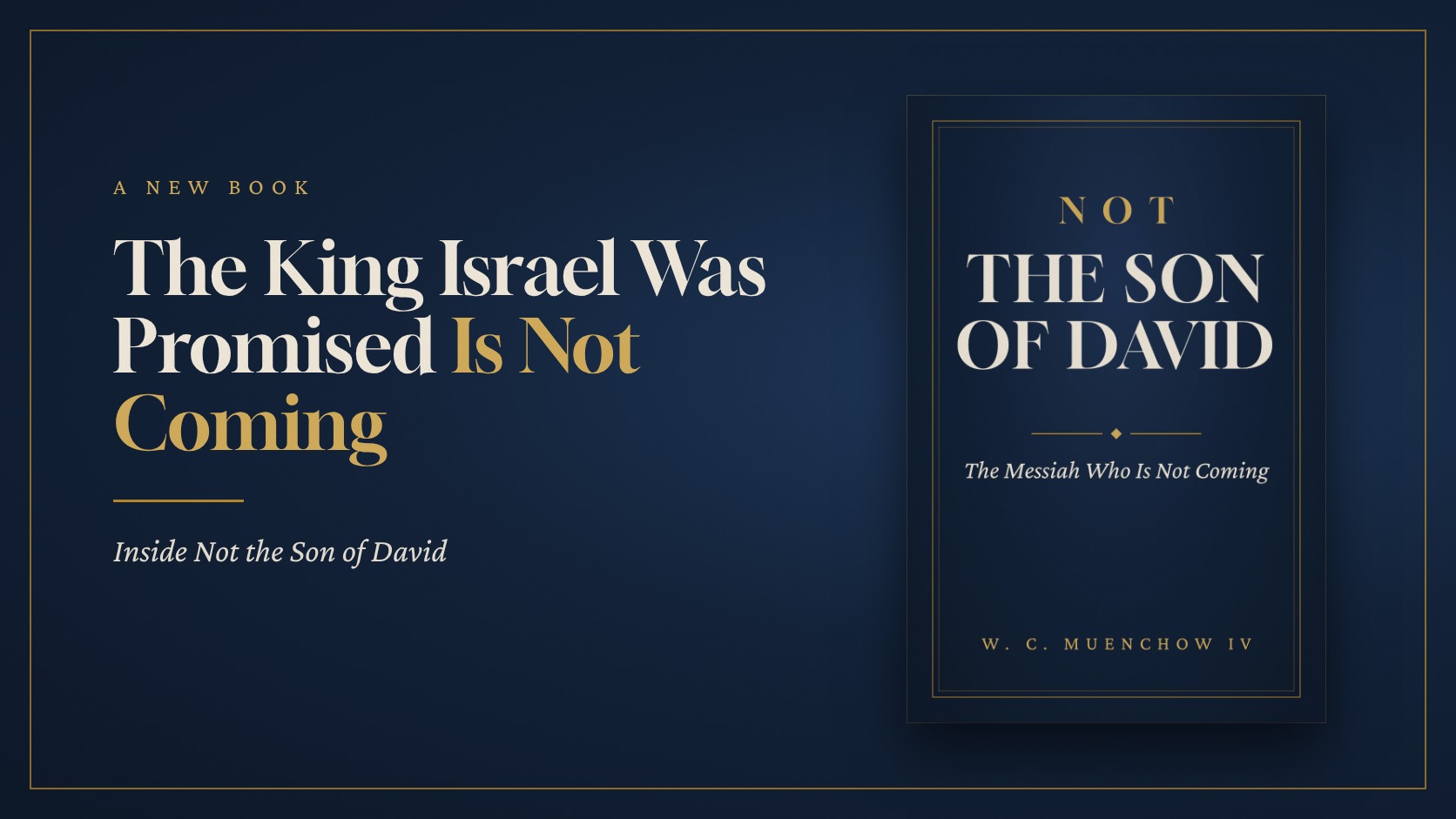
Not the Son of David: The Messiah Who Is Not Coming is about the difference between two figures who share one title.
The first is the king the God of Israel promised through his prophets. To follow the book you need one idea that most churches never teach. Around the year 140 a shipowner from the coast of the Black Sea, Marcion of Sinope, published the first Christian Bible in Rome: one Gospel and ten letters of Paul. He and the assemblies that kept his Bible did not believe that the God who made this world was the same as the Father whom Jesus made known. One is the Creator, the God of the Hebrew scriptures, who gave Israel its Law and promised it a king. The other is the Father, whom no one knew until Jesus revealed him. When the book speaks of the Creator’s Christ, it means the king the Creator promised. Christ is the Greek form of the Hebrew word Messiah, and both mean “anointed.”
That promise was made in ordinary words. A prophet named Nathan told King David that God would raise up his descendant and “stablish the throne of his kingdom for ever” (2 Samuel 7:12–13, King James Version). The prophets after him filled in the picture: a son of David, a throne in Jerusalem, the exiles gathered home and Israel’s enemies defeated. The Jews of Jesus’ day were praying for exactly that, and the Dead Sea Scrolls, written by a Jewish community in the desert before and during his lifetime, show it in their own words.
The second figure is the Christ who actually came. The book argues that he was never the first.
We first set out this distinction in our article Two Messiahs: The Christ Who Came and the One the Creator Promised. It gathers what Tertullian and four German scholars reported about Marcion’s two Christs, and it lays out the order of the end as we hold it, including Paul’s words in his second letter to the Thessalonians about the defection and the person of fault. If you have read that article, this book is its full-length companion. It takes the same question chapter by chapter, answers the objections one at a time, and gives every reason we have for saying that the Creator’s Messiah is not coming.
The Title He Kept Refusing
Much of the book reads the Evangelion, the Gospel in Marcion’s Bible, scene by scene, and the pattern it finds is hard to forget once you have seen it.
When demons shout out who Jesus is, “Jesus stopped them and wouldn’t let them speak, because they knew he was the Christ.” (Evangelion 1:12 TT). When Peter finally says “You are the Christ” (Evangelion 5:31 TT), Jesus “warned them sharply and ordered them not to tell anyone” (Evangelion 5:32 TT) and starts talking about his death instead. When the council presses him at his trial, he hands their words back to them: “Those are your words.” (Evangelion 15:18 TT).
The one time he raises the subject himself, he does it in the temple, in front of the teachers of the Law, with a riddle from the Psalms. David calls the coming Christ “my Lord,” and a father does not call his own son his lord. So Jesus asks, “How can they say that the Christ is David’s son?” and then, “If David calls him Lord, how can he be his son?” (Evangelion 13:23, 13:25 TT). Nobody answers him.
The book does not skip the hard scene. A blind beggar outside Jericho shouts “Son of David” twice, and Jesus heals him without a word of correction. A whole chapter is given to that man, and to what Jesus said and did at Jericho in the scenes that follow.
Paul, the earliest Christian writer whose words survive, tells the same story from his side. In the ten letters as Marcion published them, he never once calls Jesus a descendant of David. He says, “though Christ was once known by the flesh, we know him so no longer” (2 Corinthians 5:12 TT). A son of David is someone known by the flesh, by bloodline and nothing else.
The Claim on the Cover
So far the book agrees with Marcion. The surprise is the subtitle.
Marcion and his followers believed the Creator’s king was still on his way. One day, they said, he would come and restore Israel, entirely separate from anything the Father was doing. The book shows where that report comes from: three separate remarks by Tertullian, the North African church writer who wrote five volumes against Marcion around the year 207.
The book argues that Marcion stopped one question short. If the Father has sent his own Christ into the Creator’s world, what is left of the plans made for the first? It answers with five reasons, each taken from the words of Jesus or Paul in the text Marcion handed down:
- Jesus says, “The Law and the Prophets were in effect until John.” (Evangelion 10:20 TT). The promise of a king lived inside the Prophets, and the Prophets had an end date.
- Jesus describes a strong man, fully armed, guarding his house, until someone stronger overpowers him and takes away “the weapons he was relying on” (Evangelion 7:19 TT). A king sent to restore that house would be arriving at a building that has already been emptied.
- Paul says Christ broke down the wall between Israel and the nations and abolished the Law that built it. The promised king’s whole task was to rebuild what that wall stood for.
- Paul sets out the order of events to the very end: Christ is raised, his people are raised at his coming, and then he hands the kingdom to the Father and abolishes “every rule and authority” (1 Corinthians 15:19b TT). There is no place in that order for a throne in Jerusalem.
- Jesus warns that many will come saying “I am the Christ,” and his instruction has no exception clause: “Don’t follow them.” (Evangelion 13:27 TT). Nineteen centuries of failed claimants, from the rebel leader Simon bar Kosiba in the year 132 to Sabbatai Zevi in 1665, have proved the warning true.
Two Answers the Church Will Give
A book like this has to face its strongest opponents, and two chapters are given to them.
The first is the teaching, popular in many American churches, that Jesus will come back to sit on David’s throne in Jerusalem for a thousand years. The book takes it seriously, because on one point it agrees: the prophets meant a real throne. But every Christian text it rests on comes from outside the Gospel and the letters Marcion published. In the first Gospel, Jesus comes “from heaven with great power,” and his followers are told to “look up and lift your heads, because your liberation is near” (Evangelion 13:41–42 TT). The passage has no city or throne in it.
The second is Paul’s line “all Israel shall be saved” (Romans 11:26, King James Version). In the church’s Bible it closes ninety verses about Israel’s future. In the True Testament the same three chapters of Romans are nine verses long, and Tertullian, who had Marcion’s copy in front of him, confirms that the long passage was not there.
What the Book Says to Israel
The book is careful here, and it should be.
For most of two thousand years the church claimed that it had become the true Israel and inherited the promises made to the Jews. This book says the opposite. The promises belonged to Israel, they meant what they said, and the Jewish reading of the prophets was the correct one. On the question that has divided Christians and Jews since the first century, whether Jesus was the king the prophets described, the book concludes that the synagogue was right.
Its one hard claim is that the king will not come. It does not make that claim with any satisfaction, and it does not end there. The Son was sent, Paul says, “so that he might purchase those under Law” (Galatians 4:5 TT), and the people under the Law were Israel first of all. What Israel loses is a throne. What it gains, with everyone else, is the Father.
What It Means for You
You may have been taught to wait for a king. Perhaps you were shown a chart of the end times, or told to watch the news for signs that the throne of David is about to be filled. The first Gospel lets you put that watching down.
The one who came was not a king looking for subjects. He described his own work in a single sentence, at Jericho, a few lines after the blind man called him Son of David: “the Son of Man came to rescue what was lost.” (Evangelion 12:19 TT). A king needs a capital and an army. A rescuer only needs to find the one who is lost and bring them home.
That is the good news the two men on the road to Emmaus nearly missed. They were grieving a king who never came, while the one who had come for them was walking beside them.
Read and Listen
Not the Son of David is in our Library under Our Theology. You can read it online, and every chapter is narrated, so you can listen as well. It was written for readers with no background: every person and term is explained as it appears, and a list of people and terms is at the back.