
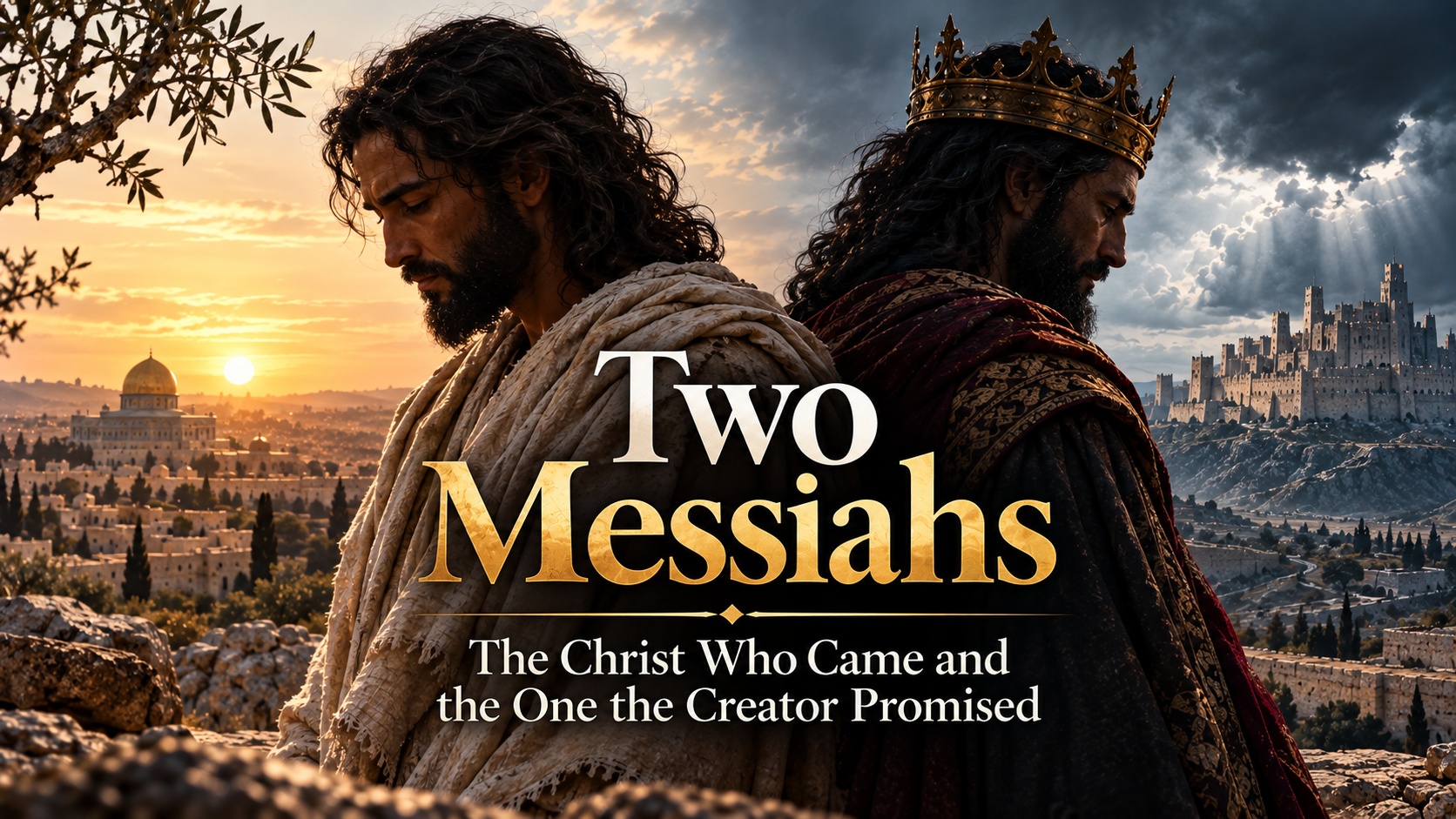
If there are two Gods, there are two Christs. The Creator promised Israel a king from David’s line who would gather the scattered people and restore the kingdom. That promise is real, and it is his. The Christ who descended into Capernaum in the fifteenth year of Tiberius was sent by a Father nobody knew, for all nations, and he carried none of that promise. He is not David’s son. He never claimed to be.
The Imperial Church fused the two. It gave the Father’s Son a genealogy, a birth in David’s city, and the Creator’s prophets as his credentials, and it has been waiting ever since for him to come back and do what the Creator’s Messiah was supposed to do. The men who wrote against Marcion knew he kept the two apart. The German scholars who reconstructed his gospel found that it carries no Jewish Messiah. And our own scripture shows Christ refusing the role every time it is offered to him.
This article sets out those three witnesses, and then says where the Creator’s Messiah belongs in the order of the end.
What the Church Fathers report
Tertullian is our best witness, because he states the doctrine as a thing both sides agree Marcion taught. At the head of his fourth book he lays it down as the ground rule for everything that follows: “Marcion established that there is one Christ who was revealed in the times of Tiberius by a once-unknown god for the salvation of all nations, and another who was destined by the Creator God to come some day for the restoration of the Jewish state. Between these he drives a great and total wedge, as great as between the just and the good, as great as between the law and the gospel, as great as between Judaism and Christianity” (Against Marcion 4.6.3).
He says it four more times, each time in passing, which is how we know it was not in dispute.
- Counting the divine substances Marcion’s system requires, he adds “his own Christs, the one who appeared under Tiberius, and the other who is promised by the Creator” (1.15.6).
- He restates our side before answering it: “the Jewish Christ was indeed destined by the Creator for gathering the dispersed people alone, while your Christ was bestowed by the best God for liberating the whole human race” (3.21.1).
- He draws the consequence: since Marcion held that a Christ had come “who had never been announced, it followed that it contended that Christ had not yet come who had always been proclaimed” (3.6.1).
- And on the person of fault in 2 Thessalonians he admits, “according to Marcion, I do not know if he is the Christ of the Creator. He has not yet come according to him” (5.16.4).
On the road to Emmaus he even concedes what the disciples were expecting. They had thought Jesus “was the Redeemer of Israel, that is, his own Christ, that is, the Creator’s” (4.43.3).
Tertullian’s answer is not that there is one Messiah with one job. It is that there is one Christ with two advents, “one in humility, indeed the first,” and a second “of sublimity” (3.7.1–3). He needs two comings to do the work we assign to two Christs. Keep that in mind. We will return to it at the end.
The Dialogue of Adamantius shows our people still pressing the point generations later. Megethius tells the catholic that his proofs “concern the Christ who was declared by the law and the prophets,” and that John the Immerser, a prophet of the Law, did not recognize Jesus, “being utterly impossible that a prophet of the law would be ignorant of his own Christ” (1.26). The Law’s prophet did not know this Christ because this Christ was not the Law’s.
What the German translators found
The four scholars whose work we have put into English did not share our faith, and two of them believed Marcion cut the church’s Luke. That makes their findings on this point more useful, not less.
Ritschl (1846) examined the gospel Marcion used and reported what it lacks. It “tells nothing of his Davidic descent, nothing of the solemn new legislation which he, as Messiah, had to promulgate.” Where the demons call Jesus “the Son of God” and “the Christ,” he showed the two titles are interchangeable in that gospel, and that this conception of Jesus “counts for Ur-Luke by no means as the main thing, as it does for Matthew.”
Baur (1847) described what the church’s Luke added. The infancy narrative “sets Jesus before one’s eyes, through his birth and descent, and through his whole surroundings, with all the marks of the Jewish Messiah.” He named the addition for what it is: “the specifically Jewish determination given to the Messiah, when he is depicted as an offshoot of the Davidic line.” Against the earlier gospel’s universalism, he wrote, “the Jewish Messiah has sunk to a subordinate significance.”
Zahn (1892) held that Marcion edited Luke, and he still saw what Marcion’s Christ does at the trial. When the council asks whether he is the Son of God, Marcion’s text has only “You say so.” Zahn’s comment: “Marcion’s Christ is content to establish that they say so, but he himself says nothing, so as not to profess himself the Jewish Messiah.”
Harnack (1921) noticed where Tertullian has to reach. In the parable of the servants, Tertullian can claim the returning master for his God only by naming him “the Son of Man, the Creator’s Christ, now acting not as a thief but as a judge.” The Creator’s Christ had to be imported into the Evangelion by its enemy.
Four men, four methods, and the same result. The gospel Marcion published never makes Christ the son of David.
The Messiah people expected
We do not need the Creator’s prophets to tell us what his Messiah was supposed to be. The Evangelion shows us the expectation in the mouths of the people who held it.
John the Immerser, the last and greatest of the Law’s prophets, heard what Jesus was doing and sent to ask, “Are you the one who’s supposed to come, or should we wait for someone else?” (Evangelion 4:15 TT). He had a Christ in mind, and this one did not match.
The Pharisees wanted a date. They “asked Jesus when the kingdom of God would come” (Evangelion 11:13 TT). A restored kingdom is something you can wait for and watch for.
The council and the governor wanted a king. The charge against him was “claiming to be the Christ, a king” (Evangelion 15:20 TT).
And the two on the road to Emmaus said what everyone had been hoping: “We thought he was the one who would set Israel free” (Evangelion 16:21 TT).
A Christ who comes to Israel, restores Israel, and reigns over Israel. That is the Creator’s Messiah, and every party in the Evangelion was looking for him.
How Christ refused the role
Watch what he does with the title each time it reaches him.
He silences it. In Capernaum, “Demons came out of many, shouting, ‘You are the Son of God!’ But Jesus stopped them and wouldn’t let them speak, because they knew he was the Christ” (Evangelion 1:12 TT). When Peter answers “You are the Christ,” Jesus “warned them sharply and ordered them not to tell anyone” (Evangelion 5:31–32 TT). A Messiah come to claim a throne wants the title shouted. This one shuts it down.
He breaks the pedigree. “How can they say that the Christ is David’s son? For David himself says in the book of Psalms, ‘The Lord said to my Lord, sit at my right hand.’ If David calls him Lord, how can he be his son?” (Evangelion 13:23–25 TT). The Creator’s Messiah is David’s son by definition. Christ takes the scribes’ own text and shows that it cannot hold him. Tertullian saw the danger and answered that Christ “might show himself to be also his Lord,” rewarding the blind man who had called him son of David (4.38.10). But Christ did not say “also.” He asked how both could be true. In our gospel the blind man does cry, “Jesus, Son of David, have mercy on me!” (Evangelion 12:10 TT), but Christ never takes up the title. He asks, “What do you want me to do for you?” and says, “Your faith has made you well” (Evangelion 12:12–13 TT). The title is the blind man’s; the question about how the Christ can be David’s son is Christ’s.
He refuses the timetable. “The kingdom of God doesn’t come with visible signs. People won’t be able to say, ‘Here it is!’ ‘There it is!’ Because the kingdom of God is already among you” (Evangelion 11:13–14 TT). The Creator’s kingdom was a restoration you would be able to point to. The Father’s was standing in front of them.
He warns against the claimants. “Many will come in my name, saying, ‘I am the Christ,’ and, ‘The time is near.’ Don’t follow them” (Evangelion 13:27 TT). Christ knew the Creator’s promise would keep producing candidates, and he told his own not to follow a single one.
He will not confess it at the trial. The council says, “If you are the Christ, tell us.” He answers, “If I told you, you wouldn’t believe it” (Evangelion 15:16 TT). They press: “So you are the Son of God then?” He answers, “Those are your words” (Evangelion 15:18 TT). Pilate asks, “Are you the Christ?” and gets “You say so” (Evangelion 15:21 TT). Zahn read those answers correctly. He would not profess himself the Jewish Messiah, because he was not.
He corrects the hope on the road. To the two who had hoped he would set Israel free, he says “the Christ must suffer these things” (Evangelion 16:23 TT). Not restore. Suffer. A suffering Christ is the one thing the Creator’s promise never contained, which is why Paul calls the message about the stake “to the Jews a stumbling block” (1 Corinthians 1:23 TT).
The title he uses for his own coming is Son of Man: “the Son of Man will come at an hour you don’t expect” (Evangelion 8:31 TT). He does not say the Messiah will come. He never took the role of the Creator’s Messiah, so he never promised to return in it.
Paul and the Twelve
The Twelve walked with him and still expected the Creator’s Messiah. That is why Emmaus happens. Paul’s Evangelion came another way, “through a revelation of Christ Jesus” (Galatians 1:11 TT), and his first letter opens by naming the problem. People are turning “to a different message,” and “some are disturbing you and wish to change it into a different message of Christ” (Galatians 1:5–6 TT). A different message of Christ is a different Christ. In Corinth he calls men of the same kind “false apostles and deceitful workers, changing themselves into apostles of Christ” (2 Corinthians 11:2 TT).
Paul’s own Christ is the one who “gave himself for our sins so that he might deliver us from the present evil aeon” (Galatians 1:4 TT). The Creator’s Messiah was to restore a kingdom inside this aeon. The Father’s Son came to take people out of it. And the rulers who staked him did not know whom they held: “None of the rulers of this aeon understood it; for if they had, they would never have staked the Lord of glory” (1 Corinthians 2:8 TT). They were waiting for their own king. They killed a stranger.
One more thing the Apostolikon does not say. The church’s Romans opens with Christ “descended from David according to the flesh.” Ours does not. It runs from “Paul, a servant of Christ Jesus, called to be an apostle, set apart for the Evangelion of God” straight to “Through Christ we received grace and apostleship for the obedience of faith among all the nations” (Romans 1:1–2 TT). We say plainly that this is an editorial decision of our reconstruction and not an attested absence. We print it because a Paul who no longer knew Christ by the flesh (2 Corinthians 5:12 TT) did not open his greatest letter with a bloodline.
Where the Creator’s Messiah belongs
If Jesus is not the Creator’s Messiah, the question is where that Messiah is. Tertullian reports Marcion’s answer: he has not come. Beyond Tertullian’s remark that Marcion probably took the person of fault to be the Creator’s Christ (5.16.4–5), no surviving report gives Marcion’s account of what happens next, so what follows is ours, built from Paul and the Evangelion. This is the order as we hold it.
- The Creator promised Israel a Messiah. A king of David’s line, to gather the people and restore the kingdom. The promise is real. It is his, and it binds him.
- Christ came and was not that Messiah. He descended into Capernaum, refused the title, and was staked by rulers who did not know him.
- The Creator still rules this aeon, and his promise is still unfulfilled. He is “the god of this aeon” who “has blinded the minds of the untrusting” (2 Corinthians 4:1 TT). His rulers are “being nullified” (1 Corinthians 2:6 TT), but they still sit. Israel still waits for his Messiah. The Imperial Church waits for the same Messiah and calls him Jesus. That is the merger in one sentence: they took the Father’s Son and assigned him the Creator’s unfinished work.
- The defection. Paul writes that “that day will not come unless the defection comes first” (2 Thessalonians 2:3 TT). We read it as people leaving the Creator’s house once they see whose house it is. The seeing comes first, the walking out follows, and only then is the landlord unmasked before everyone. The defection is the first sign that the blindness of this aeon is lifting, and it is the Father gaining his own, not losing them.
- The revealing of the person of fault. The Creator is seen for what he is by everyone, not only by those who already left. The world learns that the Creator is not the Father. The next section is about this.
- The Creator’s Messiah never arrives. His promise ends with his aeon. Before the king comes, the people who see walk out and the landlord is unmasked, with the rest still inside under his display. The only Christs his promise ever produces are the ones Jesus warned about: “Many will come in my name, saying, ‘I am the Christ,’ and, ‘The time is near.’ Don’t follow them” (Evangelion 13:27 TT).
- The parousia. “For the Lord will descend from heaven by a command of God with the voice of an archangel and with the last trumpet, and the dead will be awakened first. Then we who remain for the presence of Christ will be caught up together with them in the clouds to meet the Lord in the air” (1 Thessalonians 4:16–17 TT). The Son of Man comes, not the Messiah, and he comes to take his own out, not to take a throne.
- The reconciliation of all things. Through Christ the Father reconciles “all things to himself, making peace through the blood of his stake, through him, whether things on earth or things in heaven” (Colossians 1:19 TT). We do not exclude the Creator from that.
So the answer to “when does the Creator’s Messiah come?” is that he does not. His coming is replaced by a revealing. What Israel waits for is a king who will set it free. What arrives instead is the exposure of the god who made the promise, and then the Father’s Son, who frees everyone.
The person of fault
Paul writes: “Let no one deceive you in any way, for that day will not come unless the defection comes first and the person of fault is revealed, the one bound to perishing. He exalts himself above everything called a god and every object of reverence, so that he sits in the temple of God, displaying himself as God” (2 Thessalonians 2:3–4 TT). Then: “His coming is according to the operation of the Adversary, with all power and signs and deceptive wonders” (2 Thessalonians 2:6 TT).
The Imperial Church reads this as a future Antichrist, a world ruler assembled from the letters of John, the beast of Revelation, and dispensational charts. None of those books is in our canon. Tertullian, who had Marcion’s Apostolikon in front of him, named the figure the Antichrist for his own side. For Marcion’s side he hesitated, “I do not know” (5.16.4), and then reported that Marcion held him to be the Creator’s Christ (5.16.5). He never considered that the god of the temple might be the fault.
We hold that the person of fault is the Creator. Our books have said so for some time, and three objections can be raised. Here are our answers.
“Bound to perishing” is said of him, and we say the Father reconciles him. Both are true, because perishing is his nature before it is his sentence. Everything the Creator makes bears his nature, and everything he makes perishes. Of the body Paul says “it is sown in decay” (1 Corinthians 15:34 TT), and of the world, “the form of this world is passing away” (1 Corinthians 7:14 TT). A maker whose every work comes apart is bound to perishing the way a potter is bound to clay. In our vocabulary perishing is never the Father’s verdict on anyone. It is a condition the Father reaches into. The Creator is bound to it, and the Father reaches him too. We read the phrase, as our books do, of his rule: his domain ends. It ends because everything he makes perishes, including the order he rules.
The temple is “the temple of God,” so the figure must be an intruder in God’s house. The word God is a title with two referents, and here the referent is the Creator. It is his temple, the one his Law built and his people kept. The Imperial Church’s Antichrist breaks into someone else’s temple. Ours sits in his own. That is the whole difference, and it is the difference between a criminal and a landlord. He “exalts himself above everything called a god,” and that includes the Father, whom he has never acknowledged. “Displaying himself as God” is not a usurper’s costume. It is the Creator’s standing claim, made in his own house, that there is no god but him.
The Creator has been visible since Sinai, so he cannot be “revealed.” He has been visible, and nobody has seen him, because he blinds. “The god of this aeon has blinded the minds of the untrusting, so that the light of the Evangelion of the glory of Christ, who is the image of God, might not shine to them” (2 Corinthians 4:1 TT). A being who blinds everyone to who he is must be revealed before he can be seen. The one who thundered from the mountain is the one the world has never once seen for what he is. The revealing is not his first appearance. It is the first time the blindness lifts.
The Adversary does not change this. He is the Creator’s functionary, his prosecutor and tempter, never his anointer and never his master. When Paul says the person of fault comes “according to the operation of the Adversary, with all power and signs and deceptive wonders,” he is describing the house defending its owner’s claim with everything it has. The signs serve the display. They are the last argument of a god who is about to be seen.
The defection
One more word in that verse needs its own treatment, because most Christians read it one way and we read it another. Paul writes that “that day will not come unless the defection comes first” (2 Thessalonians 2:3 TT). The Imperial Church calls this the great apostasy, a falling away from the faith, a last generation of the church going cold or going heretical before the Antichrist appears. That reading does not come from Paul. It comes from the Pastoral letters, which warn that in later times some will depart from the faith, and from Matthew’s line about the love of many growing cold. Neither is in our canon. The True Testament contains no verse that says the faith will be abandoned before the end.
What Paul wrote is narrower than that. The word means a desertion, a walking out, a standing away from something, and Paul does not say what is deserted. He says the defection and moves straight on to the person of fault sitting in his own temple and displaying himself as God. The Imperial Church filled in the blank with “the faith.” The passage itself fills it in with the god whose house it is.
So we read the defection as people leaving the Creator’s house once they see whose house it is. Our books have said this for some time, and they say plainly that it is not the usual reading. What makes it ours is that it is the same event our whole faith is built on, seen from the other side of the wall. Paul describes the rescue as a transfer of allegiance: “He rescued us from the realm of darkness and transferred us into the kingdom of his beloved Son” (Colossians 1:13 TT). From the Father’s side that is a rescue. From the side of the god of this aeon, who claims a worship that belongs to the Father, it is desertion. One event, two ledgers. The defection is the transfer written in the Creator’s book.
Paul is the pattern. He was “circumcised the eighth day, of Israel’s stock, from the tribe of Benjamin, a Hebrew of Hebrews; as to Law, a Pharisee” (Philippians 3:2 TT), and he walked out of all of it: “whatever was gain to me, I now count as loss for the sake of Christ” (Philippians 3:3 TT). He deserted the Creator’s house the moment he saw whose house it was. What happened to him one man at a time happens at scale when the blindness of this aeon lifts widely, and that is the defection Paul says must come first. The walk-outs happening now are its firstfruits, not its fulfillment.
The defection does not empty the house. Paul says in the same breath that the person of fault comes “with every deception of wickedness for those who perish, because they did not receive the love of the truth so as to be rescued” (2 Thessalonians 2:7 TT). The deception works on people who are still inside. Some see and walk out. Others are held by the signs and the display. Paul is not describing empty streets. He is describing a house in which the blindness is lifting for some while the owner puts on his last show for the rest, and the end comes in the middle of that.
This changes the tone of the verse completely. Under the Imperial reading, “that day will not come unless” is a threat: the church will rot before Christ returns. Under ours it is a promise with a condition, and the condition is the Father’s own work. He is the one lifting the blindness. The day comes when eyes are opened and people start leaving, and the last sign before the Son of Man appears is not a tragedy. It is the Father gaining his own, and his dignity is that he loses nothing.
So the end of the Creator’s story is not the arrival of his Messiah. It is the moment the blindness comes off and the world learns that the god it has been told about was never the Father.
Which Messiah Christian Zionism is waiting for
Tertullian gives the ending away in his own book. Having spent his third book insisting there is only one Christ, he confesses what he expects that Christ to do: “we also confess that a kingdom is promised to us on earth, but before heaven, but in another state, as it were after the resurrection, for a thousand years in the city of divine workmanship, Jerusalem” (3.24.3).
A kingdom on earth. A thousand years. Jerusalem. That is the Creator’s promise to Israel, with Jesus’s name written over it. Tertullian needed two advents because he had merged two Christs, and the second advent is where he parked the Creator’s Messiah. By the early third century the merger already had its timetable.
Christian Zionism is the same move, eighteen centuries on. It reads the modern state of Israel as the countdown and expects Jesus to come back and reign from Jerusalem over a restored nation with its enemies defeated. Every item on that list belongs to the Creator’s Messiah. Not one of them belongs to the Son of Man who said his kingdom “doesn’t come with visible signs,” who asked how the Christ could be David’s son, and who told his own not to follow anyone who comes saying “I am the Christ.”
So when a Christian Zionist asks us whether we believe Jesus is coming back to rule from Jerusalem, our answer is that they are waiting for the wrong Messiah. They have taken the Creator’s king, who is not coming, and given him the Father’s Son’s name. We are not waiting for a throne in this aeon. “Our citizenship is in the heavens above, from where we eagerly await a rescuer, the Lord Jesus Christ” (Philippians 3:6 TT). A rescuer takes you out. A king takes the city. We are waiting to be taken out.
What we cannot show
No manuscript of the Evangelion or the Apostolikon survives from Marcion’s assemblies. That there were two Christs in his teaching rests on Tertullian, who was his enemy, confirmed by the Dialogue of Adamantius, which is later and hostile. The verses we have quoted from 2 Thessalonians 2 are attested in Marcion’s text by Tertullian. The only report of Marcion’s own reading of them is Tertullian’s, that Marcion took the person of fault to be the Creator’s Christ (5.16.4–5). Several other verses we rely on, including Galatians 1:4, Galatians 1:11, 1 Corinthians 7:14, 2 Corinthians 5:12, Colossians 1:13 and the opening of Romans, are graded Probable in our edition rather than Attested, and the argument does not rest on any of them alone, and the identification of the person of fault with the Creator is ours. The order of the end in this article is ours as well, built from Paul and the Evangelion, and we have marked it that way. The absence of David’s line from the opening of Romans is an editorial decision of our reconstruction, not an attested absence, and we have said so.
What we can show is this. The men who fought Marcion agreed that he taught two Christs. The scholars who rebuilt his gospel, including those who thought he cut it, found no Davidic descent for Christ in it. And the Evangelion, read as it stands, has a Christ who silences the title, breaks the pedigree, refuses the timetable, will not confess it at the trial, and tells his own not to follow anyone who claims it.
Sources
Ancient writers
Tertullian, Against Marcion 1.15.6; 3.6.1; 3.7.1–3; 3.21.1; 3.24.3; 4.6.3; 4.38.10; 4.43.3; 5.16.4–5. English from the translation of the Latin in the True Testament library.
Dialogue of Adamantius 1.26, from the text in the True Testament library.
True Testament
Evangelion 1:12; 4:15; 5:31–32; 8:31; 11:13–14; 12:10; 13:23–25; 13:27; 15:16; 15:18; 15:20–21; 16:21; 16:23. Galatians 1:4–6; 1:11. 1 Corinthians 1:23; 2:6; 2:8; 7:14; 15:34. 2 Corinthians 4:1; 5:12; 11:2. Romans 1:1–2. 1 Thessalonians 4:16–17. 2 Thessalonians 2:3–7. Colossians 1:13; 1:19. Philippians 3:2–3; 3:6. All by True Testament numbering.
The German translations in our library
Ritschl, Albrecht. The Gospel of Marcion and the Canonical Gospel of Luke (1846), chapter II on the dogmatic tendency of Ur-Luke.
Baur, Ferdinand Christian. Marcion and the Gospel of Luke (1847), on the canonical Gospel of Luke and on the original Gospel’s Pauline character.
Zahn, Theodor. Marcion’s New Testament (1892), apparatus on Luke 22:67–70 and 23:1–3.
Harnack, Adolf von. Adolf von Harnack’s Reconstructed Marcionite New Testament (1921), apparatus on Luke 12:39–48.
From our own books
Perishing, Beyond the Rupture, and Aeonic Dispensationalism on the person of fault. Christ Without Bloodline on the absence of Davidic descent and on Romans 1:3. Key Words of Our Faith on Son of Man and Parousia. The article “The Rescue of All Things” on the reconciliation of the Creator.