
In the summer of 1098, the archbishop of Canterbury was living as an exile in southern Italy. Anselm, a monk from the Alpine town of Aosta who had spent more than thirty years at the abbey of Bec in Normandy before he was made archbishop, had quarreled with the English king, William Rufus, over the rights of the church, and he had left England rather than give way. In a village in the hills near Capua, as a guest of a friendly abbot, he finished a short book he had begun in England. He wrote it as a conversation with his student Boso, and he called it Cur Deus Homo, Why God Became Man.
Boso asks the question that every child in a church school eventually asks: if the God of the church’s teaching is merciful, why could he not simply forgive, and why did anyone have to die? Anselm’s answer comes in a single line that has shaped Western Christianity ever since: “You have not as yet estimated the great burden of sin” (Why God Became Man, book 1, chapter 21). He then asks Boso whether he would commit one small act against the divine will if it would save the whole universe from falling back into nothing, and Boso admits that he ought not to, even to preserve the whole creation. One sin, Anselm concludes, outweighs everything that is not divine, and the debt it creates is therefore greater than anything a creature could ever pay.
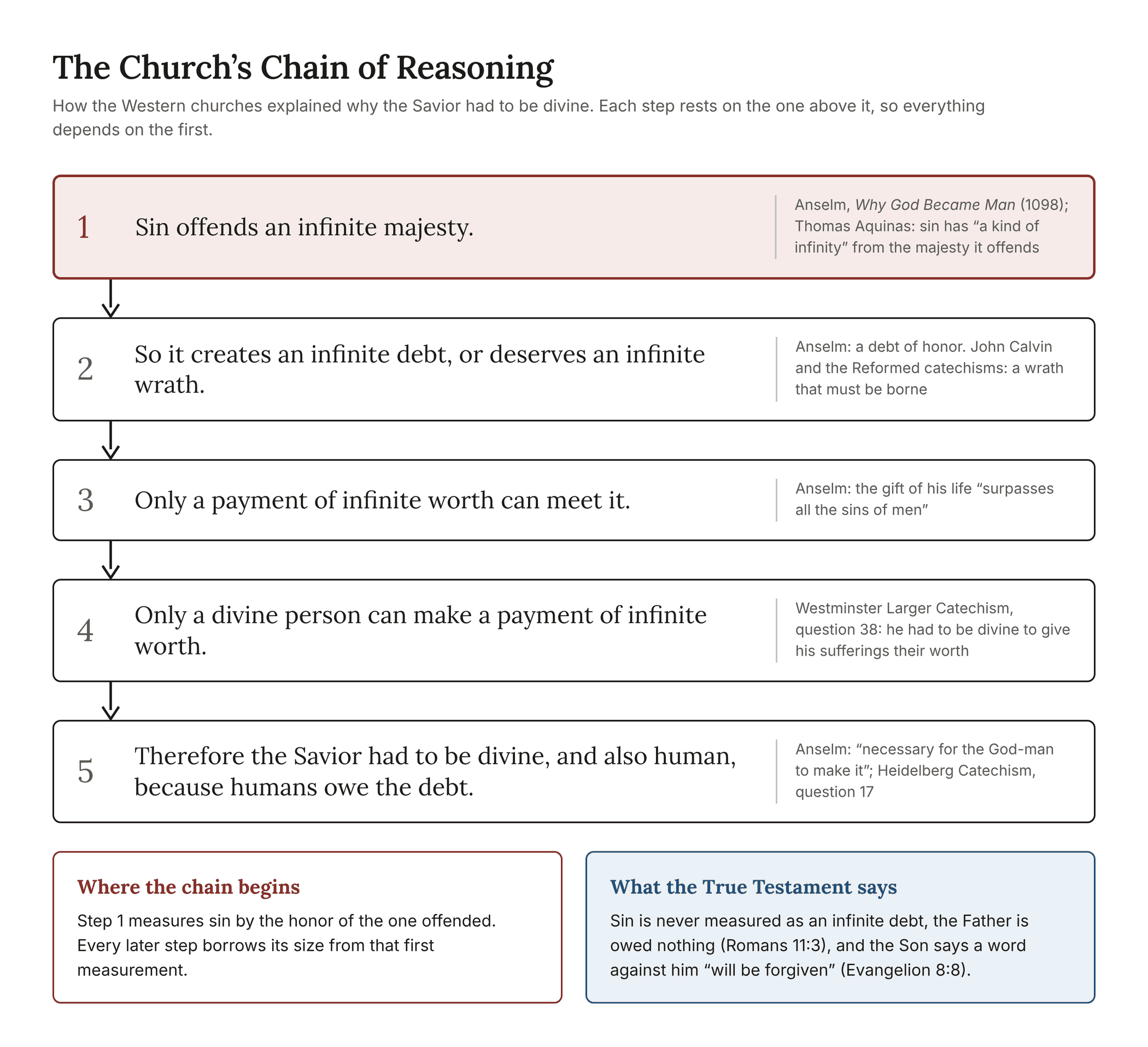
From that starting point Anselm drew the conclusion his title promised. Because the debt is owed by human beings, a human being must pay it, and because it is greater than all creation, only a divine person can pay it, so the payment must be made by one who is both, a satisfaction “which none but God can make and none but man ought to make,” so that “it is necessary for the God-man to make it” (book 2, chapter 6). For nine hundred years, this has been the West’s most influential answer to the question of why the Savior had to be divine.
The True Testament, the Bible of the churches founded by Marcion, a Christian teacher in Rome in the second century, does not accept that answer. Our scripture is made up of one Gospel, called the Evangelion, and ten letters of Paul, called the Apostolikon, and nowhere in it is sin measured as an infinite debt, the Father presented as a creditor, or the Savior’s worth calculated from the size of a bill. The church’s argument deserves to be heard in its own words first.
Why God Became Man
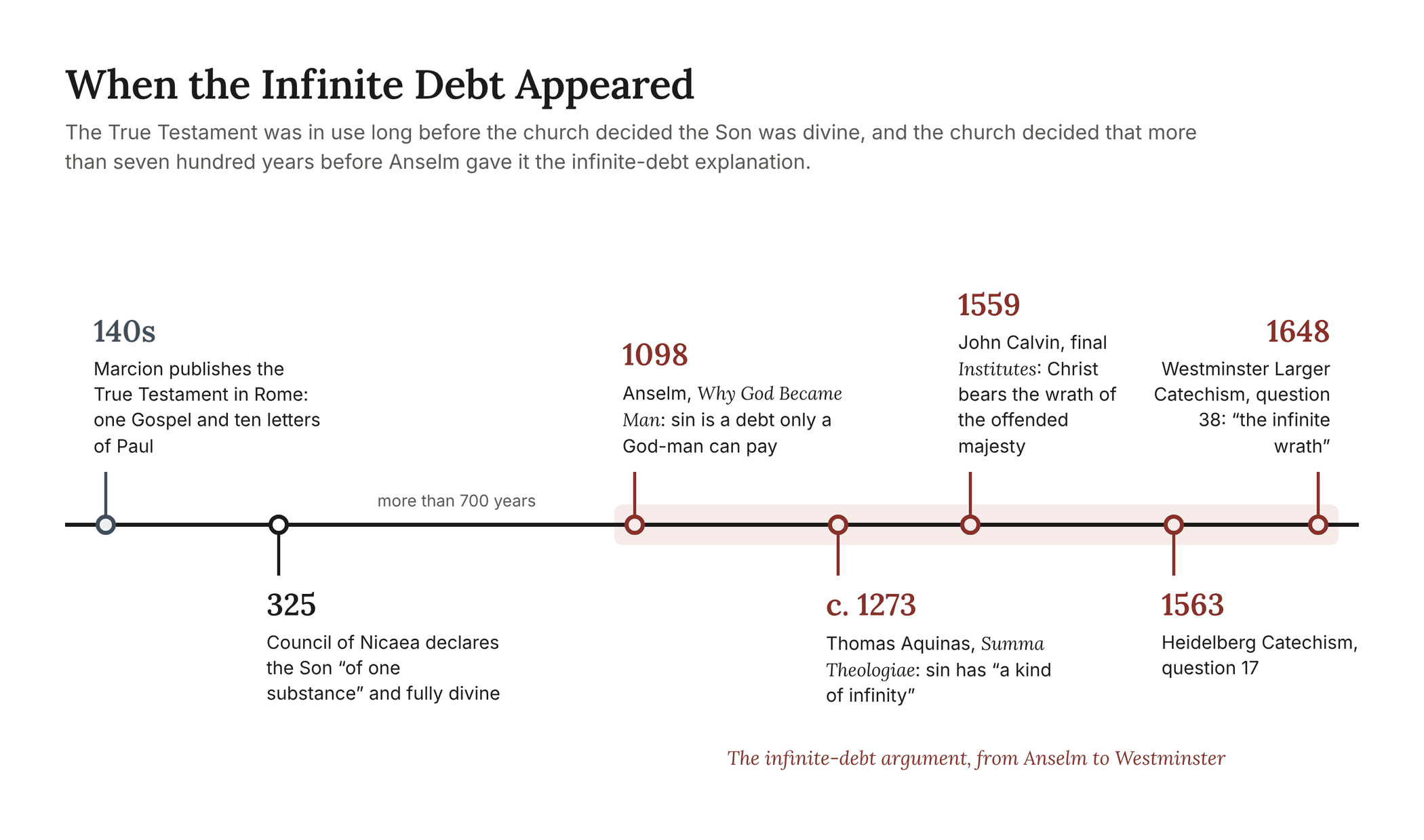
The church had already decided, long before Anselm wrote, that the Son was divine. At the Council of Nicaea in 325, the bishops of the Roman empire declared that the Son is “of one substance” with the one the church calls the Father, and is divine in the same full sense. That decision came more than seven hundred years before Anselm, and it was argued on other grounds. What Anselm supplied was a reason for it that fit the way people in his world thought about honor and debt, and that reason became the standard explanation in the Western churches of why the Savior had to be divine.
Anselm lived in a world of lords and vassals, the tenants and fighting men who held their land in return for loyalty, where an insult to a great lord could not be wiped away by an apology from a peasant. The greater the lord, the greater the offense, and the greater the satisfaction required to put things right. Anselm applied that reasoning to his God. Sin, for him, is a refusal to give that God the honor owed to him, and since his honor is the highest honor there is, the dishonor done by sin is beyond measure. He cannot simply let it go, Anselm argues, because to forgive without satisfaction would leave his honor unrestored and the order of the universe disturbed.
The argument then closes on itself like a trap, because humanity owes the debt but cannot pay it, since a creature already owes its maker everything and has nothing extra to give, while the divine person who could pay it does not owe it. The only way out is a person who is both divine and human, whose death, being the death of a divine person, is worth more than all the sins of the world. As Anselm puts it in the fourteenth chapter of his second book, the gift of his life surpasses all the sins of men. In this account the Savior must be divine because the size of the debt requires a payment of infinite worth.
From Honor to Infinite Wrath
The theologians who came after Anselm kept his measure of sin, even where they softened his conclusion. Thomas Aquinas, the leading Roman Catholic theologian of the 1200s, held that his God could have forgiven without any satisfaction at all, but he kept Anselm’s way of weighing sin and gave it the form most often repeated: “a sin committed against God has a kind of infinity from the infinity of the Divine majesty” (Summa Theologiae, Third Part, question 1, article 2, reply to the second objection). The greater the one offended, the graver the offense, and so only an act of infinite worth, done by one who is both divine and human, could make a satisfaction equal to it.
The Protestant Reformers of the 1500s, the leaders who broke with the Roman church, turned the debt of honor into a debt of punishment. For John Calvin, the French Reformer whose teaching shaped what are called the Reformed churches, the problem is that his God “does not allow his Law to be violated with impunity without being armed for vengeance,” so that until sinners are released from guilt “the wrath and curse of God always hang over them” (Institutes of the Christian Religion, book 2, chapter 16, section 1). Christ’s death was the satisfaction made to that judgment (book 2, chapter 17, section 4). The catechisms of the Reformed churches, the question-and-answer books used to teach their members, taught the conclusion to ordinary believers. The Heidelberg Catechism of 1563 asks why the Savior must also be “true God,” and answers that by the power of his divinity he might bear in his humanity the burden of his God’s wrath (question 17). The Westminster Larger Catechism, approved in 1648, says the Mediator, its name for the one who stands between the offended deity and the offenders, had to be divine to keep his human nature from sinking under “the infinite wrath of God” and to give his sufferings their worth (question 38).
The same measure was then turned toward hell. If sin is weighed by the majesty it offends, a finite life of sin can deserve an endless punishment, and Calvin says so without flinching. When objectors complain that the sins of the condemned were temporary, he grants it and answers that the majesty they violated is eternal, and he calls it “a blasphemy not to be borne, when the majesty of God is valued so cheaply, when contempt of it is counted of no more weight than the ruin of a single soul” (book 3, chapter 25, section 5). Our book Against Calvin grants him that this is coherent, because if majesty is the first thing about Calvin’s God, then every slight against it is infinite, and the punishment need not fit the deed. Our article Neither Fire nor Darkness sets out why the True Testament does not teach an eternal hell.
The church’s chain of reasoning therefore runs from one premise to the next: sin offends an infinite majesty, the offense creates an infinite debt or deserves an infinite wrath, only a payment of infinite worth can meet it, and only a divine person can make such a payment, so the Savior had to be divine. Every link in that chain depends on the first.
One Being on Every Side of the Church’s Transaction
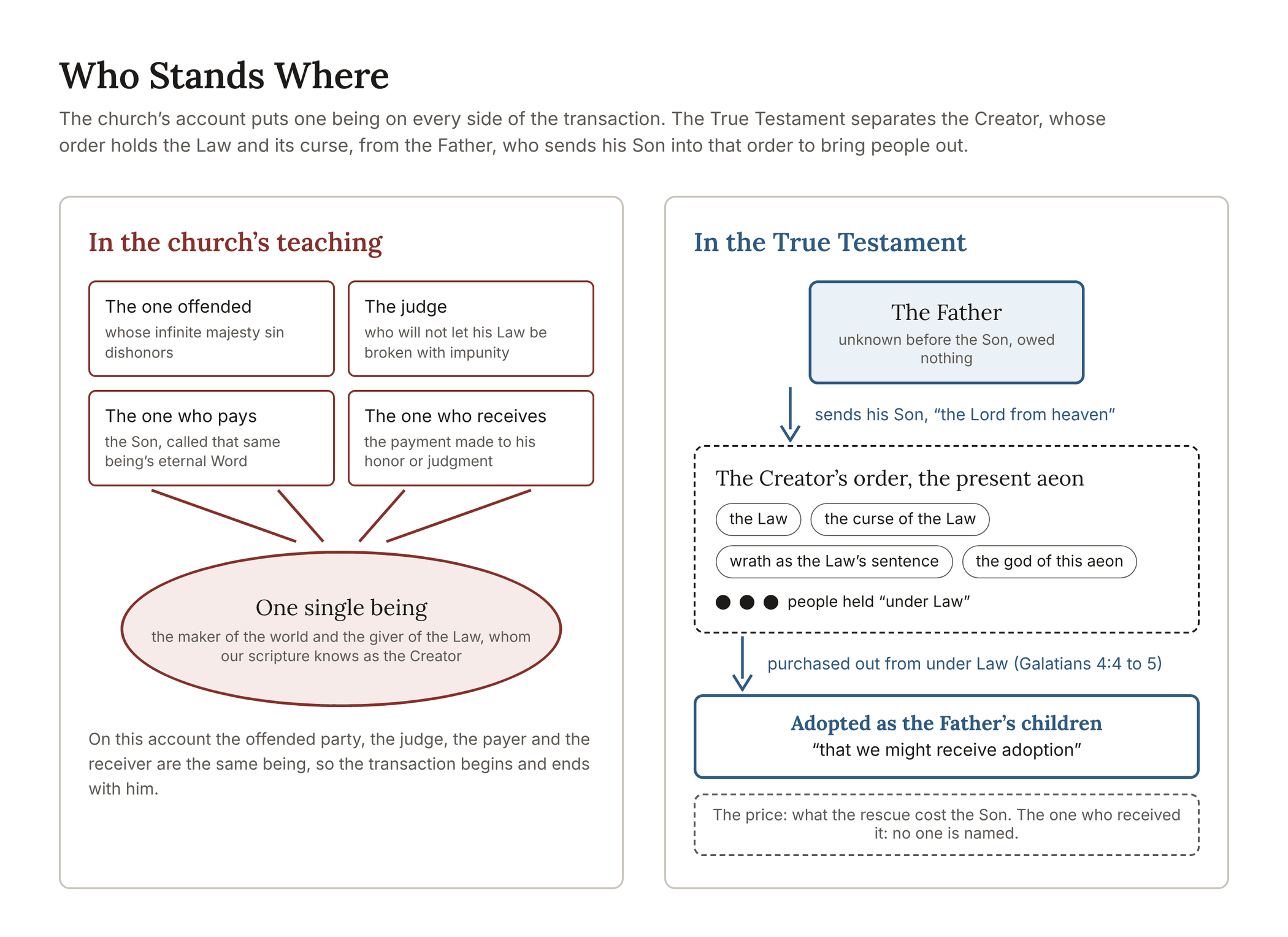
The same being stands at every point in that chain. In the church’s teaching, the one whose majesty is offended is the maker of the world and the giver of the Law, and the judge who will not let his Law be broken with impunity is the same being. The one who pays is the Son, whom the church identifies as that same being’s eternal Word, the one through whom the world was made, and the one who receives the payment is, once again, that same being. On the church’s account, then, the offended party, the judge, the payer and the receiver are a single being, and our scripture knows that being as the Creator.
Our scripture separates what the church joined together. The Creator is the god who made this world and gave Israel its Law, and Paul calls him “the god of this aeon,” the god of the present age, who “has blinded the minds of the untrusting” (2 Corinthians 4:1). The Father is a different being, the God whom Jesus revealed and who was unknown to everyone before him. In Laodiceans, the letter the church calls Ephesians, Paul says the Father’s plan was a mystery “hidden from the aeons from the God who created all things” (Laodiceans 3:6), so that even the maker of the world did not know it. The Law and its curse belong to the Creator’s order, and our Systematic Theology teaches that wrath, as the Law’s sentence, belongs to that order and not to the Father.
Once the two are told apart, the church’s transaction has no one on the other side of it. The Father did not make the Law whose breach created the debt, he did not pronounce its curse, and he is not the judge armed for vengeance, so there is no majesty of his that needs restoring at the cost of his Son, because the offense the church measured was never committed against him in the first place. People broke the Creator’s Law, inside the Creator’s order, and the Father, a stranger to that order, sent his Son into it to take people out of it.
A Father Who Is Owed Nothing
The heart of Anselm’s case is that his God cannot simply forgive, because forgiveness without payment would leave something owed. Our scripture describes a Father to whom nothing is owed. Paul’s letter to the Romans asks, “Or who has first given to him that it should be repaid to him again?” (Romans 11:3), and the answer the question expects is that no one has, since the Father did not lend humanity its existence and then call in the loan. Our book Against Calvin draws the conclusion that the Father of the Evangelion was owed nothing, because we were never his debtors.
The Lord’s own teaching describes the Father in the opposite terms from Anselm’s lord. In the Sermon on the Plain, the collection of his teaching that our Evangelion gives in its third chapter, he asks, “If you lend only to those you expect to be paid back from, what kind of generosity is that?” (Evangelion 3:34). The word he uses for generosity is the same word Paul uses for grace, and a loan that expects repayment, he says, is not grace at all. Then he gives the Father as the pattern for his hearers, who will be “children of God. For he is kind even to the ungrateful and the wicked” (Evangelion 3:35). A Father who is kind to the ungrateful is not keeping an account of what the ungrateful owe him.
His children are told to act the same way: “Don’t judge, so that you won’t be judged. Don’t condemn, so that you won’t be condemned. Forgive, and you will be forgiven” (Evangelion 3:37). The Greek verb behind “forgive” means to release or let go, the word used for setting a prisoner free or dismissing a debt, and the command comes with no demand that anything first be paid. The prayer the Lord gives his disciples asks the Father for forgiveness outright (Evangelion 7:4, a petition that reaches us in its sense rather than its exact words), and it asks for release with no payment mentioned. If Anselm were right, that prayer would be asking for the one thing his God cannot do without first being paid, yet the Lord teaches his disciples to ask it of the Father as children ask a father, because the Father is not waiting on a payment before he will forgive.
The Son Does Not Count the Offense as Infinite
There is one place in the Evangelion where the Lord speaks of an offense against his own person, and it measures that offense very differently from Anselm and Calvin: “Anyone who speaks a word against the Son of Man will be forgiven. But whoever speaks against the Spirit will not be forgiven” (Evangelion 8:8). We do not hide the second sentence, since our Gospel does speak of a sin that is not forgiven, but the first sentence is the one that answers the church’s argument. The Son of Man is the title Jesus uses for himself, and he says that an insult to him will be forgiven, without reckoning the slight to his own honor as infinite and without saying that it must first be paid for.
The Lord’s parables also weigh the single soul the opposite way from Calvin’s balance, in which the ruin of one soul weighs less than the honor of Calvin’s God. In the Evangelion, the shepherd asks, “Wouldn’t you leave the ninety-nine out in the wilderness and go looking for the lost one until you find it?” (Evangelion 10:1), the woman sweeps her house for one lost coin, and “there is joy in God’s presence over one wrongdoer who has a change of heart” (Evangelion 10:5). These parables come to us in their sense rather than their exact original words, but their point is not in doubt, which is that heaven counts the one. The Son put it in a single sentence about his own coming: “the Son of Man came to rescue what was lost” (Evangelion 12:19). He came to rescue the lost, and nothing in the sentence speaks of restoring an injured majesty.
Purchased, With No Receiver Named
The church did not invent the language of price, and the True Testament does not pretend it is absent. Paul writes, “For you were purchased with a price” (1 Corinthians 6:20), a verse whose sense is attested and which Tertullian, Marcion’s fiercest opponent, quotes as “we were bought at a great price.” Paul also writes, “Christ purchased us from the curse of Law by becoming a curse for us, for it is written: ‘Cursed is everyone who hangs on a tree.’” (Galatians 3:9). The church read these verses and asked the natural question of who was paid. Origen, the great teacher of Alexandria in the 200s, answered that the ransom was paid to the devil, who held us, while Anselm answered that satisfaction was made to the honor of his God and Calvin that it was made to that God’s judgment. Each followed the picture of a purchase to the end it seemed to require, since a price usually goes to whoever holds the captive.
Our Systematic Theology, in its chapter “The Purchase,” reads the same verses more strictly. Paul names what we were bought out of, which is “the curse of Law” and the condition of being “under Law” (Galatians 4:5), and he names what we were bought into, “that we might receive adoption” (Galatians 4:5), as children of the Father. He names the price in the same sentence, Christ “becoming a curse for us,” so that the price is what the rescue cost the Son, but he never names anyone who received it, neither the Father nor the Creator. Gregory of Nazianzus, a bishop of Constantinople in the 300s, rejected a payment to the devil and denied that the Father had demanded one, though he allowed that the Father accepted it. Our theology goes one step further and names no receiver at all, because the text names none.
Anselm’s proof that the Savior had to be divine rests on the value of the payment, since an infinite debt needs a payment of infinite worth. Our scripture names no one who received a payment and never measures the price against a creditor’s claim, so Anselm’s calculation cannot be drawn from it. The purchase in Paul is a change of ownership, the act of buying people out from under the Law so that they belong to another. Paul says that “God sent forth his Son, so that he might purchase those under Law, that we might receive adoption” (Galatians 4:4 to 5), so the rescue began with the Father’s sending and not with a demand for payment.
Neither the Church’s God-Man nor a Mere Man
The church needed its Savior to be divine because its account of salvation required a payment that only a divine person could make. Our scripture never makes that argument, and our Systematic Theology does not call the Son God. It does not treat him as an ordinary human being either. It describes him in the words our scripture itself uses, and those words point away from both the church’s creeds and the view that Jesus was only a man.
He is the Son, sent by the Father: “But when the time was fulfilled, God sent forth his Son” (Galatians 4:4). Our Evangelion gives him no birth story and no family line, and opens instead with a Roman date, “It was the fifteenth year of Tiberius Caesar’s reign, in the days of Pilate,” followed by his arrival: “That’s when Jesus descended into Capernaum, a town in Galilee” (Evangelion 1:1 to 2). He is “the Lord from heaven,” set against Adam, who “is from the earth, of dust” (1 Corinthians 15:39). He is “the image of the invisible God” (Colossians 1:15), and “the Lord of glory,” whom the rulers of this aeon staked, that is, put to death on a stake, because they did not understand the hidden wisdom of the Father (1 Corinthians 2:8).
Paul’s letter to the Philippians describes his coming in its own terms. He was one “who, existing in the form of God, did not consider equality with God something to seize, but emptied himself, taking the form of a slave, in the likeness of a human being. And being found in appearance a man, he humbled himself, becoming obedient unto death: death on the stake” (Philippians 2:2 to 4). That passage neither makes the Son the deity of the church’s creeds nor makes him only a man. It says that he existed in the form of God and did not grasp at equality with God, and that he came into our condition in the likeness of a human being, with a real body that suffered and died.
What sets the Son apart, in our scripture, is that he alone knows the Father and makes him known, and not any infinite value his death adds to a payment: “Everything has been entrusted to me by the Father. No one knows the Father except the Son, and no one knows the Son except the Father, and anyone to whom the Son reveals him” (Evangelion 6:30). The church asked why the Savior had to be divine and answered with the size of the debt, while our scripture asks how a Father whom no one had known could be known at all, and answers with the Son, sent from that Father, who came down into the Creator’s world to make him known and to bring people out of the order that held them.
What This Means for You
If you were raised in a church that taught Anselm’s argument, or the catechism answers that grew out of it, you may have learned to think of your life as a debt so large that only a divine Savior could pay it. You may have been taught that every small wrong you did was an offense against an infinite majesty, that you deserved an infinite punishment for it, and that you could be looked on kindly only because someone else had absorbed that wrath in your place. Many people carry that picture for decades, and it often leaves them grateful and afraid at the same time.
The True Testament does not ask you to carry it. The wrongs you have done are real, and they belong to you, but they were done inside the Creator’s order, under the Creator’s Law, and that Law’s curse is what the Son entered to purchase you out of. The Father, who never lent you your existence and called in the loan, was never your creditor, he did not demand a payment before he would forgive, and he does not weigh your soul as light against his honor. He is “kind even to the ungrateful and the wicked,” and he sent his Son to rescue what was lost.
That changes the gratitude itself, because you are thanking a Father who sent his Son to look for you when you did not know him, rather than a judge who accepted a payment on your account, and you are thanking a Son who bore the cost of that rescue himself to bring you out of a house that was never the Father’s and into the Father’s family as a child.
Sources
True Testament: 2 Corinthians 4:1; Laodiceans 3:6; Romans 11:3; Evangelion 1:1 to 2, 3:34, 3:35, 3:37, 6:30, 7:4, 8:8, 10:1, 10:5, 12:19; 1 Corinthians 2:8, 6:20, 15:39; Galatians 3:9, 4:4, 4:5; Colossians 1:15; Philippians 2:2 to 4. All are quoted from the True Testament and cited by its own chapter and verse numbers.
Anselm and the medieval church:
- Council of Nicaea (325), Creed
- Anselm of Canterbury, Why God Became Man (Cur Deus Homo), book 1, chapter 21, and book 2, chapters 6 and 14, translated by Sidney Norton Deane
- Thomas Aquinas, Summa Theologiae, Third Part, question 1, article 2, reply to the second objection; question 46, article 2
The Reformation:
- John Calvin, Institutes of the Christian Religion, book 2, chapter 16, section 1; book 2, chapter 17, section 4; book 3, chapter 25, section 5, quoted in the translation given in our book Against Calvin
- The Heidelberg Catechism (1563), question 17
- The Westminster Larger Catechism (1648), question 38
Other writers: Origen, Commentary on Matthew 16.8; Gregory of Nazianzus, Oration 45.22; Tertullian, Against Marcion 5.7.4.
Our books:
- Systematic Theology: True Testament Marcionism, the chapters “The Purchase,” “Wrath Without Appeasement,” “Sent, Not Born,” “The Revealer of the Father,” “Mercy Before Merit” and “Only One Is Good”
- Against Calvin, the chapters “The Mediator Who Paid the Creator” and “The Resurrection”
Related articles: Neither Fire nor Darkness; Born Captive, Not Guilty; The Rescue of All Things.