
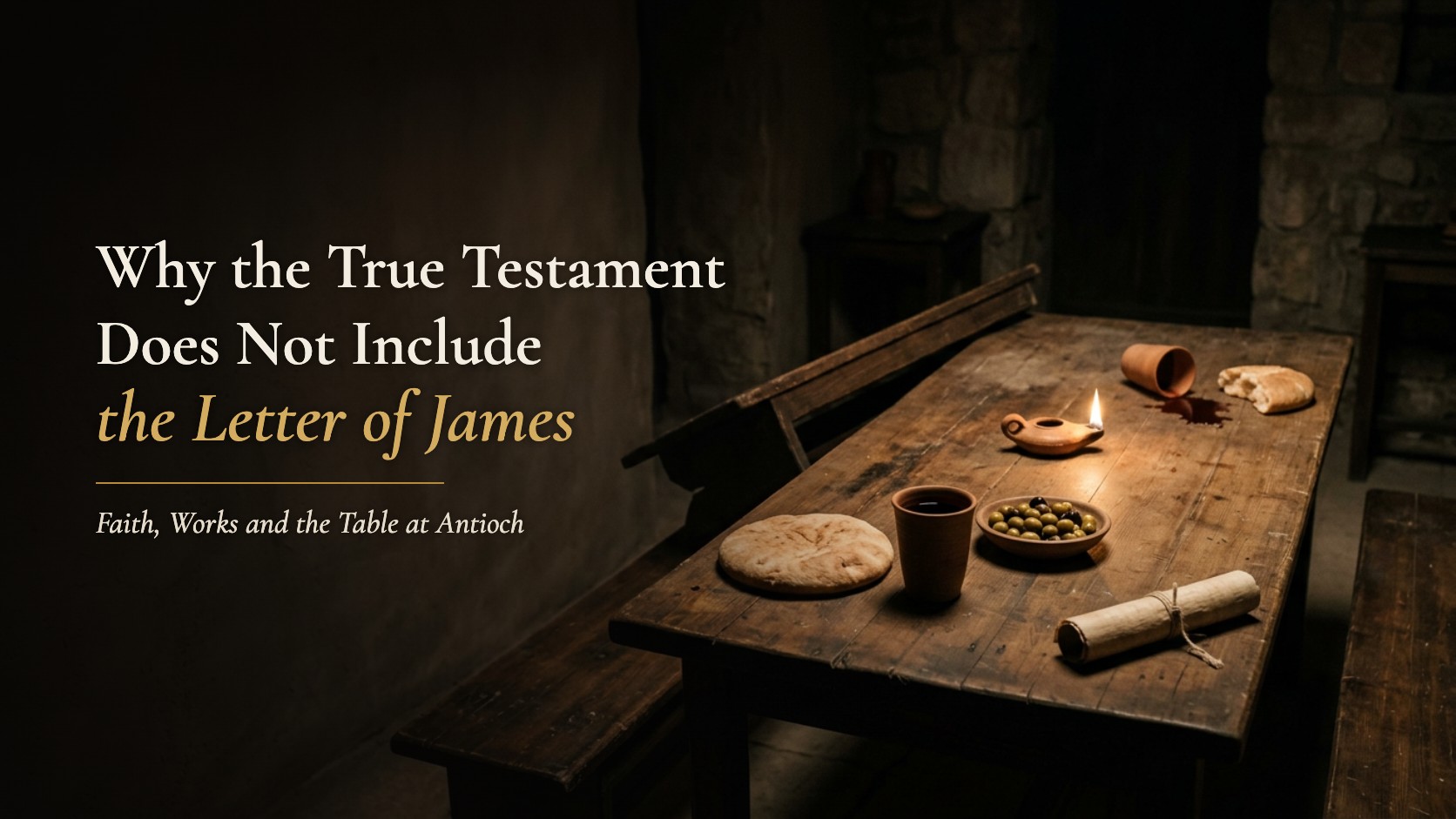
A Table in Antioch
The meal is in Antioch, the great city of Syria, where Jews who believed in Christ and believers from the nations, the non-Jewish peoples, shared one assembly. Peter, the best known of Jesus’s first disciples, has come to the city, and he sits and eats with believers who were never Jews. No one at the table asks who bears circumcision, the mark in the flesh of belonging to Israel under the Law of Moses, the commandments given to Israel through the leader who brought it out of Egypt. Paul, the apostle who carried the gospel to the nations, is there, and so is his companion Barnabas.
Then visitors arrive, and everything at the table changes. Paul tells the story in his letter to the assemblies of Galatia, a region in what is now central Turkey, and he is careful to say where the visitors came from:
“For before certain men came from James, he used to eat with the nations; but when they came, he withdrew and separated himself, fearing those of the circumcision.” (Galatians 2:10)
The verse numbers here and throughout are those of the True Testament, which has its own numbering; in the church’s Bible this verse is Galatians 2:12. James was a leader of the assembly in Jerusalem, the first assembly of Jewish believers.
Peter rises from his place, and the other Jewish believers follow him, “so that even Barnabas was carried away by their hypocrisy” (Galatians 2:11). Paul confronts Peter before the whole assembly, and the sentence that follows in his letter is the one on which his gospel stands:
“We know that a person is not justified by works of Law but through faith in Christ Jesus; and we have believed in Christ Jesus so that we may be justified by faith in Christ and not by works of Law, because by works of Law no flesh will be justified.” (Galatians 2:13)
Paul does not say that James sent those men to break up the meal; he records only whose name they carried and what happened when they walked in. The church’s Bible, the one most Christians carry, has near its back a short letter that begins, “James, a servant of God and of the Lord Jesus Christ, to the twelve tribes which are scattered abroad, greeting” (James 1:1). The words are those of the King James Version, the classic English Bible of 1611, from which this letter is quoted throughout. The letter’s second chapter holds a sentence that sounds as though someone had stood at that table and was still answering Paul years afterward.
The True Testament is the Marcionite Bible: one Gospel, called the Evangelion, and ten letters of Paul, called the Apostolikon. It is the scripture that Marcion, a shipowner from Sinope on the Black Sea, published in Rome in the 140s, the earliest fixed collection of Christian scripture that history records. The Letter of James has no place in it, but not because Marcion tore the letter out, for no one in his century can be shown to have held it as scripture. It has no place there because what it teaches about faith and works is what Paul’s sentence at Antioch denies, and because the lawgiver it sets over the believer is not the Father Paul preached.
The Sentence That Answers Paul
Paul’s letter to the Romans, the believers in the capital of the empire, makes the claim he made at Antioch:
“For we maintain that a person is justified by faith apart from works of Law.” (Romans 3:9)
To be “justified” is to be counted righteous, to be set right. This standing, Paul insists, is never earned by keeping commandments. It comes “freely by his grace through the redemption that is in Christ Jesus” (Romans 3:7).
The second chapter of James takes the same three words, faith, works and justified, and sets them in the opposite order:
“Ye see then how that by works a man is justified, and not by faith only.” (James 2:24)
Where Paul says justified by faith apart from works, James says justified by works and not by faith only. Nowhere else does the King James New Testament set “faith” and “only” side by side, and the one time it does, the sentence denies it. A few lines earlier James has already asked, of the man who has faith and no works, “can faith save him?” (James 2:14).
The usual defense is that the two men never meet. Paul, it is said, speaks of “works of Law,” the commandments of Moses such as circumcision and the food rules, while James speaks of ordinary good deeds such as feeding the poor. James himself closes that road. In the verses that lead into the passage he calls the command to love your neighbor “the royal law” (James 2:8) and warns that “whosoever shall keep the whole law, and yet offend in one point, he is guilty of all” (James 2:10). He does not separate good deeds from the Law, because the deeds he asks for are the Law’s own commands, kept and fulfilled.
A second defense holds that James attacks only a counterfeit, a faith of the lips, but James does not treat the faith he describes as false. “Thou believest that there is one God; thou doest well: the devils also believe, and tremble” (James 2:19). That is the daily confession of Israel, drawn from Deuteronomy, the fifth book of Moses. James approves that faith, “thou doest well,” and his remedy is not a deeper trust but works added to it, as a faith that consists in assent to a creed will always need something added. Paul preached a different faith, and it has a person at its center: “I have been staked with Christ; yet it is no longer I who live, but Christ lives in me. And the life I now live in the flesh I live by faith in the Son of God, who redeemed me and gave himself for me” (Galatians 2:17). The stake is the instrument on which Christ was put to death, and through his whole argument about faith and works, James never mentions what Christ did. His faith is a creed about the one who made the world, while Paul’s is trust in the one who came to take us out of it.
Abraham Pulled Both Ways
The collision is loudest over one man, Abraham, the ancestor of Israel, whose story is told in Genesis, the first book of the Hebrew scriptures. James calls him as his chief witness:
“Was not Abraham our father justified by works, when he had offered Isaac his son upon the altar?” (James 2:21)
He means the story in which Abraham is commanded to sacrifice his son Isaac and has raised the knife before he is stopped. For James, that act of obedience is what made Abraham righteous. He quotes an earlier verse of Genesis, “Abraham believed God, and it was imputed unto him for righteousness,” says that the offering “fulfilled” it, and adds that Abraham “was called the Friend of God” (James 2:23).
Paul had already spoken about the same man. In the True Testament the fourth chapter of Romans is a single sentence; the church’s Romans runs that chapter to twenty-five verses, and the True Testament does not include the rest, as later additions. This is the sentence that remains:
“For if Abraham was justified by works, he has glory, but not before God.” (Romans 4:1)
Compare the two in Greek, the language in which both were written, and the wording is the same. “Abraham,” “by works,” “was justified”: the words Paul uses are the words James uses, in the same forms. Paul sets them inside an “if” and then shuts the door, while James turns them into a question that expects the answer yes. Of all that the church’s Romans says about Abraham, the one sentence the True Testament has is the sentence James contradicts.
Two details of Paul’s sentence carry great weight, and the first is a missing word. At Antioch and in the third chapter of Romans he wrote “works of Law,” but here he writes only “works,” because Abraham lived centuries before Moses and had no Law to keep, only a command and his obedience to it. The claim that Paul objects to nothing beyond the ceremonies of Moses therefore fails at the example James himself chose.
The second detail is the phrase “not before God.” Paul grants that works may win a man glory somewhere, but he denies that they win it before God. In the True Testament, God is the Father whom Jesus Christ revealed, and he is not the Creator who made this world and gave the Law. In Genesis the voice that orders the sacrifice of Isaac and the voice that rewards it are one voice, the Creator’s, so whatever Abraham’s obedience earned, it earned in that court. James can call him the friend of the one he obeyed, and Paul leaves that friendship where it stands while saying that it counts for nothing before the Father.
The most careful defenders of the church’s Bible answer that the two writers have different moments in view. Paul, they say, thinks of the fifteenth chapter of Genesis, where Abraham believes and is counted righteous, while James thinks of the twenty-second, years later, where the offering of Isaac proves that the faith was real. James does speak of showing faith by works (James 2:18), but of Abraham he says more: faith “wrought with his works, and by works was faith made perfect” (James 2:22). Then he draws a rule for everyone: “by works a man is justified.” The harmony needs James to have meant “shown to be righteous,” and what James wrote was “justified.”
That harmony has a deeper weakness, and only the True Testament exposes it. The church’s Romans and the church’s Galatians both build long arguments on the Genesis verse, “Abraham believed God, and it was counted unto him for righteousness” (Romans 4:3, King James Version; compare Galatians 3:6), and neither passage belongs to the True Testament. In its Romans and Galatians, Paul never holds Abraham up as the pattern of faith, so the quarrel over which chapter of Genesis made Abraham righteous is fought on ground where the True Testament never stood. James says “Abraham our father,” and the Paul of the True Testament makes no such claim on him.
Our book Against Calvin answers John Calvin, the French theologian of the Protestant Reformation. Its chapter Justified Before Which Judge? shows how hard Calvin had to work to make James and the church’s Paul agree about Abraham.
A Letter to the Twelve Tribes
The letter’s first line addresses “the twelve tribes which are scattered abroad,” the tribes of Israel, the Jewish people living outside their homeland. Some read the phrase as a figure for all believers, but the letter resists that reading. The meeting its readers attend is called, in Greek, a synagogue, a word the King James Version softens to “assembly” (James 2:2). The nations are never mentioned, and neither is circumcision, the question that split the table at Antioch.
That is the line Paul says was drawn when he went up to Jerusalem and met the leaders there:
“Recognizing the grace that had been given to me, Peter and James and John, who were regarded as pillars, gave to me the right hand of fellowship, that I should go to the nations and they to the circumcised.” (Galatians 2:7)
The handshake was real, and James did not refuse Paul, though of the meeting itself Paul says, “Those of reputation contributed nothing to me” (Galatians 2:6). The agreement divided the fields without merging the messages, and the letter that carries James’s name is written from his side of that line to his side of that line. If you came to the Father from outside Israel, the letter is addressed to someone else.
The two Bibles differ as well on who this James is. In the church’s Galatians, Paul says that on an early visit to Jerusalem he saw “James the Lord’s brother” (Galatians 1:19, King James Version), and in the Acts of the Apostles, the church’s account of the years after Jesus, a James presides over a council in Jerusalem. The church has long treated the author of the letter as that man. The True Testament does not include that passage of Galatians, as a later addition, and it does not include Acts. In its Evangelion the men named James are James the son of Zebedee, James the son of Alphaeus, and the father of the disciple called “Judas the son of James,” and none of them is called a brother of Jesus. The letter itself claims no family tie: its author is “a servant of God and of the Lord Jesus Christ,” and there he stops.
The One Lawgiver
Beneath the dispute about works lies a deeper dispute about who stands behind the Law.
James loves the Law and calls it “the perfect law of liberty” (James 1:25). In his fourth chapter, warning his readers not to speak against one another, he names the one to whom each of them must answer:
“There is one lawgiver, who is able to save and to destroy: who art thou that judgest another?” (James 4:12)
His purpose is to stop believers from judging each other, but his reason is a statement about the one before whom every believer stands. It is the only time the church’s New Testament uses the word “lawgiver,” and James gives it to the one who holds your fate. Elsewhere he calls him “the Father of lights” (James 1:17), the maker of the sun and the stars.
In our faith, the giver of the Law is the Creator, who delivered it through Moses and whom Paul calls “the god of this aeon,” the god of this present age, who “has blinded the minds of the untrusting” (2 Corinthians 4:1). James uses the word Father, but the one he gives it to is the maker of the lights, the giver of the Law and the judge. Paul’s Father enters from outside the Law altogether: “But when the time was fulfilled, God sent forth his Son,” “so that he might purchase those under Law, that we might receive adoption” (Galatians 4:4 and 4:5). A lawgiver has subjects, but a Father who adopts has children, and he found them under someone else’s Law.
Here the letter and Paul part at the root, because they are not describing one God from two different sides. The lawgiver James sets over every believer, the one able to save and to destroy, is the Creator, who gave the Law and judges by it. The Father Paul preached is not that lawgiver; he is the God the Law never revealed, who sent his Son into the Creator’s world to purchase those held under its Law. The Letter of James speaks for the Creator, and Paul speaks for the Father.
That is why the two speak of the Law in opposite tones. James calls it liberty, while Paul calls it a yoke: “Stand firm, then, in the freedom with which Christ freed us, and do not again submit to the yoke of slavery” (Galatians 5:1). His verdict on anyone who looks to the Law for a right standing is severe: “You who seek to be justified in Law have been severed from Christ; you have fallen from grace” (Galatians 5:4). James offers you a law of liberty, and Paul offers you liberty from the Law.
The Letter Nobody Quoted
For more than a century and a half after Paul wrote, no Christian writer we know of quotes the Letter of James by name.
There may be echoes of it in a few earlier writers. The Shepherd of Hermas, a book of visions written in Rome in the second century, shares phrases with James, and scholars disagree about whether its author had read the letter. Irenaeus, bishop of Lyon in Gaul, which is now France, wrote a long work around 180 against teachers he judged false, and in it he says that Abraham “believed God, and it was imputed unto him for righteousness; and he was called the friend of God” (Against Heresies 4.16.2), the same pairing James makes. Some scholars see the letter’s influence there, while others reply that “friend of God” was a common title for Abraham, found already in the book of the prophet Isaiah in the Hebrew scriptures. Neither writer names the letter or cites it as scripture.
The first writer known to quote the letter by name is Origen of Alexandria, the great Egyptian teacher of the first half of the 200s. Even he, in his Commentary on the Gospel of John, once introduces it as the letter “current” under the name of James, a phrase that many scholars read as keeping its distance. Early in the 300s Eusebius of Caesarea, the first great historian of the church, wrote of it: “it is disputed; at least, not many of the ancients have mentioned it,” though he granted that it was read in very many churches (Church History 2.23.25). In his list of the church’s books he placed it “among the disputed writings, which are nevertheless recognized by many” (Church History 3.25.3). Near the end of that century Jerome, who translated the Bible into Latin and accepted the letter himself, still reported that some claimed it had been published by another under James’s name and had gained its authority “gradually, as time went on” (Lives of Illustrious Men 2).
Modern scholars remain divided over the letter’s date. Many place it in the first century, and some of those hold that it was written before Paul’s letters. David R. Nienhuis, a scholar of the New Testament, argues in his book Not by Paul Alone that it was written near the middle of the second century under James’s name, to head a collection of letters from the Jerusalem pillars that would balance the letters of Paul. John-Christian Eurell, another scholar of the New Testament, defends the letter against the charge that it opposes Paul and reads it as “an early reception of Paul.” On both of those readings the author wrote with Paul in front of him, and the shared Greek wording about Abraham points the same way.
The Weapon Tertullian Never Used
Marcion did not keep quiet about Antioch. Tertullian, a churchman of Carthage in North Africa who wrote five books against him around 207, complains that Marcion seized on Galatians, where Paul rebukes the apostles themselves for not walking uprightly toward the truth of the gospel, and used it to cast doubt on the gospels published under the names of apostles (Against Marcion 4.3). The table at Antioch was Marcion’s evidence, and Tertullian had to answer it.
The rebuke, Tertullian said, concerned Peter’s conduct and not his preaching: Peter, James and John gave Paul their right hands and divided the work between them, so they must have preached one gospel (Against Marcion 5.3). To prove it he had Paul’s own words and the Acts of the Apostles, a book Marcion did not accept, and he used both (Against Marcion 5.2 and 5.3). Some thirty of Tertullian’s works survive, and he argues from scripture in nearly all of them. Having already stepped outside Marcion’s Bible for Acts, he had every reason to reach for a letter in which James himself speaks about faith and the Law, yet he never names it, and scholars who have searched his writings for a clear quotation of it have found none.
Irenaeus had stood in the same position a generation earlier. Writing against Marcion among others, he set out to show that the Jerusalem apostles and Paul agreed, and he wanted the voice of James to prove it. For that voice he quoted the speech James gives at the council in the Acts of the Apostles (Against Heresies 3.12.14), and not a letter.
Marcion’s opponents also kept account of what he would not accept. Tertullian protests that Marcion received Paul’s short letter to Philemon yet refused the two letters to Timothy and the one to Titus, which the church’s Bible also assigns to Paul (Against Marcion 5.21). No one accuses him of refusing James, and you cannot reject a book that no one has handed you.
Silence proves little by itself, but what this silence shows is narrower and firmer: in the churches that fought Marcion, the Letter of James was not a scripture to appeal to, even when the argument was about James. When the church later gathered its own larger canon, its official list of sacred books, it set beside Paul a letter that turns his central sentence around. The True Testament keeps the older shape, the Evangelion and the Apostolikon as they were published before both sides of the argument were bound into one volume.
Why Luther Called It Straw
Binding the two sides into one book did not end the argument. In 1522 Martin Luther, the German monk whose protest began the Protestant Reformation, published his New Testament in German. In its preface he set James beside the Gospel of John and the letters of Paul and called it “really an epistle of straw, compared to these others.” In his preface to James itself he praised the letter for pressing the Law, and then judged it “flatly against” Paul “in ascribing justification to works.” His proof was Abraham, and he was reading the church’s Romans, with all twenty-five verses of its fourth chapter, so the clash does not depend on our shorter text. Luther moved James to the back of his New Testament, and although later editions dropped the line about straw, the Lutheran churches kept the letter.
John Calvin felt the same pressure and chose a different escape. Since the Spirit cannot contradict himself, he reasoned, James must use the word “justify” in another sense: James speaks of “the manifestation” of righteousness, and Paul of its “imputation,” its crediting to a person’s account (Institutes of the Christian Religion 3.17.11 and 3.17.12). Pulpits have repeated that answer ever since, though it requires one word to carry two meanings when two writers apply it to the same man.
The True Testament has no such harmony to perform, because it never bound the two arguments together.
What James Gets Right
The letter is not without truth, and its anger at the rich who cheat their workers is real, as is its picture of the believer who tells a cold and hungry brother “Depart in peace, be ye warmed and filled” and gives him nothing (James 2:16). Paul would have quarreled with none of that, for when the pillars in Jerusalem took his hand, “They only asked that we remember the poor, which was indeed what I was eager to do” (Galatians 2:8).
The faith Paul preached is not idle, and the two men agree that believers do good, but they part over what the good is for. In James, works complete faith and justify the one who does them; in Paul, love is what faith does once the believer has been set free. He asks the Galatians a question that settles the order: “This only I want to learn from you: Did you receive the Spirit by works of Law or by hearing through faith?” (Galatians 3:2).
What This Means for You
If you were raised in a church that read James one Sunday and Romans the next, you were probably told that the two agree and that any strain between them is a misunderstanding. The strain is real, and the church’s own teachers have felt it: Luther felt it sharply enough to call the letter straw, and Calvin felt it sharply enough to give one word two meanings.
Beneath the history lies a question you meet every day: when you fall short, before whom are you standing? James answers that you stand before a lawgiver, whose verdict waits on whether your works have made your faith complete. Paul answers that you stand before a Father, who sent his Son for you while you belonged to another and made you his child. Paul puts wages and gift in a single sentence: “For the wages of sin is death, but the free gift of God is life of the aeon in Christ Jesus our Lord” (Romans 6:20). An aeon is an age, and the life of the aeon is the life of the age the Father gives, which comes to you as a gift and never as a wage.
That is why the True Testament does not include the Letter of James. We share its care for the poor, but the letter sets you before the Creator’s Law and makes your standing depend on what you add to your faith, while Paul’s gospel is that the Father asks you to add nothing. “I do not set aside the grace of God, for if righteousness comes through Law, then Christ died for nothing” (Galatians 2:18). Serve your neighbor with everything you have, and do it as someone already set free, not as someone still waiting to learn whether it was enough.
Sources
The Letter of James, King James Version.
Romans 4:3, Galatians 1:19 and Galatians 3:6, King James Version.
The Shepherd of Hermas.
Irenaeus, Against Heresies 3.12.14 and 4.16.2.
Tertullian, Against Marcion 4.3, 5.2, 5.3 and 5.21.
Origen, Commentary on the Gospel of John, as discussed by George Salmon, A Historical Introduction to the Study of the Books of the New Testament.
Eusebius, Church History 2.23.25 and 3.25.3, translated by Arthur Cushman McGiffert.
Jerome, Lives of Illustrious Men 2, translated by Ernest Cushing Richardson.
Martin Luther, Preface to the New Testament (1522) and Preface to the Epistles of Saint James and Saint Jude, in Luther’s Works, volume 35.
John Calvin, Institutes of the Christian Religion 3.17.11 and 3.17.12, translated by Henry Beveridge.
David R. Nienhuis, Not by Paul Alone: The Formation of the Catholic Epistle Collection and the Christian Canon (Baylor University Press, 2007).
John-Christian Eurell, “The Epistle of James as a Reception of Paul: Rehabilitating an Epistle of Straw,” Scottish Journal of Theology, volume 73, issue 3 (2020).
W. C. Muenchow IV, Against Calvin, chapter “Justified Before Which Judge?”
Scripture is quoted from the True Testament, with its own chapter and verse numbers, except where another translation is named.