
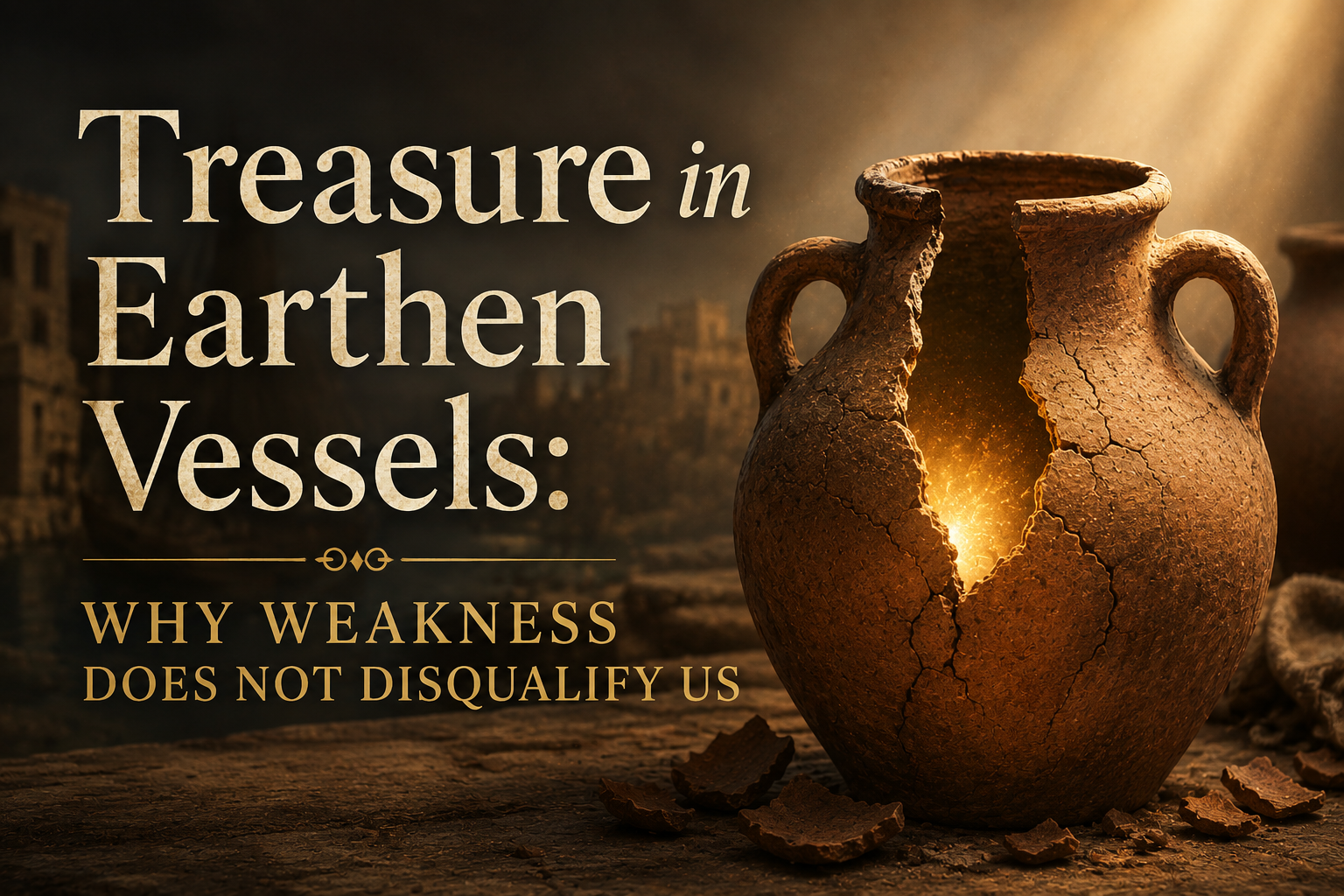
Ancient cities were full of pottery. Clay vessels carried water, oil, grain, wine, medicines, cosmetics, and household goods. They stood in kitchens, storerooms, workshops, markets, and ships. Some were carefully decorated, but many were ordinary objects made for ordinary work.
They were useful precisely because they were common. They could be shaped for almost any purpose, produced locally, carried easily, and replaced when broken. Yet their usefulness did not make them durable. A clay vessel could survive years of service and still be destroyed by one careless fall.
Archaeologists often reconstruct ancient life from the fragments of these vessels. Stone monuments tell us what rulers wanted remembered. Pottery tells us how people actually lived. The broken pieces preserve evidence of meals, trade, travel, labor, and domestic life. What appeared disposable to its first owner can become an enduring witness to an entire world.
Paul draws upon this familiar object when he describes the people entrusted with the Evangelion:
We have therefore this treasure in earthen vessels, that the surpassing power may be of God and not of us.
2 Corinthians 4:4 TT
The force of the image depends upon the contrast. The treasure is extraordinary. The container is not. The vessel does not become gold because it carries gold. It remains earthen.
That is the beginning of Paul’s theology of weakness.
The Treasure Is Not the Vessel
Paul does not leave the identity of the treasure entirely undefined. The preceding verses speak of the Evangelion, Christ, light, and recognition:
For we do not proclaim ourselves but Christ Jesus the Lord, and ourselves as your slaves through Jesus.
2 Corinthians 4:2 TT
For the God who said, Light shall shine out of darkness, has shone in our hearts to give the light of the recognition of his glory in the face of Christ.
2 Corinthians 4:3 TT
The treasure is not the apostle’s personality. It is not intelligence, charisma, education, physical strength, or institutional authority. Paul explicitly says, “We do not proclaim ourselves.” The proclamation concerns Christ; the apostle is its carrier.
This distinction protects both the Evangelion and its messenger. It protects the Evangelion because its truth does not depend upon the brilliance of the person proclaiming it. It protects the messenger because the vessel is not required to pretend that it is the treasure.
Much religious exhaustion begins when those two things are confused. A teacher believes the Evangelion will fail if every question cannot be answered immediately. A minister believes the Father’s work depends upon uninterrupted strength. An assembly begins to treat confidence, polish, growth, and public approval as evidence of spiritual power. Eventually the vessel must maintain the appearance of being made from something stronger than clay.
Paul refuses that performance. The apostle is not the light. The apostle carries testimony to the light. The apostle is not the power. The power is of God.
Weakness does not disqualify the vessel because the vessel was never the source.
Why Clay?
Paul does not merely say that treasure happens to be carried in earthen vessels. He provides a purpose:
We have therefore this treasure in earthen vessels, that the surpassing power may be of God and not of us.
2 Corinthians 4:4 TT
The word “that” matters. The difference between treasure and vessel makes the origin of the power visible. If the vessel appeared indestructible, observers could credit the vessel. Because the vessel is visibly fragile, endurance requires another explanation.
This is not a celebration of suffering for its own sake. Paul does not say weakness creates divine power. Clay does not manufacture treasure by cracking. Rather, weakness prevents us from confusing the carrier with the source.
The Father does not wait for the vessel to become invulnerable before entrusting it with anything valuable. He places the treasure in clay while it is still clay.
That is good news for anyone who has mistaken human limitation for spiritual failure. Fatigue does not prove that the Evangelion has departed. Illness does not erase adoption. Grief does not cancel calling. Uncertainty does not mean that the Father has withdrawn His light. The vessel may shake without the treasure becoming less true.
Pressed, but Not Finished
Paul develops the image through four carefully balanced statements:
We are afflicted in every way, but not crushed; perplexed, but not driven to despair;
2 Corinthians 4:5 TT
persecuted, but not forsaken; struck down, but not destroyed;
2 Corinthians 4:6 TT
Each statement acknowledges injury without granting it the final word.
Paul does not say that the rescued are never afflicted. He says affliction does not crush them. He does not say that revelation eliminates every question. He says perplexity does not have to become despair. He does not deny persecution or the experience of being struck down. He denies that either proves abandonment or completes destruction.
The repeated “but not” is the sound of the vessel surviving what should have ended it.
This survival should not be confused with the modern demand to appear resilient. Paul is not advising people to suppress pain, smile through exhaustion, or turn suffering into a display of personal strength. Such performance would contradict his argument. If the vessel must prove its own invincibility, the power once again appears to come from us.
Paul names what happened honestly: afflicted, perplexed, persecuted, struck down. The positive confession comes after the wound has been admitted. The vessel need not deny the impact in order to testify that it has not been abandoned.
There is an important difference between being perplexed and being untrusting. Perplexity admits, “I do not understand what is happening.” Despair concludes, “Nothing beyond what I see can be trusted.” Paul allows the first without surrendering to the second.
An earthen vessel is permitted to be confused.
The Body as the Place of Manifestation
Paul continues:
always carrying about in the body the dying of Christ, so that the life of Christ also may be manifested in our body.
2 Corinthians 4:7 TT
For we who live are always being delivered over to death, so that the life of Christ also may be manifested in our mortal flesh.
2 Corinthians 4:8 TT
The body is mortal, but Paul does not therefore treat it as irrelevant. It becomes the visible place where the life of Christ is manifested.
This distinction matters. Paul does not teach that flesh will gradually become incorruptible through effort. Mortal flesh remains mortal. The earthen vessel remains earthen. Yet while it remains, it can carry something that did not originate within it.
Paul’s image therefore avoids two opposite errors. The first error idolizes the vessel, treating health, beauty, productivity, or strength as evidence that the Father approves of a person. The second error despises the vessel, treating embodied life as worthless because it is temporary.
Paul does neither. He tells the truth about mortality without denying present purpose. The vessel will not last, but what it carries matters now.
The body that tires can still comfort another person. The voice that trembles can still speak truth. The hands that have lost their former strength can still refuse harm. The person who requires help can still manifest the life of Christ.
Dependence does not erase usefulness.
Decaying and Renewed
Paul states the tension directly:
Though our outer man is decaying, yet our inner man is being renewed day by day.
2 Corinthians 4:10 TT
The sentence does not hide decay. It begins with it.
The outer person is not becoming progressively stronger through rescue. Age continues. Bodies remain vulnerable to injury and disease. Memory can fail. Energy decreases. People who belong to the Father still experience the conditions of mortal life inside the present aeon.
Paul’s answer is not denial but renewal.
The inner person should not be understood as a divine fragment naturally concealed inside matter, waiting to be uncovered. Paul’s language is active: the inner person “is being renewed.” Renewal is received. It is not the discovery of an untouched spiritual possession that was always ours.
Nor is renewal postponed until every external problem has ended. It happens “day by day.” The phrase is deliberately modest. Paul does not promise a permanent emotional height or uninterrupted certainty. He describes repeated provision.
We often want enough strength today to guarantee that we will never feel weak again. Paul describes enough renewal for today.
The difference is pastoral as much as theological. A person who expects permanent self-sufficiency will interpret tomorrow’s weakness as failure. A person who expects daily renewal can receive tomorrow’s need without shame. Dependence is no longer proof that rescue did not work. Dependence is the ordinary posture of an earthen vessel carrying treasure it did not produce.
What Can and Cannot Be Seen
Paul then turns from decay to perception:
For we look not at the things that are seen, but at the things that are unseen; for the things that are seen are temporary, but the things that are unseen are aeonic.
2 Corinthians 4:11 TT
The contrast is not between reality and imagination. The seen things are real, but temporary. The unseen things are no less real because they are not available to ordinary sight.
This explains why visible weakness cannot serve as a reliable measure of the Father’s work. If we judge only by what can be seen, the cracked vessel appears to be the whole story. Paul asks the assembly to perceive according to another horizon.
The outer person decays. That is seen.
The inner person is renewed. That is not always visible.
Affliction is seen.
The power preventing affliction from becoming final destruction may not be.
The vessel is seen.
The treasure must be recognized.
Paul does not ask us to call temporary things permanent. He asks us not to call them ultimate.
Power Perfected in Weakness
Later in the letter, Paul returns to the same argument through his own suffering. He describes a thorn in his flesh and identifies its immediate tormenting agent as “a messenger of Adversary”:
Because of these surpassingly great revelations. Therefore, in order to keep me from becoming conceited, I was given a thorn in my flesh, a messenger of Adversary, to torment me.
2 Corinthians 12:3 TT
Paul implores the Lord three times for its removal. The answer does not pretend that the thorn is pleasant:
And He said to me, “My grace is sufficient for you, for my power is made perfect in weakness.” Therefore I will most gladly boast in my weakness, that the power of Christ may rest upon me.
2 Corinthians 12:5 TT
This passage has sometimes been used carelessly. People in pain are told to stop seeking relief because suffering is supposedly good for them. That conclusion does not follow from Paul. Paul himself asks three times for the thorn to depart. Seeking relief is not distrust.
Neither does Paul identify torment as the Father’s character. The tormenting messenger belongs to Adversary. The grace that sustains Paul belongs to Christ. The agents must not be confused.
The positive claim is not that weakness is good. It is that weakness cannot prevent grace from being sufficient.
“My power is made perfect in weakness” does not mean that weakness generates Christ’s power. It means that Christ’s power reaches its intended visibility where human power cannot claim the result. The crack in the vessel becomes the place through which the distinction between treasure and container can no longer be ignored.
Paul can therefore boast in weakness without boasting in pain. His boast concerns the power resting upon him. He is not proud that he suffers. He is free from the need to hide suffering in order to appear qualified.
Comfort Received and Shared
The letter begins by naming the Father in language that prepares us for everything that follows:
Blessed be the God of our Lord Jesus Christ, the Father of mercies and God of all comfort,
2 Corinthians 1:3 TT
The Father’s relation to weakness is merciful and consoling. He is not waiting beside the cracked vessel to condemn it for failing to be stone. He comforts those in trouble and makes their received comfort useful:
who comforts us in all our trouble, so that we may be able to comfort those in any trouble with the comfort we ourselves receive from God.
2 Corinthians 1:4 TT
Comfort moves through people who have needed comfort themselves. Once again, the vessel’s limitation does not remove its purpose. It becomes part of how the gift is carried.
This is one of Paul’s most humane insights. Those who have never admitted weakness often offer poor comfort. They provide explanations when presence is needed. They turn another person’s grief into a problem to solve. They fear tears because tears threaten the appearance of control.
Those who know themselves as earthen vessels can offer something different. They do not arrive as rescuers possessing strength of their own. They carry comfort they first received.
Paul describes a circulation of mercy: from the Father, to the afflicted, and through the afflicted to another person in trouble. The recipient becomes a bearer without becoming the source.
That is the earthen vessel again.
A Different Account of Qualification
Human systems normally qualify people by visible capacity. The strongest worker receives more responsibility. The most polished speaker receives the platform. The institution protects the leader who appears certain, productive, and difficult to wound.
Paul’s account is different.
He does not say skill is worthless, preparation unnecessary, or responsibility unimportant. An earthen vessel still must carry its contents faithfully. But none of these qualities transforms the vessel into the treasure. None makes the power originate from us.
The person who knows this can serve without pretending to be indispensable.
That freedom changes leadership. A leader can say, “I do not know,” without fearing that truth will destroy the Evangelion. A teacher can receive correction without treating correction as an attack upon the Father. An assembly can care for the exhausted instead of discarding them. The ill, grieving, disabled, aging, or anxious person does not have to prove usefulness according to the Creator’s measurements before being treated as a bearer of treasure.
The question is no longer, “Is this vessel impressive?”
The question is, “What has been entrusted to it?”
The Dignity of Clay
There is dignity in Paul’s image because the vessel is chosen with full knowledge of what it is. The Father is not surprised by human limitation. He does not discover too late that the people carrying the Evangelion can be afflicted, confused, frightened, tired, and struck down.
The treasure was entrusted to clay from the beginning.
This means our limitations do not interrupt a plan designed for stronger material. The distinction between treasure and clay belongs to the plan itself: “that the surpassing power may be of God and not of us.”
We may wish we were iron. Paul permits us to be earth.
We may wish faith eliminated perplexity. Paul says we can be perplexed without being driven to despair.
We may wish rescue stopped every form of decay. Paul says the outer person decays while the inner person is renewed day by day.
We may wish grace made us self-sufficient. Christ says, “My grace is sufficient for you.”
These are not smaller promises. They are promises fitted to people who actually exist.
Conclusion
The earthen vessel does not become worthy by hiding its cracks. It becomes truthful by refusing to claim the treasure as its own.
Paul’s theology of weakness is therefore neither self-hatred nor sentimental praise of suffering. He names affliction as affliction, persecution as persecution, and decay as decay. Yet none of these conditions possesses the authority to declare the vessel abandoned.
Afflicted, but not crushed.
Perplexed, but not driven to despair.
Persecuted, but not forsaken.
Struck down, but not destroyed.
The pattern is not denial. It is grace refusing to surrender its carrier.
Weakness does not disqualify us because strength was never the source of our calling. The power belongs to the Father. The life manifested belongs to Christ. The comfort we give is comfort we first received.
We are clay. That is not the whole truth about us, but it is an honest part of the truth. The rest is treasure.