
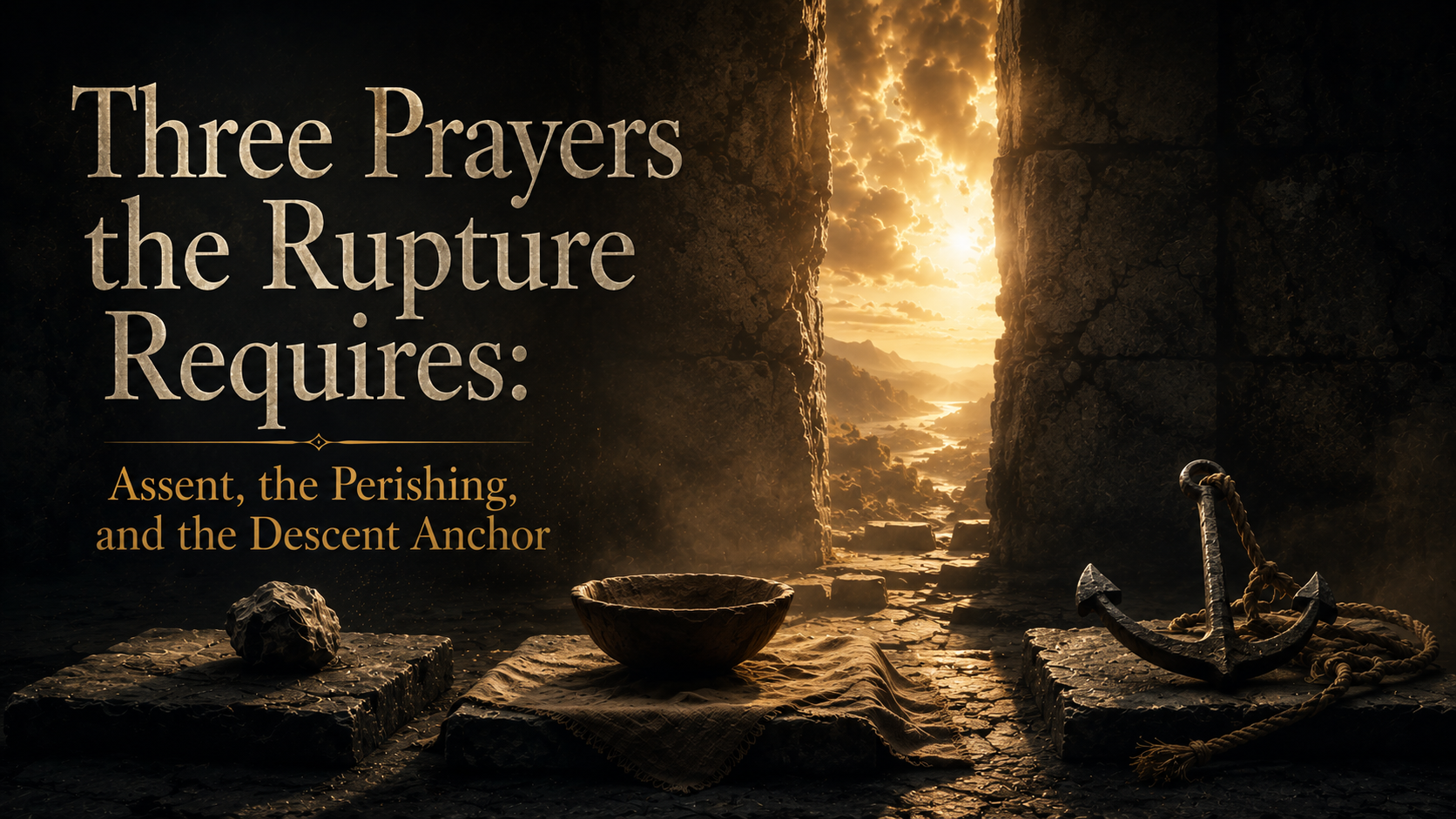
Most Christian prayer assumes one God, a working will, and a world worth improving. The True Testament assumes something else: two domains, a dead will, and a rescue that enters from outside. That assumption cannot stay in doctrine alone. It has to become something people do with their mouths shut, their grief named honestly, and their week oriented toward a Christ who did not grow up in the Creator's storyline. He descended into it.
This article names three Marcionite prayers that belong together. They are not healing prayers. They are not petition lists dressed in pious language. They are the daily, intercessory, and weekly forms of a confession that already holds Spirit possession at the far end (when the Spirit takes the microphone entirely) and the Spirit's prayer at the foundation, when Paul says you do not know how to pray as you should.
Between those poles sit three practices unique to us: Assent Prayer, Prayer for the Perishing, and the Descent Anchor.
Why These Three Belong Together
Assent Prayer is how you pray when you have nothing worth saying. Prayer for the Perishing is how you love neighbors still inside the Creator's decay without lying about hell. The Descent Anchor is how you enter each week remembering that Christ did not arrive as the fulfillment of Israel's plot. He arrived as a stranger in enemy territory.
One handles the inside of the believer's prayer life. One handles the edge toward those outside rescue yet. One handles time: the calendar of a gospel that opens with Tiberius and Capernaum, not with Bethlehem.
All three are grounded in the True Testament. All three are useless to a one-god religion. That is how you know they are ours.
I. Assent Prayer: When the Spirit Prays and You Say Amen
Paul does not flatter the believer's prayer skills. He diagnoses them:
"The Spirit also helps our weakness, for we do not know how to pray as we should, but the Spirit intercedes for us with groanings too deep for words." (TT Romans 8:20)
Notice the order. Weakness first. Ignorance second. Spirit third. The human person is not the author of adequate prayer. The Spirit is already interceding before you compose a sentence elegant enough to deserve the Father's attention.
Galatians and Romans say what that intercession sounds like when it surfaces in the heart:
"Because you are God's children, He has sent His Spirit into our hearts, crying, Abba, Father." (TT Galatians 4:6)
"For you have not received a spirit of slavery again to fear, but we have been received into adoption, crying 'Abba, Father.'" (TT Romans 8:15)
The cry is already happening. Adoption is already real. The Spirit is not waiting for you to master prayer technique. The Spirit is crying Abba in a domain that only knows fear, slavery, and the Creator's accusation.
What Assent Prayer Is
Assent Prayer is the daily form of this doctrine. It is the quiet counterpart to Spirit possession, which is the intense form when the Spirit takes over speech entirely. Assent Prayer is what you do every morning and every night when possession is not occurring but the same theology still governs your life.
You do not produce prayer. You withhold prayer long enough to hear whether the Spirit is already groaning toward the Father. Then you answer with one word of agreement: Abba. Or Amen. Or silence that means the same thing.
This is not Eastern meditation emptied of content. It is not "speak your desires into the universe." It is the refusal to pray in the Creator's voice (fear, merit, bargaining, self-justification) and the willingness to let the Father's Spirit be the only speaker worth backing.
How to Practice It
Posture: Sit or kneel. Hands open. No list.
Referent: Address the Good Father through Christ, not the Creator of Law. (If you use a opening formula from Praying Beyond the Creator, speak it once and stop.)
Withhold: When words rise (guilt, plans, rehearsed piety, anxiety dressed as intercession), do not polish them. Notice them as the Creator's aeon talking to itself. Let them pass.
Listen: Wait for the deeper movement Paul names: groaning too deep for words. It may feel like heaviness, relief, grief, or wordless love toward the Father you did not know until Christ revealed him.
Assent: Speak once: Abba. Or Amen: "so be it," "let that groan be the prayer," "I add my one syllable to what the Spirit is already doing."
Stop: Do not lengthen the prayer into performance. Assent Prayer ends when assent is given. The Spirit continues interceding after you stand up.
What Assent Prayer Is Not
It is not passive spirituality. Paul pairs intercession with prevailing:
"Yet in all these things we prevail through him who loved us." (TT Romans 8:27)
It is not replacement of assembly prayer or Spirit possession when the assembly gathers for the deeper form. Assent is the daily bread. Possession is the feast.
It is not an excuse never to speak to the Father in your own words. Paul commands prayer without ceasing. Assent Prayer trains you to recognize which words are yours and which are already the Spirit's, so that when you do speak, you speak with the groan, not against it.
II. Prayer for the Perishing: Intercession Without Hell
Orthodox intercession trades in terror: save them before the flames. Marcionite intercession trades in diagnosis: they are perishing now, inside a system that cannot sustain them, and the Father's rescue is an extraction from an aeon, not a reprieve from a torture chamber the Good Father runs.
Paul uses the language clinically, in the present tense:
"For the message about the stake is foolishness to those who are perishing, but to those who are being rescued it is the power and wisdom of God." (TT 1 Corinthians 1:18)
"For we are an aroma of Christ among those being rescued and among those who perish." (TT 2 Corinthians 2:8)
Perishing is not a future damnation sentence in our canon. It is the slow undoing of souls held in the Creator's domain without the Spirit's adoption: decay, blindness, bondage to fear, the weight of Law without the Father's grace. You know people in this condition. You were in it. Some you love still are.
Prayer for the Perishing is how the assembly intercedes for them without smuggling orthodox hell back through the side door.
What This Prayer Is
Prayer for the Perishing asks the Good Father to break in: to let the aroma of Christ reach someone still inside the decaying order; to let the foolishness of the stake become power for them; to begin the extraction Galatians names:
"Who gave himself for our sins so that he might deliver us from the present evil aeon according to the will of God the Father." (TT Galatians 1:4)
It is intercession for apokatastasis as we hold it: not Origen's loop back to the God who started the trouble, but the Father's gathering of souls out of the Creator's house. We do not pray them into a nicer corner of the same prison. We pray the Father to invade.
How to Practice It
Name one person (or a people, or a city) without turning them into a project. Prayer for the Perishing is love, not recruitment.
Refuse hell imagery. Do not threaten them with flames the Father does not operate. Do not use intercession as covert violence. The Creator's order already perishes them. Name that honestly.
Pray extraction, not improvement. Example shape (not a fixed liturgy):
Father, [name] is perishing inside an aeon you did not build. I do not ask you to bless the Creator's machinery. I ask you to break in as you broke in on me. Let the aroma of Christ reach them. Let the stake stop being foolishness. Deliver them from the present evil aeon according to your will, not mine, not my timeline, not my proof.
Hold grief without despair. Paul comforts the Thessalonians about those who have fallen asleep without orthodox hope-theater:
"We do not want you to be ignorant, brothers and sisters, about those who have fallen asleep, so that you will not grieve like the rest who have no hope." (TT 1 Thessalonians 4:13)
Marcionite hope for the dead is not "they are in heaven now because they prayed the sinner's prayer." It is: the Father who raised Christ is the one who gathers. Prayer for the Perishing extends that hope backward and outward, for the living who do not yet know the rupture and for the dead who died inside the Creator's order without hearing the Evangelion.
What This Prayer Is Not
It is not a doctrine recited and called prayer. We hold, as our reading of the attested text, that no one is finally lost, and still we ask the Father who invades, and leave the timing of his gathering to him.
It is not contempt for the unrescued. Perishing is a diagnosis of a condition, not an insult to a people. The Creator binds Jew and Gentile alike in the same decay. Extraction is offered without ethnic gatekeeping.
It is not a substitute for proclamation. You pray for the perishing and you still speak the Evangelion when the door opens. Prayer prepares your grief; proclamation offers the rescue.
III. The Descent Anchor: Weekly Prayer at Capernaum
Orthodox time is liturgical Advent: a baby, a manger, prophecy fulfilled, lineage secured. Marcionite time opens differently. The Evangelion does not begin with birth. It begins with imperial dating and descent:
"It was the fifteenth year of Tiberius Caesar's reign, in the days of Pilate." (TT Evangelion 1:1)
"That's when Jesus descended into Capernaum, a town in Galilee. Every Sabbath, he taught the people there." (TT Evangelion 1:2)
The word descended is the whole christology in one verb. Christ did not emerge from David's line in this gospel. He came down from the Unknown Father into enemy territory and began teaching with an authority the synagogue had never heard.
The Descent Anchor is the weekly prayer that keeps that opening from becoming doctrine you once read and forgot. It orients the week the way the Evangelion orients the canon: from above, into Galilee, among strangers.
What the Descent Anchor Is
Once a week (many in the assembly use the eve of service or the first day of the work week), you pray the descent before you re-enter the Creator's order of wages, news, fear, and Law.
You are not asking for success in the aeon. You are remembering that you follow a Christ who walked into Capernaum as a stranger, taught on Sabbath as an outsider, and could not be held even when Nazara tried to kill him:
"But Jesus walked right through the crowd and went on his way." (TT Evangelion 1:10)
The Descent Anchor says: this week I descend again into the same territory he entered, not as owner, not as native, but as one whose Father is unknown here until Christ reveals him.
How to Practice It
When: Weekly. Fixed time matters more than fixed length.
Shape: Three movements: Date, Descent, Delegation.
Date: Name the present aeon's markers honestly: the powers, schedules, and fears of the week ahead. Tiberius had a fifteenth year; you have a calendar too. Naming the aeon is not worshipping it. It is locating the descent.
Descent: Recall Evangelion 1:1–2. Christ did not ask permission from the Creator's storyline to begin. He descended and taught. Pray to walk into the week the same way, with the Father's authority, not the Creator's approval.
Delegation: Close by entrusting the week to the Son who reveals the Father:
"Everything has been entrusted to me by the Father. No one knows the Father except the Son, and no one knows the Son except the Father, and anyone to whom the Son reveals him." (TT Evangelion 6:30)
Example closing shape:
As Christ descended into Capernaum in the fifteenth year of Tiberius, I enter this week in his path: a stranger to the Creator's verdict, a child of the Unknown Father, taught by the Son who reveals you. Entrust my days to him. When the crowd presses, let me walk through as he walked through.
What the Descent Anchor Is Not
It is not a prosperity blessing over your job, health, or nation. The descent is not into a better life inside the Creator's favor. It is into mission in hostile territory.
It is not replacement for Assent Prayer daily or Prayer for the Perishing when grief demands it. The Anchor is weekly orientation. The others are daily silence and intercessory love.
It is not a denial of the Evangelion's geography. Nazara, Judea, and Galilee are real in the Evangelion. It is a denial that Christ belongs to the Creator's messianic script. He appears in the land. He is not from the Creator's covenant arc.
Living the Three Together
A practical rhythm many in the assembly use:
Daily: Assent Prayer, morning and night. One Abba, one Amen, built on Romans 8:20 and Galatians 4:6.
As love requires: Prayer for the Perishing, when you watch someone decay inside the aeon, when you grieve the dead without orthodox hope-theater, when the aroma of Christ must reach past your own rescue.
Weekly: The Descent Anchor. Evangelion 1:1–2 and 6:30 before the week consumes you.
When the Spirit warrants: Spirit possession, the deeper form where the Spirit does not wait for your assent syllable but takes the whole prayer. Assent Prayer trains you for possession. Possession does not replace Assent; it intensifies the same doctrine.
Conclusion: Prayer That Can Only Be Marcionite
Assent Prayer confesses that you do not know how to pray. Prayer for the Perishing confesses that hell is not the Father's tool and perishing is happening now. The Descent Anchor confesses that Christ did not enter the world as its product. He descended into it from the Father you did not know until the Son revealed him.
None of these prayers flatter the human will. None bribe the Creator. None assume one God managing a single plan. All three train the assembly to live inside the rupture, daily and intercessory and weekly, until the parousia finishes what the descent began.
You already have the Spirit's groaning in your chest. You already know people who are perishing. You already live in the fifteenth year of someone's Tiberius, every week.
Now you have names for what to do with that.
Assent. Intercede. Descend.