
Imagine you are handed two programs for the same play. The first one is crowded. It lists an old priest and his wife, an angel with a name, a young mother and her husband, an old prophet and a widow who wait in the temple, an emperor, a governor, a king, two high priests and a family tree of more than seventy ancestors. Only after all of them does it list the man the play is about and the people he meets along the way.
The second program is much shorter, and it opens with a date, the fifteenth year of the Roman emperor Tiberius, and a man walking into a town by a lake. The priest, the angel, the mother, the husband, the ancestors and the temple prophets are not on it. The man is the same, and most of the people he meets are the same, but nearly everyone who surrounded his arrival is absent from the list.
That is what you find when you lay the Gospel the church calls Luke beside the Evangelion, whose name is simply the Greek word for Gospel. Marcion, a Christian teacher in Rome in the second century, published the Evangelion in the 140s together with ten letters of Paul, as the first Christian Bible we know of, which is why we call it the first Gospel. That Bible is the True Testament. Much has been written about the passages of the church’s Luke that the Evangelion does not include, but as far as we have been able to find, no one has done something much simpler: taken the cast list itself, every person the church’s Luke calls by name, and checked each one against the Evangelion.
We did so verse by verse, and the result is a pattern so clear that it tells a story of its own.
The Count
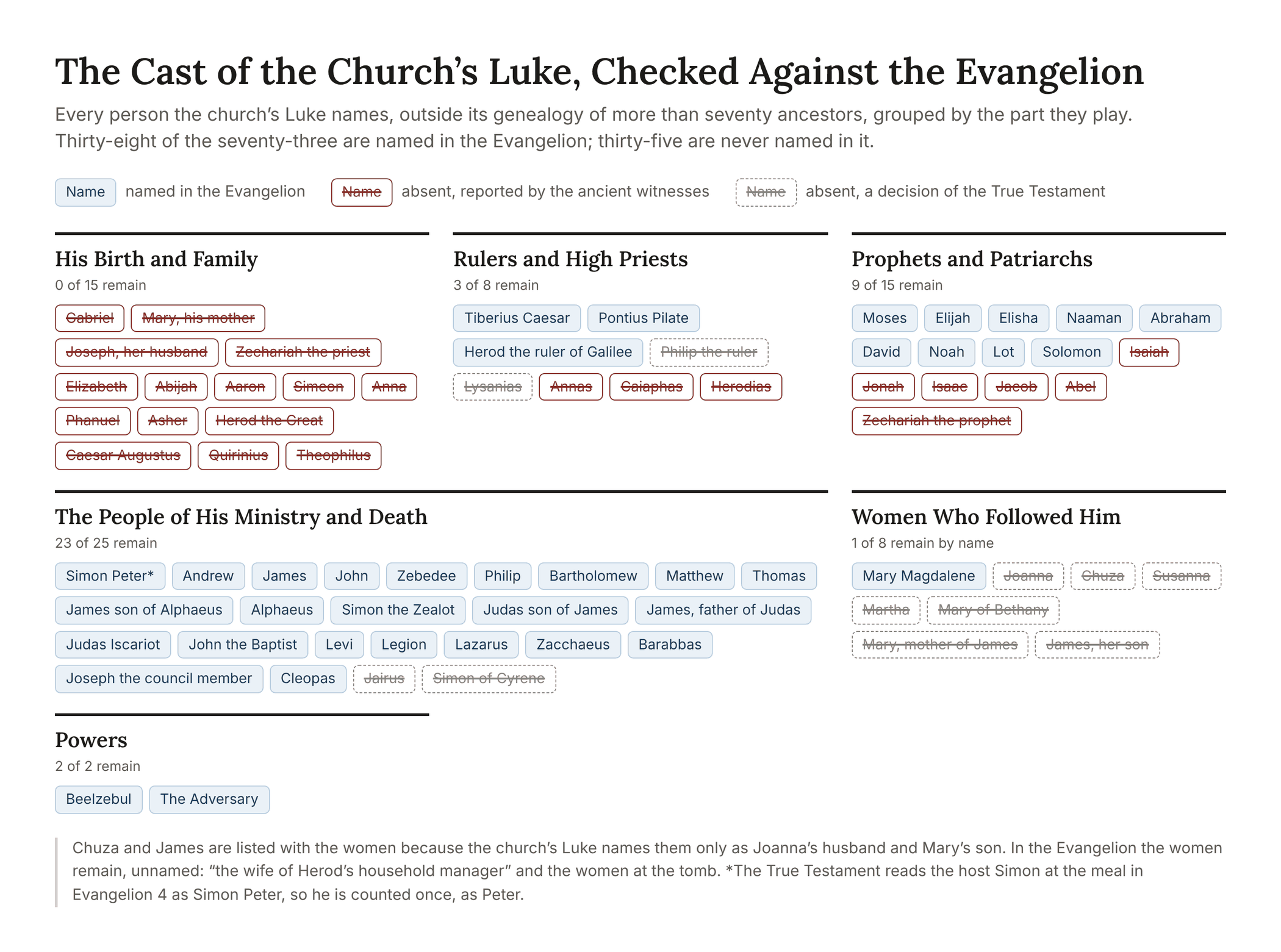
The church’s Luke names seventy-three different people, not counting the family tree of Jesus. They include apostles, rulers, prophets, the founding fathers of Israel, women who followed Jesus, people he healed, and two spiritual powers: Beelzebul, whom Jesus’s opponents call the ruler of the demons, and the Adversary, the one the church calls Satan.
Thirty-eight of those seventy-three are named in the Evangelion, and thirty-five are never named in it at all. The family tree, with its more than seventy names running from Joseph back to Adam, is not in the Evangelion either.
Numbers like these could mean very little on their own. What makes them remarkable is who lands on each side of the line.
Nobody From His Birth Is There
The Christmas story, the first two chapters of the church’s Luke, comes first. Fifteen names belong to it, counting Aaron, Israel’s first high priest, and Asher, one of Israel’s tribes, through whom Elizabeth and Anna are identified:
- Zechariah, a priest descended from Aaron, and his wife Elizabeth, the parents of John the Baptist
- Abijah, the ancestor whose name Zechariah’s group of priests carried
- the angel Gabriel, who announces two births
- Mary, and Joseph her husband
- Simeon and Anna, who wait in the temple for the day the god of Israel would comfort his people, along with Anna’s father Phanuel and her tribe of Asher
- King Herod the Great, the emperor Augustus and Quirinius, the governor of Syria, whose census brings the family to Bethlehem
- Theophilus, the wealthy friend to whom the book is dedicated
Not one of the fifteen is in the Evangelion. Its first words are these:
“It was the fifteenth year of Tiberius Caesar’s reign, in the days of Pilate. That’s when Jesus descended into Capernaum, a town in Galilee.” (Evangelion 1:1 to 2)
This is not a guess drawn from silence, because two ancient writers who argued against Marcion, and quoted his Gospel in order to do it, tell us how it began. Tertullian, a churchman of Carthage in North Africa who wrote five books against Marcion around the year 207, reports that Marcion’s Gospel went straight from that date to Jesus’s arrival in Capernaum, with nothing before it. Epiphanius, a bishop on the island of Cyprus who made notes on Marcion’s Gospel around the year 376, complains that Marcion “cut away and leapt over” everything before those first words. Epiphanius assumed Marcion had taken the chapters away, whereas the True Testament holds that they were added to the Gospel later, a question we come back to at the end.
The family tree is not there either, and neither is Joseph’s last appearance in the church’s Luke, when the people of Nazareth ask, “Is not this Joseph’s son?” (Luke 4:22, King James Version). The Evangelion does take Jesus to Nazareth and shows the crowd turning against him there, but in it he does not read aloud from the scroll of the prophet Isaiah, and no one asks about his father.
So the Son of the Evangelion arrives with no mother named, no father named, no priestly relatives, no angel announcing him, no ancestors and no temple prophets waiting for him. He simply comes, and Paul puts it in a single line, as the True Testament has it: “But when the time was fulfilled, God sent forth his Son” (Galatians 4:4). Our book Systematic Theology: True Testament Marcionism calls this teaching “Sent, Not Born,” and the cast list confirms it, because every person whose part in the church’s Luke is to tie Jesus to a family, a priesthood or a royal line is absent from the Evangelion.
Only Two Rulers Date His Arrival
The church’s Luke dates the start of John the Baptist’s work with a whole row of officials: the emperor Tiberius; Pontius Pilate, the Roman governor; Herod, the ruler of Galilee and a son of King Herod the Great from the Christmas story; Herod’s brother Philip; a ruler named Lysanias; and the high priests Annas and Caiaphas. The Evangelion keeps only the first two, Tiberius and Pilate, and uses them to date something else, the moment Jesus comes down into Capernaum.
Philip, Lysanias, Annas and Caiaphas never appear, and neither does Herodias, the wife of Herod whose marriage John the Baptist condemned. Herod himself does appear later, when he hears about Jesus and finally questions him, but the high priests are not at the opening at all. A fourth-century Greek book called the Dialogue of Adamantius, written as a debate, gives a speaking part to a follower of Marcion named Marcus, and he says the Gospel begins “under Tiberius Caesar, in the days of Pilate,” naming no other ruler. The Evangelion is not dated by the temple and its priests, but by Rome.
The Prophets Who Point Forward Fall Silent
Some of the most striking absences are people who never walk through the story themselves but are spoken about in it: figures from the Hebrew scriptures, which the church calls the Old Testament, whom the church’s Luke calls on to show that Jesus was foretold.
Isaiah is named twice in the church’s Luke, once to introduce John the Baptist and once when Jesus reads from his scroll, and he is never named in the Evangelion. Jonah is named four times, in the saying about “the sign of Jonah” and the verses after it. The Evangelion has the saying without him:
“This generation asks for a sign, and it will not be given a sign.” (Evangelion 7:22)
Epiphanius says outright that the passage about Jonah was not in Marcion’s Gospel, and neither were the verses about Nineveh, the city Jonah warned, and the queen who traveled to hear Solomon. Abel, the first man murdered in the scriptures, and a prophet named Zechariah, a different man from the priest in the Christmas story, are absent in the same way. In the church’s Luke their blood “shall be required of this generation” (Luke 11:51, King James Version), and Epiphanius reports that Marcion’s Gospel did not have that passage.
The founding fathers of Israel tell the most revealing story of all. In the church’s Luke, Jesus warns his hearers that they will see “Abraham, and Isaac, and Jacob, and all the prophets, in the kingdom of God” while they themselves are thrown out (Luke 13:28, King James Version). The Evangelion gives the same warning, but with different people inside the kingdom:
“There will be weeping and clenching your teeth in despair when you see all the righteous in the kingdom of God, while you yourselves are shut outside.” (Evangelion 9:15)
Both Tertullian and Epiphanius report that Marcion’s Gospel had these words. The church’s Luke names Isaac and Jacob in only one more place apart from the Christmas story, the saying about Moses at the burning bush and “the God of Abraham, and the God of Isaac, and the God of Jacob” (Luke 20:37, King James Version), and Epiphanius records twice that Marcion’s Gospel did not have it. So Isaac and Jacob are never named in the Evangelion at all.
Not every figure from the Hebrew scriptures is absent, and the ones who remain are just as telling. Moses and Elijah still stand with Jesus on the mountain, and Noah and Lot still serve as warnings about sudden judgment. Abraham is still there too, but in different roles: in the story of the rich man and the beggar Lazarus, and as the ancestor of a woman Jesus heals on the Sabbath, “whom the Adversary held captive for eighteen years” (Evangelion 9:7). What the Evangelion does not have is Abraham seated in the kingdom as its guarantee, or Jesus speaking of the god of Abraham.
One saying has simply moved. In the church’s Luke, Jesus mentions the prophet Elisha and Naaman, a Syrian army commander whom Elisha healed of leprosy, in his sermon at Nazareth. Tertullian and Epiphanius both report that in Marcion’s Gospel he says it when he sends ten men with leprosy to the priests, and that is where the Evangelion has it:
“He sent them, saying, ‘Go and show yourselves to the priests. There were many with leprosy in Israel in the days of the prophet Elisha, and not one of them was cleansed except Naaman the Syrian.’ And as they went, they were healed.” (Evangelion 11:7)
David is treated the way Abraham is, since he is still mentioned but never as Jesus’s ancestor. In the church’s Luke, David is named as the ancestor of Jesus in six verses, all in the Christmas story and the family tree, and none of them is in the Evangelion. What remains is Jesus recalling what David did when he and his men were hungry, a blind man shouting “Jesus, Son of David, have mercy on me!” (Evangelion 12:10), and Jesus asking how the Christ can be David’s son when David himself calls him Lord. In the Evangelion David is a figure from Israel’s past, and “Son of David” is a title other people call out and Jesus questions.
Almost Everyone He Met Is Still There
The other side of the line tells the opposite story. Setting aside the women who followed him, whom we come to next, the church’s Luke names twenty-five people in the story of Jesus’s work and death: the people he called, met, healed and ate with, and those who stood around him at his trial and death. Twenty-three of them are in the Evangelion.
All twelve apostles are there, listed by name, and Levi is still called away from his tax booth: “After this, Jesus went out and saw a tax collector named Levi sitting at the tax booth, and said to him, ‘Follow me’” (Evangelion 2:25). The man with many demons still gives his name: “He answered, ‘Legion,’ because many demons had gone into him” (Evangelion 5:4). Zacchaeus is still “a chief tax collector, and he was rich” (Evangelion 12:15), and the beggar Lazarus is still lying at the rich man’s gate. John the Baptist is honored as the last of the age of the Law: “The Law and the Prophets were in effect until John” (Evangelion 10:20). Barabbas is set free in place of the Lord, Joseph, the council member who buries him and a different man from Mary’s husband, is there at the end, and Cleopas walks to the village of Emmaus.
Only two of the twenty-five are absent: Jairus, the synagogue leader whose daughter Jesus raises, and Simon of Cyrene, who carries the stake, the word our scripture uses for the cross, on which Jesus was put to death.
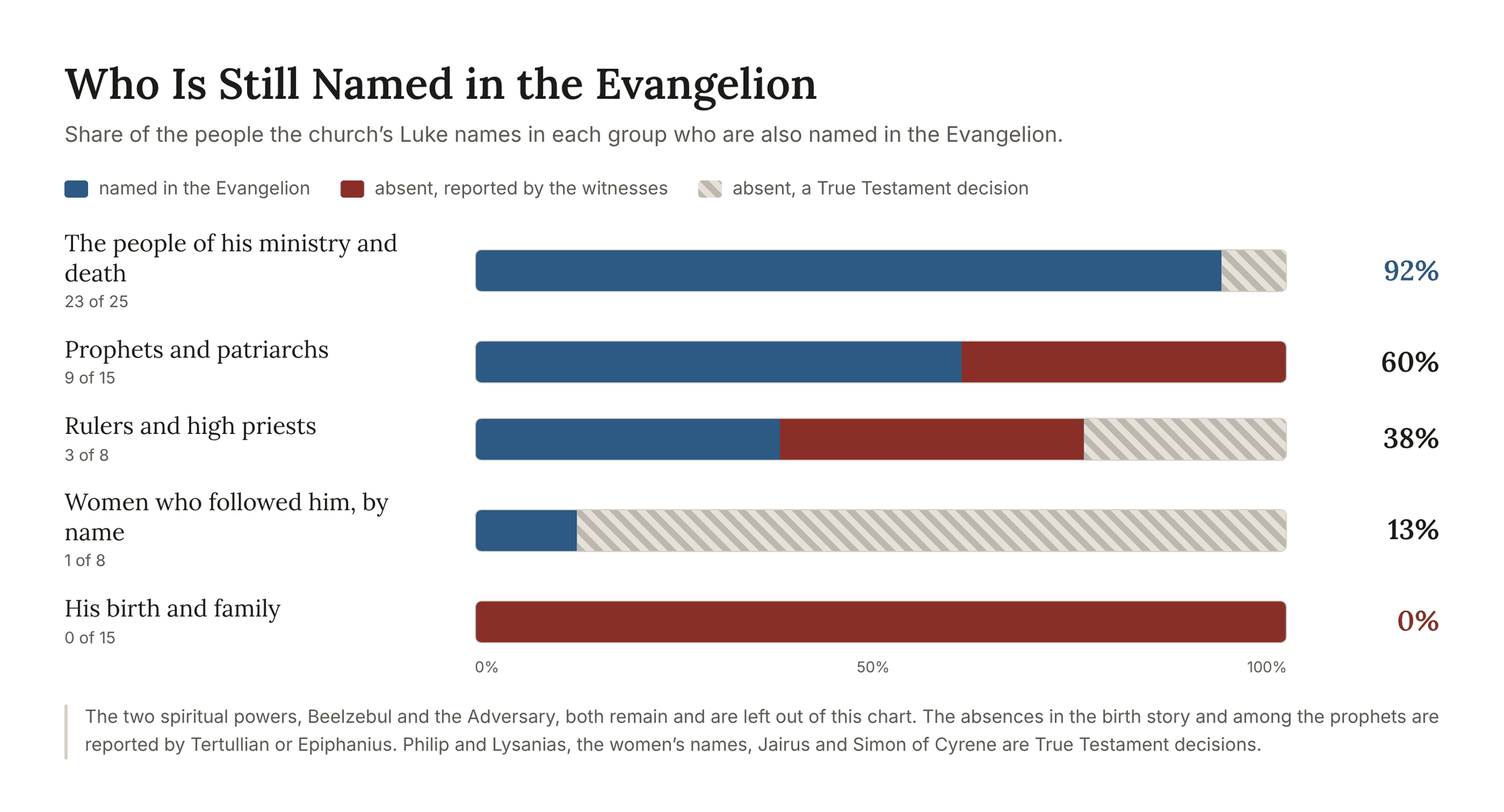
Put the two sides together and the pattern is hard to miss. Of the fifteen people in the Christmas story, none remain. Of the people who tie Jesus to the temple, the priesthood, a royal family tree and the prophets said to foretell him, almost none remain. Of the people he actually met, nearly all are still there.
The Women Who Are There Without Their Names
The women who followed Jesus are the one group where the change looks different. The church’s Luke names Joanna, the wife of Herod’s household manager Chuza, and Susanna among the women who supported him, and names Joanna again, with Mary the mother of James, among the women at the empty tomb. It also tells the story of two sisters, Martha and Mary of Bethany.
The Evangelion keeps the women but not most of their names. Mary Magdalene is the one it names, and she is named first:
“Some women had been cured of evil spirits and illnesses: Mary, called Magdalene, from whom seven demons had been cast out, and the wife of Herod’s household manager. They, along with many others, used their own resources to support him.” (Evangelion 4:28)
Tertullian describes this same passage without naming the steward’s wife. The women still come to the tomb at dawn and are the first to carry the news, but the Evangelion does not give their names, and Martha and Mary of Bethany are not in it at all.
How Certain Each Absence Is
A careful reader will want to know how certain each of these absences is, and the answer differs from name to name.
The Evangelion has not survived as a book of its own. We know its words from the writers who opposed Marcion and quoted his Gospel in order to argue with it, above all Tertullian and Epiphanius. Our book The Greek True Testament, Critical Edition, which prints the Greek text of our scripture with a full record of the ancient evidence, notes passage by passage what these writers report.
Of the thirty-five absent people, twenty-four are reported absent by the ancient writers themselves, including everyone in the Christmas story, the high priests, Isaiah, Jonah, Abel, Isaac and Jacob. The other eleven are the True Testament’s own decisions: Philip and Lysanias at the opening, Jairus, Simon of Cyrene, the women’s names, Joanna’s husband Chuza, and James the son of Mary. Where the ancient writers say nothing either way, the True Testament follows the reading that best fits the passages they do report, and the Critical Edition gives the reason for each one. The diagrams mark these decisions differently, so you can see where each name stands.
What the Missing Cast Tells Us
On any single passage, people can argue about whether the church added it to Luke or Marcion left it out. A cast list cuts across that argument, because it shows what kind of person is absent, and the absent people are not a random handful. They are the people whose part in the church’s Luke is to bind Jesus to the Creator, the god who made this world and gave Israel its Law. In the True Testament the Creator is not the Father of Jesus: the Father is a different God, whom no one had known until the Son came to reveal him.
Without these people the story has no frame tying Jesus to the Creator, yet the man at the center, and the people he rescues, are untouched. That is what you would expect if the Evangelion is the older Gospel and the church’s Luke is the same Gospel with a frame built around it. The True Testament calls the passages it does not include later additions, and the cast list shows what those additions were for: they brought in the witnesses who could vouch for Jesus as Israel’s Messiah.
It also fits how Jesus describes himself in the Evangelion: “No one knows the Father except the Son, and no one knows the Son except the Father, and anyone to whom the Son reveals him” (Evangelion 6:30). A Son whom no one knew, sent by a Father whom no one had known, does not arrive with a priesthood to vouch for him or a family tree to prove his claim. He arrives in Capernaum in the fifteenth year of Tiberius, and the first people to know him are the ones he goes looking for.
What This Means for You
If you grew up with the church’s Luke, the Christmas cast was probably the first part of the Gospel you ever learned: Gabriel and Mary, the shepherds, old Simeon holding the baby in the temple. It can be unsettling to learn that the first Gospel has none of them.
Yet the people at the heart of the story are still there: the tax collector at his booth, the man with a legion of demons, the beggar at the rich man’s gate, the woman freed from seven demons, the rich tax collector who welcomed Jesus into his home with joy, and the prisoner set free in his place.
The cast of the Evangelion is not the cast of a royal birth but the cast of a rescue, and you are meant to find yourself in it. The Son came, in his own words, “to rescue what was lost” (Evangelion 12:19), and the people the first Gospel remembers by name are the lost he found. The people who were there to prove his credentials to Israel are absent, while the people he came for remain, and there is still room on that list for you.
Sources
True Testament: Evangelion 1:1 to 2, 2:25, 4:28, 5:4, 6:30, 7:22, 9:7, 9:15, 10:20, 11:7, 12:10, 12:15, 12:19; Galatians 4:4. All are quoted from the True Testament and cited by its own chapter and verse numbers.
Church Bible: Luke 4:22, 11:51, 13:28 and 20:37, quoted from the King James Version.
Ancient writers:
- Tertullian, Against Marcion 4.7.1, 4.8.2, 4.19.1, 4.30.5 and 4.35.6
- Epiphanius, Panarion (his book against the heresies) 42.11.4 to 6, with his numbered notes on Marcion’s Gospel 25, 28, 40, 48, 56 and 57
- The Dialogue of Adamantius, the words of the Marcionite Marcus on the opening of the Gospel
Our books:
- The Greek True Testament, Critical Edition, the Evangelion, with its record of what each ancient writer reports
- Systematic Theology: True Testament Marcionism, the chapter “Sent, Not Born”
How the count was made: A person counts as named in the Evangelion if it names them anywhere, even when some of their verses are not included, which is why Abraham and David count as present. People named only as someone’s father, son or husband are counted too. The host at the meal where a woman washes Jesus’s feet, whom the church’s Luke calls Simon the Pharisee, is read in the True Testament as Simon Peter, so he is counted once, as Peter.
Related reading: our book Not the Son of David.