
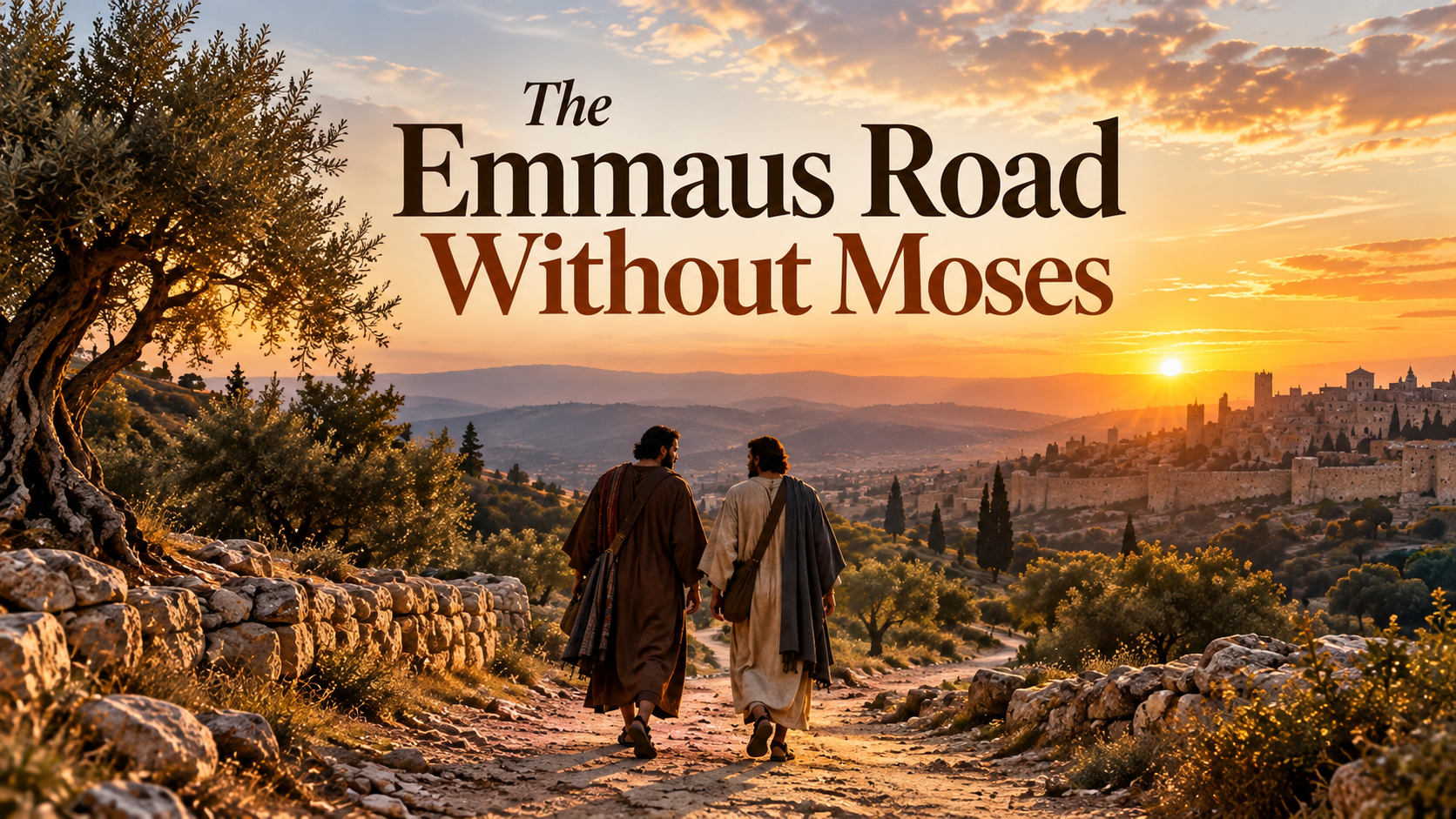
Ask a Christian where the habit of finding Jesus in the Old Testament comes from, and sooner or later you will be taken to a road outside Jerusalem. In canonical Luke, the risen Jesus walks with two disciples to a village called Emmaus, calls them "slow of heart to believe in all that the prophets have spoken," and then, "beginning from Moses and from all the prophets," explains to them "in all the Scriptures the things concerning himself" (Luke 24:25, 27). Later that evening he does it again for the eleven: everything "written in the law of Moses, the prophets, and the psalms" about him must be fulfilled, and he opens their minds "that they might understand the Scriptures" (Luke 24:44–45).
Those verses are the charter of a whole way of reading the Bible. Typology, prophecy charts, Christ-centered preaching, every Bible study that looks for the cross in the bronze serpent and the blood on the doorposts: all of it claims the risen Lord as its first teacher. If Jesus himself read Moses that way on the first Easter afternoon, the method needs no other defense.
The Evangelion has the road, the two disciples, the stranger, the rebuke, and the bread. It does not have Moses. It does not have the prophets. It does not have a single verse in which the risen Christ opens a scroll. In the True Testament the rebuke on the Emmaus road sends the disciples back to something else entirely: "all that he told you" (Evangelion 16:22 TT). This article sets the two texts side by side, lays out who attests the Evangelion's wording, and follows that phrase back through the gospel to see what the risen Christ actually pointed to.
The two texts
The Evangelion's account begins at the tomb. The women find no body, and two men in shining clothes tell them, "He has been awakened. Remember what he told you while he was still in Galilee, that the Son of Man must be handed over, be staked, and rise on the third day" (Evangelion 16:11–12 TT). The women report it, and the disciples think it nonsense (Evangelion 16:13–14 TT).
Then the road. "Two of them were walking to a village called Emmaus, about seven miles from Jerusalem. While they were talking, Jesus came up and walked with them. But they were kept from recognizing him" (Evangelion 16:15–17 TT). He asks what they are discussing; Cleopas asks whether he is the only visitor in Jerusalem who has not heard; he asks, "What things?" They answer with the whole of their disappointment in one line: "We thought he was the one who would set Israel free" (Evangelion 16:18–21 TT).
Here is his answer as the Evangelion preserves it:
He said to them, "How foolish you are, and how slow of heart to trust all that he told you" ... "that the Christ must suffer these things." (Evangelion 16:22–23 TT)
At the table he takes bread, gives thanks, breaks it, and gives it to them, "Then their eyes were opened, and they recognized him" (Evangelion 16:26–27 TT).
Canonical Luke tells the same walk with three additions at exactly the point where the Evangelion is shortest. Its rebuke names a different object: "slow of heart to believe in all that the prophets have spoken" (Luke 24:25). It adds a lesson: "Beginning from Moses and from all the prophets, he explained to them in all the Scriptures the things concerning himself" (Luke 24:27). And it adds the disciples' memory of that lesson: "Weren't our hearts burning within us while he spoke to us along the way, and while he opened the Scriptures to us?" (Luke 24:32).
The difference is not a word or two. In Luke the stranger's authority is Moses and the prophets, and his proof is a Bible study. In the Evangelion his authority is his own earlier word, and his proof is the breaking of bread. The two men at the tomb and the stranger on the road say the same thing in the same terms: remember what he told you.
Who attests it
The Evangelion's wording here does not rest on guesswork. The rebuke is attested by Tertullian, who quotes it from Marcion's gospel in the course of arguing against it: "O foolish ones, and slow of heart to believe all that he has spoken to you" (Tertullian, Against Marcion 4.43.4). The walk itself, Cleopas's question, "that the Christ must suffer these things," and the breaking of bread are listed by Epiphanius among the readings of Marcion's text that he answers (Panarion 42.11.6, scholion 77). The two men's words at the tomb are attested by both (Tertullian, Against Marcion 4.43.5; Panarion 42.11.6, scholion 76).
Tertullian's handling of the passage is the strongest evidence of what the text did not say. His whole purpose in Book 4 is to prove from Marcion's own gospel that Jesus was the Creator's Christ, foretold by the prophets. At Emmaus he had every reason to reach for the prophets, and he cannot quote them from the text. He quotes "what he has spoken to you" and then has to supply the prophets himself. Of the two men's words at the tomb he asks, "And why was it necessary, except because it was thus written by the Creator God?" (Against Marcion 4.43.5). The "must" is in the text; the "written" is Tertullian's.
He does the same at the end of the chapter. When the risen Christ sends his followers to proclaim to all peoples, Tertullian says this fulfilled a psalm about voices going out to the ends of the earth (Against Marcion 4.43.9). The Evangelion at that point says only, "Go and proclaim this to all peoples" (Evangelion 16:35 TT). A writer who could have quoted "beginning from Moses and from all the prophets" or "all things which are written in the law of Moses, the prophets, and the psalms" from his opponent's book would have done it. Tertullian argues from what the text implies because the text he was answering did not say it.
What he told you
If the rebuke does not point to Moses, it points somewhere. Follow the phrase back through the Evangelion and you find exactly what the two men at the tomb meant by "what he told you while he was still in Galilee."
After Peter's confession, Jesus said, "The Son of Man must suffer many things, be rejected by the elders, the scribes and the chief priests, be killed, and after three days be awakened" (Evangelion 5:33 TT). When he came down from the mountain and found that his disciples could not cast a spirit out of a boy, he said, "Listen carefully to these words: the Son of Man is going to be handed over into the hands of men" (Evangelion 6:6 TT). Speaking of the day of the Son of Man, he said, "But first, he must suffer greatly and be rejected" (Evangelion 11:16 TT). Three predictions, each in his own voice, two of them with the same "must," and none of them appealing to anything written.
That last point is not an accident of selection. Where canonical Luke has Jesus say that "all the things that are written through the prophets concerning the Son of Man will be completed" (Luke 18:31), the Evangelion has no such verse. Where canonical Luke has him say at the supper that "this which is written must still be fulfilled in me" (Luke 22:37), the Evangelion has no such verse either. In the True Testament the necessity of the suffering is announced by the one who will suffer, and its authority is his word: "Listen carefully to these words."
The same instruction was given from above. On the mountain, Moses and Elijah appear talking with him, Peter offers to build three tents. Then: "A voice came from the cloud: 'This is my beloved son. Listen to him!'" (Evangelion 5:38, 5:40, 5:42 TT). Moses and Elijah were present, and the voice did not tell the disciples to listen to them.
So when the risen Christ calls the two disciples slow of heart "to trust all that he told you" and repeats "that the Christ must suffer these things" (Evangelion 16:22–23 TT), he is not introducing a new source of proof. He is holding them to the one they already had. Their failure was not ignorance of the prophets. Their failure is in their own sentence: "We thought he was the one who would set Israel free" (Evangelion 16:21 TT). They had been waiting for a liberator of Israel, the king the Creator's prophets promised, and they could not fit a staked man into that hope. He does not answer by showing them how the prophets foresaw a staked king. He answers by reminding them that he had told them, in plain words, what would happen to him.
The two bookends
The Emmaus road is not the only place where canonical Luke and the Evangelion part ways on this question. The same pattern frames both gospels from the first sermon to the last command.
That evening, in canonical Luke, the risen Jesus appears to the eleven, shows his hands and feet, eats a piece of fish, and then says that "all things which are written in the law of Moses, the prophets, and the psalms concerning me must be fulfilled." He opens their minds "that they might understand the Scriptures," and tells them, "Thus it is written" (Luke 24:44–46). In the Evangelion the same scene runs through the hands and feet, the fish, and the eating (Evangelion 16:28–33 TT), and then: "Then he said to them, 'Go and proclaim this to all peoples'" (Evangelion 16:34–35 TT). There is no list of Moses, prophets, and psalms. There is no opening of minds to the scriptures. What they are sent to proclaim is "this": what happened, not what was foretold.
Canonical Luke opens Jesus' ministry the same way it closes it. In its synagogue at Nazareth, Jesus is handed the scroll of Isaiah, reads it, rolls it up, and says, "Today, this Scripture has been fulfilled in your hearing" (Luke 4:21). In the Evangelion, "Jesus came to Nazara, where he went into the synagogue on the Sabbath, just as was the custom," and the next words are his: "I know what you're going to say: 'Doctor, heal yourself'" (Evangelion 1:7–8 TT). No scroll is handed to him. No scripture is said to be fulfilled.
So canonical Luke has a frame. Scripture fulfilled at the first sermon, scripture explained on the road, scripture opened to the eleven at the end. The True Testament has the same events without the frame. Readers who hold, as our articles do, that canonical Luke was written in answer to the Evangelion will recognize what the frame is for: it answers a gospel in which Jesus never once says that he is fulfilling the Creator's books.
Paul's own summary points the same way. In canonical 1 Corinthians, the gospel Paul handed on is that Christ died for our sins "according to the Scriptures" and rose on the third day "according to the Scriptures" (1 Corinthians 15:3–4). In the True Testament it reads, "For I handed on to you first of all that Christ died for our sins, that he was buried and was raised on the third day" (1 Corinthians 15:3–4 TT). The True Testament prints “for our sins”, which Tertullian quotes, but otherwise follows the reading attested by Epiphanius for these verses (Panarion 42, Apostolikon scholion 24), and neither appeal to the scriptures appears in it.
Why it matters
The Emmaus verses carry more weight than almost any other lines in the Imperial Church's gospels. They are why a sermon on Leviticus is expected to end at the cross, why a seminary course can be built on reading every page of the Creator's books as a picture of Christ, and why a Christian who asks whether the prophets were really talking about Jesus is told that Jesus himself said they were. Remove Luke 24:27 and 24:44–46, and the method loses its founder. It becomes what it looks like from outside: a reading imposed on the Creator's books by later teachers.
The Evangelion offers something plainer and harder. It does not deny that the Creator had prophets or that they spoke. It says, "The Law and the Prophets were in effect until John. Since then, the kingdom of God is being announced" (Evangelion 10:20 TT). It even contains, in a parable, the Creator's own rule for belief. The rich man in the place of the dead asks that someone be sent to warn his brothers, and Abraham answers, "They have Moses and the prophets; they should listen to them," and then, "If they won't listen to Moses and the prophets, they won't listen even if someone goes to them from the dead" (Evangelion 10:33, 10:35 TT).
That is the logic of the house the Creator built: Moses first, and resurrection only as confirmation of Moses. Six chapters later someone does rise from the dead, and he does not send anyone to Moses. He meets two grieving people on a road, holds them to his own word, breaks bread, and is recognized. Abraham said that nobody who ignores Moses will be convinced by a resurrection. The Evangelion ends with people convinced by a resurrection and by the one who told them it would happen.
For anyone reading the True Testament, the practical point is this. The authority of the gospel is the Son's word. "Listen to him" was said as Moses and Elijah were leaving (Evangelion 5:40, 5:42 TT). The proclamation he sends out is "this" (Evangelion 16:35 TT): a man staked, buried, awakened, and known at the table. It does not need a prophecy chart to be true, and it never asked for one.
What we do not claim
We do not claim the Evangelion pretends the Creator's books do not exist. It says of John, "He is the one it was written about: 'Look, I am sending my messenger ahead of you'" (Evangelion 4:19 TT), and it names the Creator's books for what they are: "They have Moses and the prophets; they should listen to them" (Evangelion 10:33 TT). That saying is the nearest our Evangelion comes to a prophecy fulfilled in the Son's story, and we grant it, but the one it calls written about is John. It never presents Jesus as the fulfillment of what was written. The Creator's books speak of the Creator's messenger, John. They do not supply the proof of the Son.
We do not claim every absence is separately attested. The wording of the rebuke rests on Tertullian's direct quotation (Against Marcion 4.43.4), and the surrounding verses on Tertullian and Epiphanius together. That canonical Luke 24:27, 24:32, and 24:45–46 stood nowhere in the text they were answering is an inference from the way Tertullian handles the chapter. Tertullian, whose aim was to prove from Marcion's own gospel that Jesus was the Creator's Christ, quotes the rebuke without the prophets and supplies the prophets himself. That is strong evidence, but it is evidence from what a hostile witness did not quote, and we say so.
We do not claim more than the text preserves. Tertullian gives the rebuke in Latin as "all that he has spoken to you"; the True Testament renders it "all that he told you." Evangelion 16:23 TT survives as a clause, "that the Christ must suffer these things," and we have not reconstructed what stood between it and the rebuke. Two verses of the walk, Evangelion 16:24–25 TT, where he acts as if going farther and they urge him to stay, are rated Probable rather than Attested; nothing in this article depends on them. Evangelion 16:34 TT, the words "Then he said to them," is also rated Probable; the command that follows, "Go and proclaim this to all peoples" (Evangelion 16:35 TT), is attested.
And we do not claim the scholarly majority. Most historians hold that Luke came first and that Marcion's gospel is a shortened Luke. Our articles hold the reverse, that the Evangelion was received by Marcion from the assemblies and that canonical Luke was written in answer to its publication. On that view the Emmaus lesson and the Nazareth scroll are additions. On the majority view they are deletions. Either way, the True Testament reader meets a risen Christ who points to his own word, and that is the text we are reading.
Sources
True Testament. Evangelion 1:7–8; 3:29; 4:19; 5:33; 5:38, 5:40, 5:42; 6:6; 10:20; 10:33, 10:35; 11:16; 16:11–14; 16:15–23; 16:26–35. 1 Corinthians 15:3–4. All are rated Preserved - Attested in the True Testament research record except where noted in the text.
Patristic witnesses. Tertullian, Against Marcion 4.43.4–5 and 4.43.9. Epiphanius, Panarion 42.11.6, scholia 76 and 77 (Evangelion), and Panarion 42, Apostolikon scholion 24.
Canonical verses quoted for comparison (World English Bible). Luke 4:21; 18:31; 22:37; 24:25, 24:27, 24:32; 24:44–46. 1 Corinthians 15:3–4.