
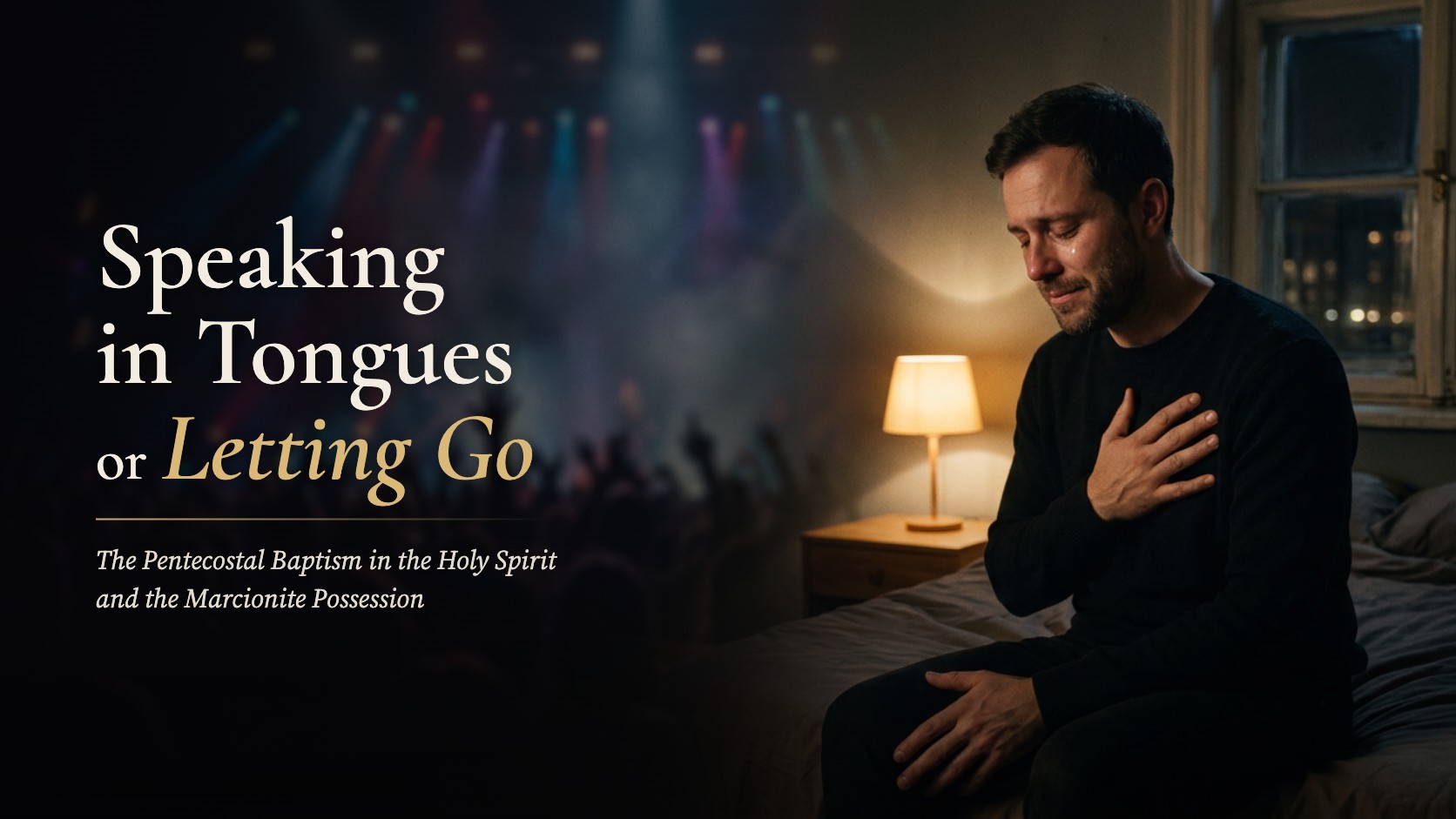
Around 2005 I was sitting in the largest megachurch in Minneapolis. I had grown up in the charismatic movement through the late 1990s and early 2000s, in Pentecostal churches, in the Assemblies of God and in the Word of Faith movement, and by then I knew the rhythm of a revival service by heart. That season the big names came through our city. Rodney Howard-Browne came. Creflo Dollar came. The music would build for a long time. The preacher would tell the room what the Holy Spirit was about to do. People would come forward, a hand would touch a forehead, and men stationed behind them would catch them as they fell. Some laughed until they could not stand. Some shook. Some spoke in tongues. Everyone in that room had been told what the Spirit looks like when he arrives, and the room delivered it.
I want to set what I saw in those years beside something quieter that we in the True Testament Assembly call possession. Both claim to be the work of God’s Spirit in a human being. They are not the same thing, and the difference matters for anyone who has stood at an altar waiting for something to happen.
Where the Pentecostal Experience Began
The modern movement has a birthday. On January 1, 1901, at a small Bible school in Topeka, Kansas, run by a preacher named Charles Parham, a student named Agnes Ozman asked to receive the Holy Spirit. She began to speak in what she and the others believed was a foreign language she had never learned. Parham taught that this speaking in tongues was the sign that a believer had been baptized in the Holy Spirit. Five years later, in 1906, a revival on Azusa Street in Los Angeles, led by a Black preacher named William J. Seymour, carried the experience across the country and then around the world. Pentecostal and charismatic Christianity is now one of the largest movements in the Christian world.
What Pentecostals Teach
The clearest statement of the Pentecostal position comes from the Assemblies of God, the largest Pentecostal denomination in the world, in its Statement of Fundamental Truths, first adopted in 1916. Two of its articles concern us here.
The first says that all believers “should ardently expect and earnestly seek the promise of the Father, the baptism in the Holy Ghost and fire.” It brings “the enduement of power for life and service,” and it is “distinct from and subsequent to the experience of the new birth.” The new birth is the moment a person first comes to faith. In the Pentecostal view, the baptism in the Holy Spirit is a second experience that comes after it, sometimes years later, and a believer is expected to pursue it.
The second article says that this baptism “is witnessed by the initial physical sign of speaking with other tongues.” Speaking in tongues means speaking sounds the speaker believes are a language given by the Spirit, one he or she never learned. Pentecostals call it the initial evidence: if you have not spoken in tongues, you have not yet received the baptism. Many churches hold tarrying services, long times of waiting in prayer at the altar, so that people can receive it.
The Word of Faith movement, which shaped many of the churches I grew up in, added a further layer. Its teachers, among them Kenneth Hagin and Kenneth Copeland, taught that a believer’s spoken words of faith release God’s power to bring health and wealth. Creflo Dollar, an Atlanta-area preacher, became one of the best-known voices of that teaching.
The Holy Ghost Bartender
The revival years I grew up in pushed all of this further. In 1993 Rodney Howard-Browne, an evangelist from South Africa, held meetings at Carpenter’s Home Church in Lakeland, Florida, where worshipers broke into uncontrollable laughter that came to be called holy laughter. He described himself as “God’s bartender” and “the Holy Ghost bartender.” The meetings that followed him were full of laughter, shaking, falling and what people called being drunk in the Spirit. In 1994 the same phenomena came to a Vineyard church near the Toronto airport, in what became known as the Toronto Blessing, which drew about 75,000 visitors that year. A year later it reached the Brownsville Assembly of God in Pensacola, Florida, in the Brownsville Revival.
Having sat in those rooms, I can tell you how they worked. The music ran long and built steadily. The preacher told the people what they were about to feel. Hands were laid on foreheads, and the catchers took their places before anyone fell. A whole room was prepared for the same result, and it usually came. Even scholars who studied these revivals sympathetically saw the pattern. The sociologist Margaret Poloma, who studied the Toronto Blessing, described the services as rituals that help people release pent-up emotion. Others have compared holy laughter to laughter yoga, a practice begun in India in 1995 that produces the same contagious laughter through group exercises, with no religion involved at all.
I do not doubt that many of the people at those altars were sincere. But a result that a skilled leader, a band and a prepared crowd can produce on schedule, and that can be produced in a room with no gospel in it, cannot by itself be the proof of God’s Spirit. Paul gives a different picture. He sets the Spirit against drunkenness, not beside it: “And do not be drunk with wine, for that is ruin, but be filled with the Spirit” (Laodiceans 5:5 TT). And he says of the assembly, “For God is not of disorder but of peace” (1 Corinthians 14:12A TT).
Where Their Proof Texts Stand in Our Bible
The True Testament is the Bible of the Marcionite churches: the Evangelion, the one Gospel they read, and ten letters of Paul. It does not include the Book of Acts.
That matters, because the Pentecostal doctrine is built almost entirely on Acts. The Assemblies of God cite Acts for the second experience: the Samaritans who believed and only later received the Spirit and the household of Cornelius, who received the Spirit while Peter was still preaching. They cite Acts 2:4, the day of Pentecost, for the sign of tongues. Their only other proof texts are Luke 24:49, where the risen Jesus tells the disciples to wait until they are “clothed with power,” and Paul’s list of gifts in 1 Corinthians 12.
Our Evangelion does not include Luke 24:49. It also does not include the saying of John the Immerser that the one coming after him would baptize “with the Holy Spirit and fire,” which gives Pentecostals the phrase “baptism in the Holy Ghost and fire.” Our Evangelion opens in the fifteenth year of Tiberius Caesar’s reign, when Jesus “descended into Capernaum, a town in Galilee” (Evangelion 1:2 TT), with no prophet announcing him. And Pentecost itself was a harvest feast commanded in the Law of Moses. In Acts 2 Peter presents the coming of the Spirit as the fulfilment of the prophet Joel, one of the Creator’s prophets. The Pentecostal experience is framed, from its first day, as the Creator’s promise being kept.
How Our Text Says the Spirit Is Received
A word first about how we read our own text. In our edition each verse carries a label. A verse is Attested when an ancient witness, usually Tertullian or Epiphanius, quotes or reports it from Marcion’s Bible. It is Probable when no witness does, but there are good reasons to keep it. This article rests its main points on attested verses and uses probable ones only in support.
Our text knows no second stage. Paul writes to the Laodiceans: “In him you also, after hearing the word of truth, the Evangelion, believed in him and were sealed with the spirit of promise” (Laodiceans 1:7 TT, attested). The seal comes with believing. There is no later baptism to seek before you belong.
Jesus teaches the same thing from the other side. In the prayer he gives his disciples, our Evangelion reads, “Father, may your Spirit come upon us and make us clean” (Evangelion 7:2 TT, attested). And he says, “If you, though evil, know how to give good gifts to your children, how much more will your Father from heaven give the Spirit to those who ask him?” (Evangelion 7:11 TT, attested). The Spirit is the Father’s gift to his children for the asking. It is not a prize for those who wait longest at the altar.
Paul’s letters, in verses our edition counts as probable, say the same. The Galatians received the Spirit “by hearing through faith” (Galatians 3:2 TT), and “in one Spirit we were all immersed into one body” (1 Corinthians 12:7 TT). All of them, not a second class among them.
What Our Text Says About Tongues
Tongues are real, and we do not forbid them. Paul says, “do not forbid speaking in tongues” (1 Corinthians 14:16 TT). But he does not make them the sign that every believer must show. He asks, “Do all speak with tongues?” (1 Corinthians 12:24 TT), and the answer he expects is no. Both of those verses are probable in our edition.
The attested verse is clearer about priorities. “But in an assembly I would rather speak five words with my mind,” Paul says, “than ten thousand words in a tongue” (1 Corinthians 14:2 TT). A doctrine that makes tongues the proof of the Spirit has turned Paul’s ranking upside down.
Our Possession: Letting Go and Letting the Father’s Spirit Move
We use the word possessed for something the orthodox have tied almost entirely to demons. We use it on purpose. Demons possess people to hold them. The Father’s Spirit possesses people to free them. Our book Key Words of Our Faith explains the word, and our Systematic Theology builds on it.
Possession begins when you give up control. You stop managing your own prayer. You stop choosing the right words, performing for the Father and holding yourself together, and you let his Spirit move. Key Words of Our Faith puts it this way: “you do not stay in charge during a prayer the Spirit is making. You are carried.”
What has been held in comes out. Grief you never said aloud, fear, relief, gratitude, things you have carried for years: you do not have to sort them first or make them presentable. You let everything out, and the Father’s Spirit takes it as it comes and speaks for you where you cannot.
It can come as an overwhelming weight, but a good one, the weight of being held rather than crushed. It can come as tears or as happiness, often both at once. It can be a deep quiet, or a long breath you did not know you were holding. No two people feel it the same way, and no one feels it the same way every time. In our Evangelion, Jesus himself “rejoiced in the Spirit” and said, “Yes, Father, because this was pleasing to you” (Evangelion 6:29 TT, attested). Joy in the Spirit begins with him.
No particular words are required. Paul says that the Father “has sent his Spirit into our hearts, crying, ‘Abba, Father’” (Galatians 4:6 TT, attested). Abba is the Aramaic word a child uses for its own father. Paul describes the cry as the Spirit’s, not as a word you are required to say. If Abba is not a word that feels like yours, you do not need it. Your own word for Father is enough, and so is no word at all.
You are not erased. You give up control of the prayer, but the Spirit does not override the person who prays. Paul describes the Spirit as one who “helps our weakness” and “intercedes for us with groanings too deep for words” (Romans 8:20 TT, a probable verse). His Greek verb means to take hold of a burden together with someone. The Spirit carries the weight with you, not instead of you.
And it proves something. It is not a second blessing to be earned. It is the evidence that you already belong to the Father. The Spirit is sent, Paul says, “because you are God’s children.” The cry does not make you his child. It is the sound of an adoption that has already taken hold.
What Happens to You
Set the two experiences side by side and the difference becomes clear.
In the Pentecostal baptism, the setting is usually an altar or a tarrying service, with others praying over you and laying hands on you. Sounds come out that the speaker believes are a language he or she never learned. Many Pentecostal teachers say the speaker can start and stop at will, and Paul assumes the same when he tells the Corinthians that tongues in the assembly should be “two, or at most three, and in turn” (1 Corinthians 14:7 TT, probable). Yet those who speak in tongues also describe the words as not their own. In a small study published in 2006, Andrew Newberg and his colleagues at the University of Pennsylvania scanned the brains of five people while they spoke in tongues and found reduced activity in the frontal lobes, the part of the brain tied to deliberate self-control. The subjects said they felt God’s Spirit was speaking through them. In 1972 the linguist William Samarin, after studying many recordings, concluded that the sounds follow the patterns of human speech but have the grammar and vocabulary of no real language. Paul himself describes the experience this way: “if I pray in a tongue, my spirit is praying, but my mind is unfruitful” (1 Corinthians 14:1 TT, probable). Afterwards the believer has a new standing. He or she has received the baptism, with power for service and often a private prayer language that can be used at will.
In our possession, the setting is often your own room, in ordinary prayer, though it can come anywhere. Nobody needs to pray over you. There is no altar, no music building for half an hour and no catcher behind you. You stop holding on. Your own words run out, and instead of forcing more you let go and let the Father’s Spirit move. What comes out is whatever the Spirit brings: tears, laughter, a long release of everything you have carried, a cry, a word repeated, or silence. You have handed control to the Father’s Spirit, not to a preacher or a crowd. Afterwards you have no new rank and no new skill. You come away lighter, held, and sure that you belong to the Father. That assurance matters most in the long stretches when you cannot feel it.
The Differences at a Glance
| The Pentecostal Baptism in the Holy Spirit | The Marcionite Possession | |
|---|---|---|
| When it comes | After the new birth, as a second experience | With the adoption, not after it |
| The sign | Speaking in tongues, heard by others | Whatever the Father’s Spirit brings: tears, joy, release, a cry or silence |
| How it comes | Sought at an altar, often with music, hands and a crowd | By letting go in prayer, with no technique |
| Who has control | Often handed to a leader, a band and a room | Given to the Father’s Spirit alone |
| What happens to you | Speech in a language you never learned, with the mind “unfruitful” | Everything comes out and the Spirit carries the prayer; you are helped, not erased |
| Afterwards | A new standing and a prayer language you can use at will | No new rank; you are lighter, held and sure you belong |
| Its purpose | Power for service | Proof that you belong to the Father |
| Whose promise | The Creator’s promise through the prophet Joel | The Spirit of a Father you did not have before |
Questions Readers Ask
Isn’t giving up control exactly what happened at those revival meetings? The difference lies in who receives it and how. At the meetings, control was handed to a man, a band and a room, and the result was public disorder staged for an audience. In possession you give it to the Father’s Spirit, with no technique and no audience. Paul names what the Spirit produces in a life, and the list ends with “gentleness, self-control” (Galatians 5:23 TT, probable). You let go in prayer so that you are held, not so that someone else can run you.
Doesn’t Acts show the pattern? Acts is not part of our scripture. And even in the church’s own Bible, Paul asks whether all speak with tongues and expects the answer no.
Doesn’t Paul say “be filled with the Spirit”? He does, and the verse is attested in our text. But in the same breath he sets that filling against drunkenness. The filling goes on through the whole of life. It is not a second baptism, and it is not intoxication.
Isn’t “possessed” a word for demons? That is why we chose it. The question is never whether a person belongs to someone. The question is to whom. The Father’s Spirit holds his children in order to set them free.
What We Share
We agree with our Pentecostal neighbors on more than they might expect. The Spirit is active today. The experience of the Spirit is real, and it can be felt in the body as well as known in the mind. Tongues are not to be forbidden. Where we part is on the timing, on the sign, and on who is in control.
If You Stood at That Altar
If you stood at an altar and never spoke in tongues, you were never a second-class believer. If you fell because the man behind you was ready to catch you, and walked away wondering why you felt nothing, nothing was wrong with you. You were sealed with the Spirit when you believed, and the Father gives his Spirit to those who ask him.
You do not need a stage, a technique or a special word. Tonight, or whenever you are alone, sit down and pray. Say what you can. When your words run out, do not force more. Stop holding on, and let the Father’s Spirit move. Let everything out. Whatever comes, tears or joy or both at once, is welcome. That is not a performance for anyone. It is a child being held by a Father who chose to make it his own.