
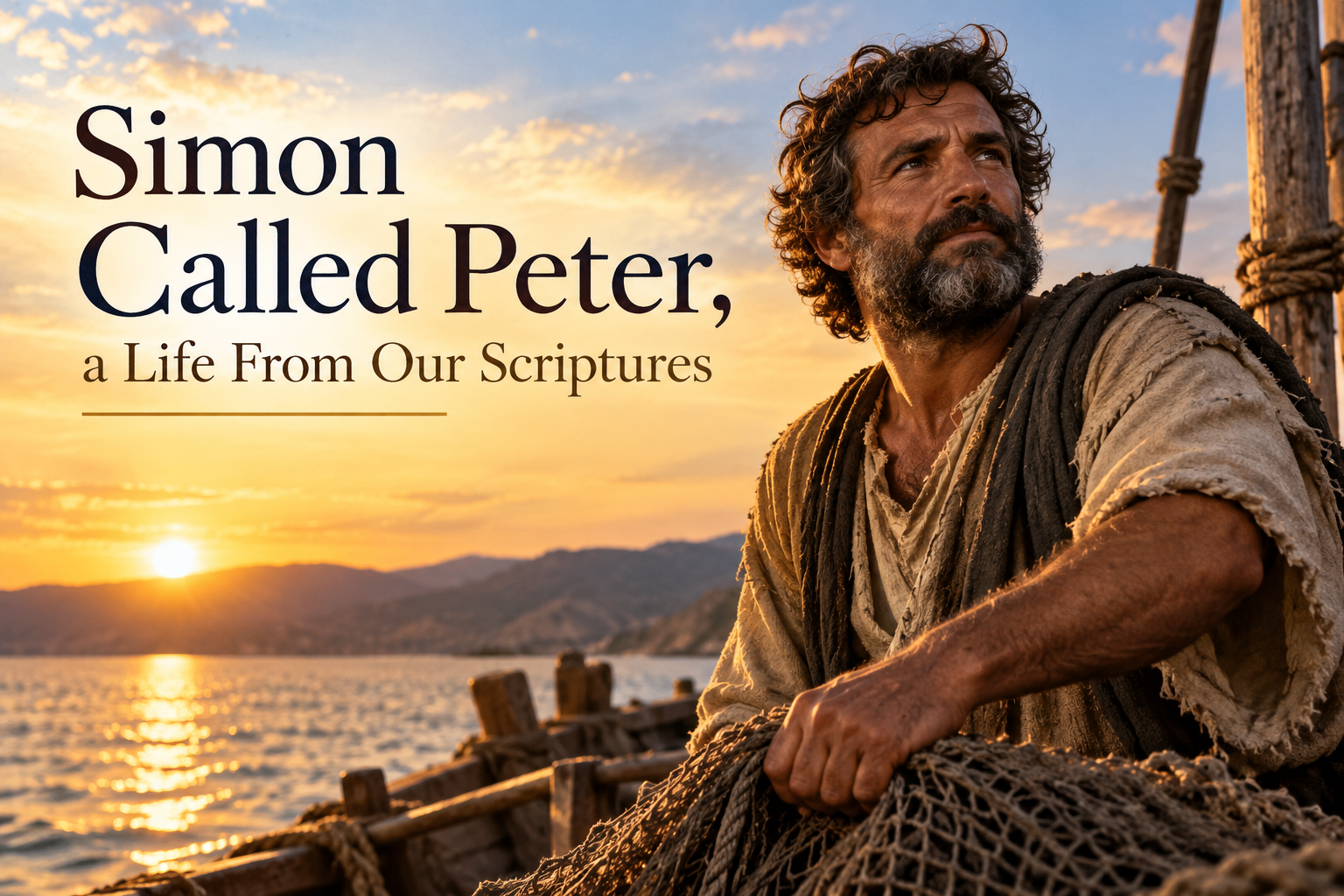
Most of what people believe about Peter comes from books outside our canon: the rock, the keys, the bishop of Rome. Read only the True Testament and a different man appears. He is a fisherman who knew he was a sinner, then sat in judgment on a sinful woman. He confessed Christ, wanted Moses and Elijah kept beside him, and denied him three times. Years later Paul found him at Antioch, still afraid of the men who kept the Law. Peter walked with Christ every day of the ministry, and he is the clearest proof in our scripture that being near Jesus is not the same as being rescued.
He walked with Christ along the way.
He walked with Christ and still was clay.
Nearness is not the Father's door.
He was close. He perished all the more.
Those lines are the chorus of our hymn "Perished All the More." I want to tell the life behind them, because Peter's story is one of the most misunderstood in the whole Christian world, and our scripture tells it in a way almost no one has heard.
What our scriptures leave us
Ask anyone what they know about Peter and you will hear about the rock the church was built on, the keys of the kingdom, the sermon at Pentecost, the two letters with his name on them, and the upside-down cross in Rome. None of that is in the True Testament. Those stories come from books the Imperial Church gathered later, and they were gathered, in large part, to put the Twelve on top.
What our scripture gives us is smaller and harder. Peter appears in the Evangelion from the call by the lake to the night of the denial. Then he appears in Paul's letters, in Galatians and in two lines of 1 Corinthians. That is the whole file. I am going to walk through it in order, and I am going to let the hymn walk with me.
The fisherman who knew he was a sinner
He left the nets upon the sand.
Our Evangelion meets Simon at the lake of Gennesaret. Jesus steps into "the one that belonged to Simon" and teaches the crowd from it (Evangelion 2:4 TT). Then he tells Simon to put out into deep water and let down the nets. Simon objects: "Teacher, we worked hard all night and caught nothing. But if you say so, I'll let them down." (Evangelion 2:6 TT)
The nets nearly break. Two boats fill until they start to sink. And Simon's first response to Christ's power is fear:
"When Simon Peter saw this, he dropped at Jesus' feet and said, 'Leave me, Lord. I'm a sinful man.'" (Evangelion 2:9 TT)
Christ's answer is spoken to Simon: "Don't be afraid. From now on, you'll be catching people." (Evangelion 2:11 TT) Then "they pulled their boats to shore, left everything behind, and followed him." (Evangelion 2:12 TT)
Christ did not leave him in his shame.
He called him out and spoke his name.
Hold on to that first scene, because it is the best Peter ever is in our scripture. He knew he was a sinner. He knew he did not belong near the one in his boat. Remember it when we come to the Pharisee's house.
The name
When Jesus chose the Twelve, our Evangelion lists him first: "There was Simon, whom he named Peter, and his brother Andrew; James and John; Philip, Bartholomew," (Evangelion 3:18 TT)
Tertullian noticed the renaming too, and remarked on it in his attack on Marcion's Evangelion. The name is all we are given. Our scripture attaches no rock to it, no church built on it and no keys. Christ gave Simon a new name. He did not give him a throne.
He walked the roads, he shared the bread,
He slept where Jesus laid his head.
From here on, Peter is with Jesus everywhere. He hears the teaching. He sees the healings. He is in the inner circle. If proximity could rescue anyone, it would have rescued him.
At the Pharisee's table
Now comes the scene I believe matters most, and the one where our True Testament reads differently from every Bible you have seen.
"One of the Pharisees invited Jesus to eat with him, so he went into the Pharisee's house and took his place at the table." (Evangelion 4:20 TT) A woman known in the city as a sinner comes in behind him. She weeps on his feet, wipes them with her hair, kisses them and pours ointment on them.
"When Simon Peter saw this, he said to himself, 'If this man were a prophet, he would know who this woman is who's touching him: she's a sinner.'" (Evangelion 4:22 TT)
The man who once fell at Jesus' feet and said "I'm a sinful man" is now sitting at the table, watching a sinful woman at those same feet, and sorting her. He says nothing aloud. The contempt is in his heart. He has her category ready, and he has a verdict on Jesus for not knowing it.
Christ answers what Simon did not say. Jesus turned toward the woman and said to Simon, "Do you see this woman? She washed my feet with her tears," (Evangelion 4:23 TT) "and she anointed and kissed them." (Evangelion 4:24 TT) "That's why I tell you, her many sins are forgiven, because she has loved much." (Evangelion 4:25 TT) And to her: "Your faith has rescued you." (Evangelion 4:27 TT)
Notice where Christ turns. He speaks to Simon, but he faces the woman. The disciple at the table is told to look at her. The woman on the floor is the one who goes home rescued.
I want to be clear about what this reading is, and about what the evidence says, because the familiar picture of this scene does not come from what the witnesses report of Marcion's Evangelion. Epiphanius quotes the scene from Marcion's text: Jesus went into the house of the Pharisee and reclined at table. Neither he nor Tertullian ever gives the host a name. In the church's Luke, the Pharisee who invited Jesus is the one who judges the woman in his heart, and Jesus answers him by name, Simon (Luke 7:39–40). No ancient witness quotes either of those verses from Marcion's text.
Modern scholars who reconstruct Marcion's Gospel see the same gap. Jason BeDuhn, Dieter Roth and M. David Litwa all leave Luke 7:39–43 out of their texts, so none of them has a Simon the Pharisee in this house. Matthias Klinghardt keeps verses 39 and 40. Simon the Pharisee belongs to the church's Luke. Nothing the witnesses report of our Evangelion puts him at this table.
No ancient witness names Simon Peter in this verse either, and our Critical Edition says so. It lists the verse among its recorded points, where the English keeps its reading by decision. It is our reading, and I hold it because the scene fits Peter's whole story in our scripture. We are also not the first to see Peter in the Simon of this house. In our translation of F. C. Baur's Marcion and the Gospel of Luke, Baur reports a critic of 1845, the so-called Saxon Anonymous, who saw "only one Simon" wherever a Simon appears with a Pharisaic stamp. Baur did not agree with him. But the reading has been on the table for nearly two centuries.
The confession and the silence
"You are the Christ," he said.
Midway through the Evangelion, Jesus asks the disciples who the crowds say he is, and then: "But who do you say I am?" Peter answered, "You are the Christ." (Evangelion 5:31 TT)
Most Bibles make this Peter's great moment. Ours does not linger on it. "Jesus warned them sharply and ordered them not to tell anyone," (Evangelion 5:32 TT) and went on, "The Son of Man must suffer many things, be rejected by the elders, the scribes and the chief priests, be killed, and after three days be awakened." (Evangelion 5:33 TT)
Peter said a title. Jesus silenced it and spoke of his rejection and death. Which Christ was Peter confessing? The one the Creator had promised Israel, the son of David who would restore the kingdom, the one every devout Jew was waiting for. I have set out the difference between those two figures in Two Messiahs. Peter had the right man and the wrong expectation, and the sharp warning was Christ refusing to let that expectation spread.
Booths on the mountain
He wanted what he knew was right.
Then comes the mountain. "Jesus took Peter, John, and James and went up on the mountain to pray." (Evangelion 5:36 TT) His face changes and his clothes become dazzling white, and two men appear with him: Moses and Elijah, the Law and the Prophets.
Peter's response says everything about him. "Peter said to Jesus, 'Teacher, it's good that we're here. Let's put up three tents, one for you, one for Moses, and one for Elijah.' He didn't realize what he was saying." (Evangelion 5:40 TT)
Three tents, side by side. Christ, the Law and the Prophets, given equal shelter. Peter wanted to keep what he knew and add Jesus to it.
The Father's answer was immediate. A cloud covered them, and "A voice came from the cloud: 'This is my beloved son. Listen to him!'" (Evangelion 5:42 TT) And then: "When the voice had passed, Jesus was there alone." (Evangelion 5:43 TT)
Peter offered three tents. The Father left one man standing. The Law and the Prophets were not given a tent beside the Son. They were gone. That is the line Peter never fully crossed, and we will see him fail to cross it again at Antioch.
For us or for everyone?
One small question tells us more. When Jesus taught about being ready, "Peter said to him, 'Lord, is this parable for us or for everyone?'" (Evangelion 8:32 TT)
It is a natural question for an insider. Is there a special word for the inner circle, or does the teaching fall on everyone alike? Jesus did not answer the question he was asked. He answered with a question of his own about faithful service: "Who then is the faithful and wise manager, the one the Lord puts in charge of his household to give them their food at the right time?" (Evangelion 8:33 TT) The answer to "us or everyone" was a call to serve the household, not a promise of rank in it.
The rooster and the look
At the last supper, Jesus sent "Peter and the others" to prepare the meal (Evangelion 14:5 TT). At the table, Peter made the boldest promise of his life:
"Peter said to him, 'Lord, I'm ready to go with you, even to prison and to death!'" (Evangelion 14:11 TT)
"But Jesus replied, 'I tell you, Peter: before the rooster crows today, you will say three times that you don't know me.'" (Evangelion 14:12 TT)
That night
He swore he'd stand and he would fight.
That same night Jesus was taken to the high priest's house, "but Peter followed at a distance." (Evangelion 15:6 TT) A servant girl saw him and said he had been with Jesus. "But Peter denied it: 'I don't know him.'" (Evangelion 15:8 TT) Someone else said, "You are one of them too," and Peter replied, "Man, that's not me." (Evangelion 15:9 TT) An hour later a third man insisted. "But Peter said, 'Man, I don't know what you're talking about!' Just as he spoke, a rooster crowed." (Evangelion 15:11 TT)
Then comes one of the most piercing sentences in the Evangelion: "The Lord turned and looked at Peter. Then Peter remembered what the Lord had said to him: 'Before the rooster crows today, you will say three times you don't know me.'" (Evangelion 15:12 TT)
And there our Evangelion leaves him. The Lord looks. Peter remembers. Nothing more is said.
He did not weep. He only heard
The rooster, and he knew the word.
Remembrance is not getting out.
He kept the fear. He kept the doubt.
The hymn puts it exactly. Our Evangelion records no tears, no turning back and no restoration scene. It records a man who remembered. Remembering what Christ said is not the same as being rescued by it. Peter knew the word, and he was still in the high priest's house, among the people who had arrested his Lord.
After the tomb
Our Evangelion gives Peter no part in the resurrection account. When the women came back from the empty tomb and "told all these things to the Eleven and to all the others," (Evangelion 16:13 TT) the response was flat disbelief: "But the disciples thought their words sounded like nonsense, and they didn't believe them." (Evangelion 16:14 TT)
The risen Christ walks with two of them on the road, and the one who speaks is named Cleopas (Evangelion 16:19 TT). He shows his hands and feet, eats in front of them, and sends them out: "Go and proclaim this to all peoples." (Evangelion 16:35 TT) Our Evangelion records no appearance to Peter by name. The chief disciple, in our scripture, is one of the group that called the women's report nonsense.
The pillar at Jerusalem
The next time we see Peter, years have passed, and we see him through Paul's eyes.
Paul is careful to say that he did not get his Evangelion from the Twelve. After God revealed his Son in him, "I did not immediately consult flesh and blood," (Galatians 1:15 TT) "nor did I go up to Jerusalem to those who were apostles before me; I went away into Arabia and returned again to Damascus." (Galatians 1:16 TT)
When he did go up, fourteen years later, he went "because of a revelation" (Galatians 2:2 TT), and he set his Evangelion before the leaders privately. His judgment of them is cool. "But from those who were of high reputation, what they were makes no difference to me; God shows no partiality. Those of reputation contributed nothing to me." (Galatians 2:6 TT)
Then the division of the field: "Recognizing the grace that had been given to me, Peter and James and John, who were regarded as pillars, gave to me the right hand of fellowship, that I should go to the nations and they to the circumcised." (Galatians 2:7 TT)
The famous pillar, so they say,
Gave Paul no gospel on that day.
"Regarded as pillars" is not praise. It is a report of reputation. Paul received nothing from them, and they kept for themselves the people still under the Law. Peter, in our scripture, chose to stay with the circumcised.
Antioch
Then comes the scene that settles the question.
"But when Peter came to Antioch, I opposed him to his face, because he stood condemned." (Galatians 2:9 TT)
Why? "For before certain men came from James, he used to eat with the nations; but when they came, he withdrew and separated himself, fearing those of the circumcision." (Galatians 2:10 TT)
Then circumcision came in sight.
He pulled his chair and left the light.
He feared the men who kept the Law.
He backed away from what he saw.
This is the same pattern we have watched from the start. At the Pharisee's table, he sorted the sinful woman by the Law's categories. On the mountain, he wanted Moses beside Christ. In the high priest's house, fear made him deny he knew Jesus. At Antioch, fear of the circumcision made him leave the table of the nations. It was not a single lapse. It was who Peter was.
And it spread. "And the rest of the Jews joined him in hypocrisy, so that even Barnabas was carried away by their hypocrisy." (Galatians 2:11 TT)
Paul did not let it pass. "But when I saw that they were not walking uprightly toward the truth of the Evangelion, I said to Peter in the presence of all, 'If you, being a Jew, live like the nations and not like the Jews, how can you compel the nations to live like Jews?'" (Galatians 2:12 TT)
Then Paul opposed him face to face.
He was not walking in the grace.
And then Paul states the principle Peter had abandoned: "We know that a person is not justified by works of Law but through faith in Christ Jesus; and we have believed in Christ Jesus so that we may be justified by faith in Christ and not by works of Law, because by works of Law no flesh will be justified." (Galatians 2:13 TT)
He snapped back to the Law he knew
The moment fear came walking through.
Our scripture never tells us that Peter changed his mind. The last scene of his life in the True Testament is a man publicly corrected for walking away from the truth of the Evangelion.
"I am of Cephas"
Peter appears twice more, by name only. In Corinth, the assembly had split into camps: "For one of you says, 'I am of Paul'; another, 'I am of Apollos'; and another, 'I am of Cephas.'" (1 Corinthians 1:12 TT)
There was already a Peter party, people who wanted to belong to the famous apostle. Paul refused to let any of them, himself included, become a banner. Everything is yours, he tells them, "whether Paul or Apollos or Cephas or the world or life or death or present things or future things: all are yours," (1 Corinthians 3:22 TT)
Cephas is on the list next to the world and death. He is not over the assembly. He belongs to the things the rescued are free of.
Where Peter is now
So what happened to Peter? Our scripture does not narrate his death. It does tell us where he stood. He lived inside the Creator's lines: clean and unclean, Jew and nations, the Law and the Prophets kept beside the Son. He feared the men who kept the Law more than he trusted the Evangelion. And "by works of Law no flesh will be justified."
Peter perished under the Law. That is the hard sentence, and I have defended it at length in The Twelve Are Still Perishing. The men whose names are on the cathedrals were not rescued by having walked beside the man in the likeness of flesh. Peter had the whole ministry of Jesus. He did not have the Father's rescue.
But hear the other half. Peter is not lost forever. The Father is not finished with the Twelve, any more than he is finished with the rest of the perishing. As The Rescue of All Things explains, the Father's reach is wider than the Creator's grip, and it does not skip the apostles. Peter is perishing now. He will be brought out then. What Peter could not do for himself, the Father will do for him, the same way the Father does it for every one of us.
Nearness is not the Father's door
Why does any of this matter for us?
Because almost every church on earth runs on Peter's mistake. It assumes that being close to the holy is the same as being rescued: close to the altar, close to the priest, close to the building, close to the tradition that claims to come down from the apostles. Peter was closer to Jesus than any bishop has ever been. He ate with him, slept beside him and saw his glory on the mountain. And he still sorted the sinful woman, still wanted Moses kept close, still denied his Lord and still pulled his chair away from the nations.
Rescue does not come by nearness. It comes from outside, from the Father who sends his Spirit to take hold of a soul that cannot climb out by itself. The woman at Jesus' feet had no standing, no history with him and no place at the table. She went home rescued. The disciple at the table did not.
So if you have ever thought you were safe because you were close, because you grew up in church, because you know the stories, because your family has always belonged, Peter is the warning. And if you have ever thought you were too far gone to come near, the woman is the answer. "Your faith has rescued you."
He walked with Christ along the way.
He walked with Christ and still was clay.
Nearness is not the Father's door.
He was close. He perished all the more.
You can hear "Perished All the More" on the Station and on our YouTube channel.