
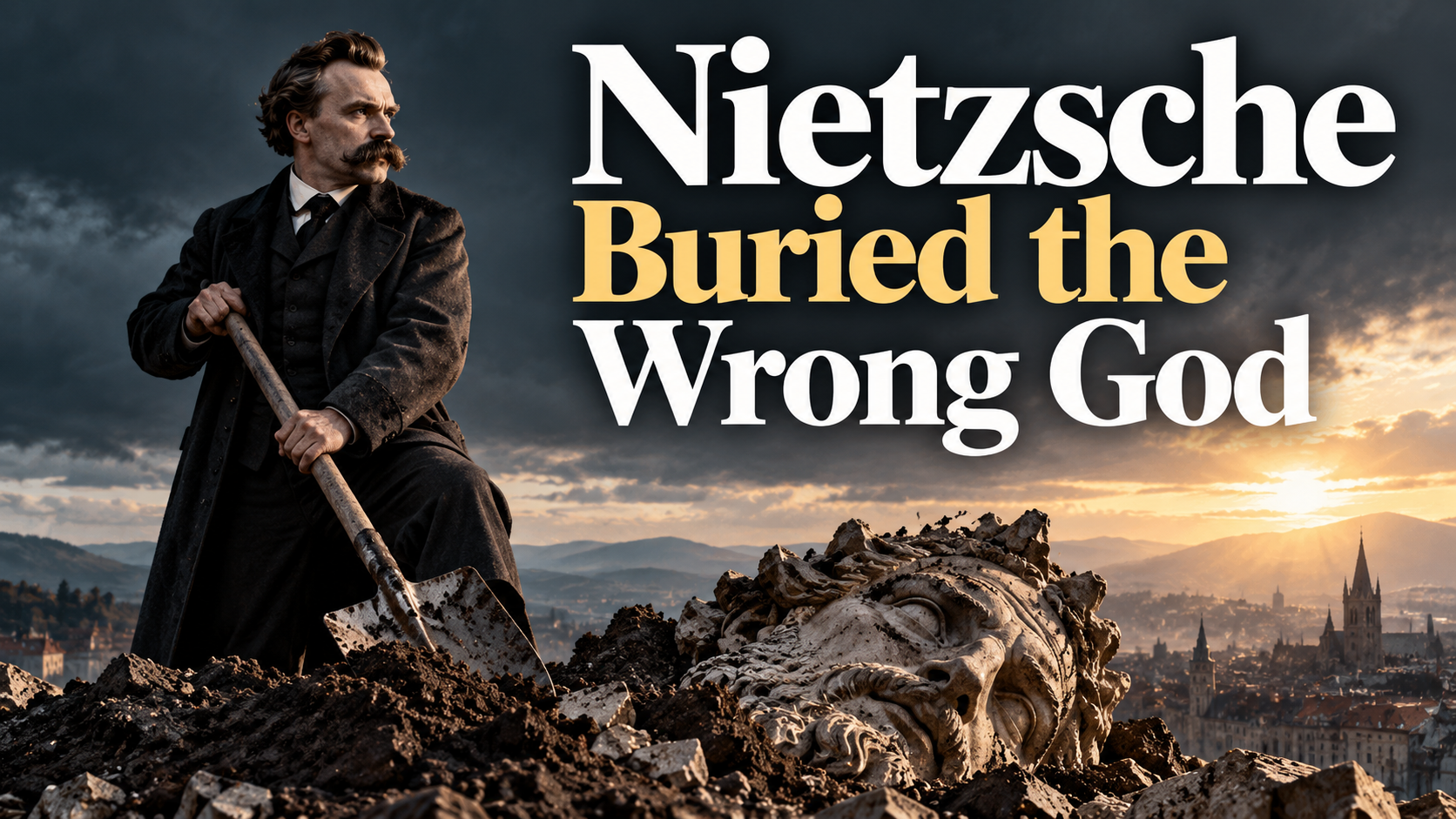
"God is dead." Few sentences from the last two hundred years are better known. The man who wrote it was Friedrich Nietzsche, and the book that made it famous is Thus Spoke Zarathustra. Nietzsche declared the death of God. He never asked which God had died.
Who Nietzsche was
Friedrich Nietzsche was born in 1844 in a small village in Prussian Saxony, the son of a Lutheran pastor. His father died before he was five, and he grew up in a household shaped by the church. He became a scholar of ancient Greek and Latin texts, and he was so good at it that the University of Basel in Switzerland made him a professor at twenty-four.
His health broke early. Headaches, eye trouble and long illnesses forced him to resign in 1879. For the next ten years he lived in rented rooms in Switzerland, Italy and the south of France, writing book after book. In January 1889, in Turin, he collapsed and never recovered his mind. He died in 1900.
He first announced the death of God in The Gay Science (1882), in the parable of a madman who runs into the marketplace crying that God is dead and that we have killed him. Then, between 1883 and 1885, he wrote the book he thought was his greatest: Thus Spoke Zarathustra.
Why the book mattered
Zarathustra is written like a Bible. It has a prophet who comes down from a mountain, sermons that begin "I teach you," beatitudes, disciples, a temptation and a last supper. Nietzsche knew the Lutheran Bible well enough to parody it line by line. In writing our reply, Against Zarathustra, we counted two hundred and fifty-three places where his book echoes, parodies or turns the Bible upside down. A pastor's son was writing a new testament.
Its prophet, Zarathustra, teaches four things that became famous:
- The overman (in German Übermensch, often translated "superman"): man is something to be overcome, and a higher kind of human must be willed into being.
- The will to power: all life, at bottom, is the drive to grow, master and overcome.
- Faithfulness to the earth: turn away from every hope of another world and love this one.
- The eternal recurrence: everything that has happened will happen again, exactly the same, forever. The task is to want it to.
These ideas left the book and entered the century. "God is dead" and "superman" became household phrases. Writers and philosophers of the twentieth century argued with Nietzsche for decades. Richard Strauss named a tone poem after the book, and its opening became one of the best-known pieces of music in film. The book also had a darker afterlife. After Nietzsche's collapse his sister took control of his papers, and her archive later enjoyed the favor of the Nazi regime, though Nietzsche himself, in a letter of 1887, had told her that he rejected antisemitism without ambiguity. Much of what the twentieth century thought it knew about Nietzsche passed through her hands first.
For a Christian, Zarathustra is the most ambitious challenge Nietzsche ever wrote. It does not argue that God is unlikely. It announces that God is dead and offers a new gospel in his place.
The question he never asked
The book opens with Zarathustra coming down from ten years alone on a mountain. In the forest he meets an old saint who still sings and prays to God. Zarathustra leaves him and says to his heart: "Could it be possible! This old saint in his forest has not yet heard anything of this, that God is dead!" (P.2.20).
Everything that follows rests on that announcement. But which God has died?
That is where a Marcionite reader comes in. Marcionites hold, as Marcion taught in the second century, that the God of the Law who made this world and the Father whom Jesus revealed are not the same God. The first was known from the beginning, in the commandments and in the world he made. The second was unknown until the Son made him known. Read Nietzsche with that distinction in mind, and his whole book looks different.
The God he described
Read what Nietzsche actually says about the God who died, and a picture emerges.
He is the God of commandments. In the book's first speech the free spirit must fight a great dragon, and Nietzsche names it: "'Thou shalt' is the name of the great dragon. But the spirit of the lion says 'I will'" (I.1.14). He is a judge. And in the fourth part of the book Zarathustra meets the last pope, an old man who says, "I served this old God until his last hour" (IV.6.10). The pope tells him what only a servant could know.
"When he was young, this God from the East, he was hard and vengeful, and built himself a hell for the delight of his favorites" (IV.6.31).
Nietzsche knew where that delight was written down. In another book, On the Genealogy of Morals, he quotes Tertullian, an early North African church writer, who looked forward to watching governors and philosophers burn in hell before his eyes. The pope's hell for the delight of the favorites is Tertullian's hell.
Then the pope describes the God's old age: "But at last he grew old and soft and mellow and pitying, more like a grandfather than a father, but most like a tottering old grandmother" (IV.6.32). And his end: "one day he choked on his all-too-great pity" (IV.6.33).
Notice what the pope has done. He has felt the seam between two characters, a hard and vengeful God and a kind one, and he explains it as old age. The church of the empire taught that the God who drowned the world in the flood and the God who is kind to the ungrateful are one and the same. Its last pope does not try to make the two agree. He tells them as one life story, and the only harmony he can find is old age.
Marcion felt the same seam and gave it a truer name. The hard God and the kind God are not one God at two ages. They are two.
The potter who took revenge
Zarathustra adds his own charge, and it is one of the sharpest things in the book.
"And if it was the fault of our ears, why did he give us ears that heard him badly? If there was mud in our ears, very well! who put it there?" (IV.6.38). "Too much miscarried for him, this potter who had never finished his apprenticeship! But that he took revenge on his pots and creatures because they turned out badly for him, that was a sin against good taste" (IV.6.39).
The potter is the Creator's own picture of himself. His prophets said that the clay may not question the potter. The story of the flood says it outright: the maker was sorry he had made mankind and resolved to destroy what he had made. That is the revenge on the pots.
We agree with Nietzsche entirely. A maker who gives his creatures ears full of mud and then rages that they did not hear, who shapes a vessel badly and then punishes it for its shape, is not a God of goodness. Nietzsche calls it bad taste. We call it the character of the Creator.
Where we part is the conclusion. Zarathustra's verdict is: "Away with such a God! Better no God, better to make destiny on one's own account, better to be a fool, better to be God oneself!" (IV.6.40). Look at the choices he weighs: such a God, no God, or yourself as God. He never asks whether the clay might have a different friend than its maker.
That is the whole message of the True Testament. Paul says Christ "purchased us from the curse of Law" (Galatians 3:9 TT). The clay was bought free from the potter by one who owed it nothing.
What he put in God's place
Once the old God is gone, Zarathustra does not look for another. He turns to the world that God made and worships it.
"I implore you, my brothers, remain faithful to the earth, and do not believe those who speak to you of otherworldly hopes!" (P.3.9).
Life is will to power. Fate is to be loved. And at the center of the book stands the eternal recurrence, the thought that came to Nietzsche in August 1881 beside a great rock near the Swiss village of Sils-Maria: everything will happen again, the same, in the same order, forever. Near its end the book sings that joy "wants recurrence, wants everything eternally the same" (IV.19.53).
Every one of these is a name for the Creator's order. The earth is the Creator's earth. The struggle of life against life is his law. The ring of recurrence is his world with the door shut. Nietzsche threw out the Creator's law and kept the Creator's world, and he praised that world more openly than any of its priests ever did.
He even supplied the joke against himself. In the fourth part, Zarathustra's guests hold a festival and kneel to an ass that "always says Yea to the world he created" (IV.17.25). Nietzsche meant it as mockery of the old faith. But a reader has to ask whether Zarathustra's own Yes to everything can be told apart from the ass's. It sounds very like it.
The Hebrew who died too early
Zarathustra speaks of Jesus at length only once, and he does it with real respect.
"Truly, too early died that Hebrew whom the preachers of slow death honor: and to many it has since become a doom that he died too early" (I.21.25). "Had he only remained in the wilderness and far from the good and the just! Perhaps he would have learned to live and learned to love the earth, and laughter as well!" (I.21.27). "Believe me, my brothers! He died too early; he himself would have recanted his teaching had he lived to my age! Noble enough was he to recant!" (I.21.28).
Zarathustra pities Jesus as a noble young man who was driven toward death and never learned to laugh. The Evangelion, the Gospel as the True Testament prints it, tells a different story. When the people of Nazara tried to throw him off a cliff, "Jesus walked right through the crowd and went on his way" (Evangelion 1:10 TT). A man who longed for death had his chance there and turned it down. As for laughter, he put it among his first promises: "Blessed are those who weep, because they will laugh" (Evangelion 3:24 TT). In the fourth part Zarathustra throws back at him the woe that follows in the same sermon, "How terrible for you who are laughing now, because you will grieve and cry" (Evangelion 3:27 TT), but the sermon that warns those laughing now also promises laughter to those who weep.
Would he have taken his teaching back if he had lived longer? The Evangelion answers that he came back from the dead, and did not. "Why are you looking for the living among the dead? He has been awakened" (Evangelion 16:10–11 TT). He sent his disciples out with the same message: "Go and proclaim this to all peoples" (Evangelion 16:35 TT). If there was ever a time for him to take it back, it was then.
Zarathustra is right about one thing. Jesus did not love the earth in Zarathustra's sense. He came to deliver us "from the present evil aeon according to the will of God the Father" (Galatians 1:4 TT), an aeon being an age of the world. But Zarathustra says Jesus hated man and earth together, and that is false. The Son refused the earth's god and loved its people. "The Son of Man came to rescue what was lost" (Evangelion 12:19 TT). Nietzsche could not imagine those two apart, because for him there was no God beyond this world's for whose sake one might refuse it.
Some god in you
Near the end of the book Nietzsche gave its most important line to someone else. The last pope listens to Zarathustra explain why the old God deserved to die, and answers: "O Zarathustra, you are more pious than you believe, with such an unbelief! Some god in you converted you to your godlessness" (IV.6.41).
The pope had already named what it was. "The lover loves beyond reward and retribution" (IV.6.30). That is a love that does not judge, does not keep accounts and does not repay. Zarathustra held to that standard firmly enough to condemn the God who fell short of it. He never asked where the standard came from.
It did not come from the Creator, whose world Zarathustra loved. It did not come from the judge, whose ledger of guilt he burned. It came from a goodness that does not belong to this world at all. Nietzsche described it more than once without knowing what he was describing. He asked for "the love that bears not only all punishment but also all guilt!" (I.19.12). He praised what he called the bestowing virtue, the virtue that gives, and likened it to gold, which "always gives itself away" (I.22.2). Those are not inventions waiting to be made. They are the Father's gift in the Son.
The Father he never heard of
Jesus gave that goodness a name. "No one knows the Father except the Son, and no one knows the Son except the Father, and anyone to whom the Son reveals him" (Evangelion 6:30 TT). This Father is "kind even to the ungrateful and the wicked" (Evangelion 3:35 TT). He does not command us to stay faithful to the earth. He does not ask us to want everything again, eternally the same.
Nietzsche ended his autobiography, Ecce Homo, with a motto: Dionysus against the Crucified. Dionysus, the Greek god of the vine that dies and grows back, stood for the world accepted exactly as it is. The Crucified stood, for Nietzsche, for life judged and condemned. We think he drew the line in the right place and put the two sides the wrong way round. Dionysus is the god of the world as it was made, the ring of recurrence given a face. The Crucified of our scripture is not the judge Nietzsche fled. He came from outside the ring and was killed by its powers. "None of the rulers of this aeon understood it; for if they had, they would never have staked the Lord of glory" (1 Corinthians 2:8 TT).
Nietzsche knew the God of the Law better than most of its defenders, and he turned him away. He heard the church of his day preach a Christ who was the judge's Son, and he refused him too. No one ever told him that the God he buried and the God he was looking for were not the same God.
He was right that the old God deserved to die. He was wrong that there was no other.
Against Zarathustra: A Marcionite Reply to Thus Spoke Zarathustra answers Nietzsche's book speech by speech, quoting him in our own translation from the German. It is in the True Testament library.