
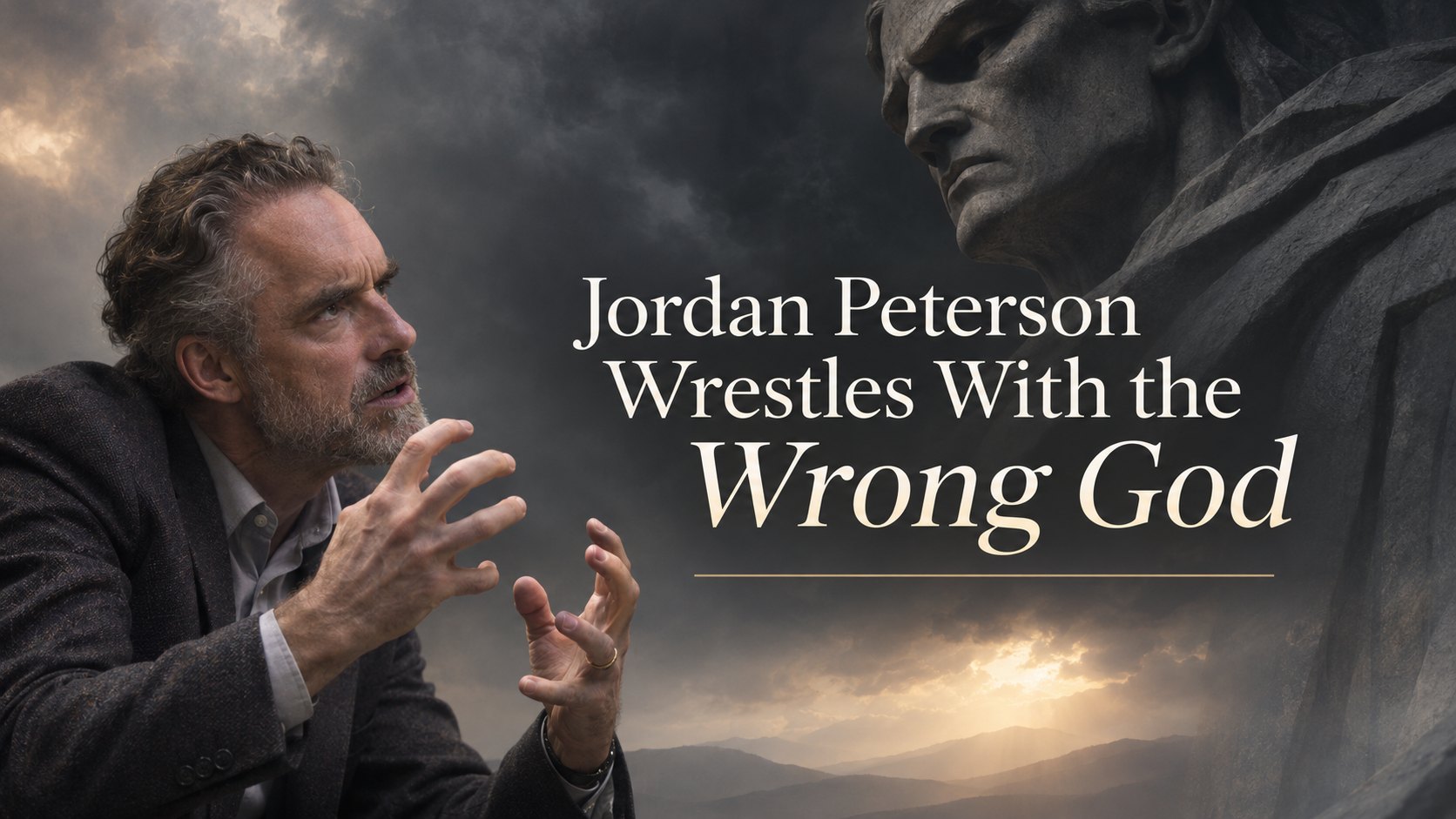
At the river Jabbok, in the thirty-second chapter of Genesis, Jacob wrestles with a stranger until daybreak. He will not let go until he is blessed, and he walks away with a limp and a new name, Israel, the one who strives with God. The title of Jordan Peterson’s book echoes the name Jacob was given that night. We Who Wrestle with God: Perceptions of the Divine, published in November 2024, reads the stories of Genesis, Exodus and Jonah as the record of a God who calls people out of comfort and into responsibility, and it treats wrestling with that call as the heart of faith.
The book is serious, and it deserves a serious answer. Our answer is that Peterson has described the God of Genesis and Exodus with real insight, and that this is exactly the problem. The God he describes is real. He is not the Father Christ revealed.
What Peterson Sees
The book works through Genesis, Exodus and the book of Jonah: creation, Adam and Eve, Cain and Abel, Noah, the tower of Babel, Abraham, Moses in two long parts, and Jonah. Its chapter titles tell the story of its God. Noah meets God as the call to prepare. Abraham meets God as a spirited call to adventure. Moses meets God as a dreadful spirit of freedom. Again and again the divine appears as the voice that calls a person out of comfort and into responsibility, and that demands sacrifice as the price of a life worth living. Abel’s offering is accepted and Cain’s is not; Abraham is ready to give up everything; Pharaoh’s tyranny is broken and a Law is given.
Peterson reads these stories as lessons in how to live: accept the moral order built into reality, offer your best upward, carry your burden, and you will find meaning and strength. Reviewers have noticed that he is not always clear whether God is a being who acts or the highest ideal a person aims at. Rowan Williams, reviewing the book in The Guardian, observed that some passages seem to identify God with our highest aspirations. Either way, the God of the book is the one who orders chaos, gives the Law, tests his servants and rewards the faithful.
We do not think Peterson is wrong about that God. He has read him more honestly than most preachers do, and he takes the Law as something to be reckoned with, not a set of suggestions. Our scripture takes that Law seriously too: “So then, the Law is holy, and the commandment holy and just and good.” (Romans 7:7 TT).
Which God Is in the Book
Our Systematic Theology teaches that the first question to ask of any sentence in our scripture that speaks of God is which God it speaks of. Paul uses the word “God” for more than one being. He speaks of the Father whom Christ disclosed, and he speaks of “the god of this aeon”: “In their case, the god of this aeon has blinded the minds of the untrusting, so that the light of the Evangelion of the glory of Christ, who is the image of God, might not shine to them.” (2 Corinthians 4:1 TT). We hold that the god of this aeon is the Creator, the one who made this world and gave its Law.
Put Peterson’s book to that question and the answer is not hard. The God who shapes the world out of chaos, who sets the tree in the garden and the cherubim at its gate, who accepts one brother’s offering and not the other’s, who drowns the earth, scatters the builders at Babel, tells Abraham to take his son up the mountain, hardens Pharaoh’s heart and gives the commandments on stone, is the Creator. Every chapter of We Who Wrestle with God is about him. That is why the book is so good at describing order, duty, sacrifice and the cost of defying the Law. It is a book about the God of this aeon, written by a man who admires him.
A Father No One Wrestled With
Peterson’s title makes a promise: that the divine can be reached by striving, by conscience, by holding on through the night. That may be true of the God Jacob met. It is not true of the Father.
Our Evangelion says plainly how the Father is known: “Everything has been entrusted to me by the Father. No one knows the Father except the Son, and no one knows the Son except the Father, and anyone to whom the Son reveals him.” (Evangelion 6:30 TT). And of the prophets it says: “For I tell you, the prophets did not see what you see.” (Evangelion 6:32 TT). Abraham, Moses and Jonah did not wrestle their way to the Father, however hard they strove. The Father was not there to be found. Paul speaks of his task “to enlighten all as to what the plan of the mystery is, which was hidden from the aeons from the God who created all things” (Laodiceans 3:6 TT). It was hidden even from the God Jacob wrestled.
In our scripture the movement runs the other way. The Father is not seized by the strong. He goes looking for the lost: in the two parables our Evangelion keeps, the shepherd goes after the sheep “until you find it”, and the woman searches the house “until she finds it” (Evangelion 10:1, 10:4 TT). The Son’s mission is summed up in one sentence: “because the Son of Man came to rescue what was lost.” (Evangelion 12:19 TT). No one in that sentence is wrestling. Someone is being rescued.
Order Is the House We Were Born Into
Peterson’s long-standing theme is that a person becomes whole by bringing order out of chaos: by taking up his place in the moral order of things and carrying its weight. For a world that has lost its footing, that sounds like wisdom, and for many young men it has been a lifeline.
Paul describes the same order from inside, and he does not call it home. “I still say, speaking in human terms, that while we were children, we were enslaved under the elements of the world.” (Galatians 4:3 TT). “For whoever is under Law is under a curse.” (Galatians 3:6 TT). The order Peterson asks us to embrace is, in Paul’s words, the household we were born into as slaves. The Law is holy within it, able to name what is wrong and unable to rescue anyone from it.
The Evangelion pictures that household as a strong man’s house: “When a strong man, fully armed, guards his house, his possessions are safe. But when someone stronger comes and overpowers him, he takes away the weapons he was relying on and divides up the plunder.” (Evangelion 7:18 to 7:19 TT). Christ does not come to help us carry our place in the house more bravely. He comes from outside to take the captives out. “But when the time was fulfilled, God sent forth his Son, so that he might purchase those under Law, that we might receive adoption.” (Galatians 4:4 to 4:5 TT).
Sacrifice Upward, Mercy Downward
Sacrifice runs through the whole book. Abel offers the best and is accepted. Abraham is willing to give up even his son. A good life, on this account, is one in which you offer up what you value most to what is highest, and are rewarded with meaning.
The Father of our Evangelion does not need anything offered up to him. “Instead, love your enemies, do good, and lend without expecting anything in return. Then your reward will be great, and you will be children of God. For he is kind even to the ungrateful and the wicked.” (Evangelion 3:35 TT). His kindness does not wait for the best offering. It goes to the ungrateful and the wicked first. “Only one is good: the Father.” (Evangelion 12:2 TT).
Where our scripture does speak of a price, the direction is reversed. We do not pay. The Son does: “Christ purchased us from the curse of Law by becoming a curse for us, for it is written: “Cursed is everyone who hangs on a tree.”” (Galatians 3:9 TT). In Genesis, Abraham climbs the mountain to give up his son to his God. In our scripture, the Son goes down into the curse of the Creator’s Law himself, to buy people out of it. The two stories look alike only from a distance. In one, a man proves his devotion by what he is willing to surrender. In the other, the Father gives, and asks nothing in return.
Jacob Walked Away Limping
Jacob’s blessing at the Jabbok came with a wound. He held on, he prevailed, and he walked away limping. That is an honest picture of life under the God of this aeon: you can win his blessing, but it costs you, and he leaves his mark.
The children of the Father are given a different name, and they do not earn it by holding on. “Because you are God’s children, he has sent his Spirit into our hearts, crying, “Abba, Father.”” (Galatians 4:6 TT). Paul even corrects himself on this point: “But now, having come to know God, or rather to be known by God” (Galatians 4:9 TT). The rescued are not the ones who took hold of God. They are the ones God took hold of.
Jordan Peterson has given a great many people a reason to open the Bible again, and he reads its first books with more courage than most of the church does. We would ask only one thing of him and of his readers. Before wrestling with God, ask which God you have hold of. The one in Genesis and Exodus will test you, command you and reward your sacrifice. The Father Christ revealed was never in those books at all, and he is not waiting at the river for you to prevail. He has already come looking.