
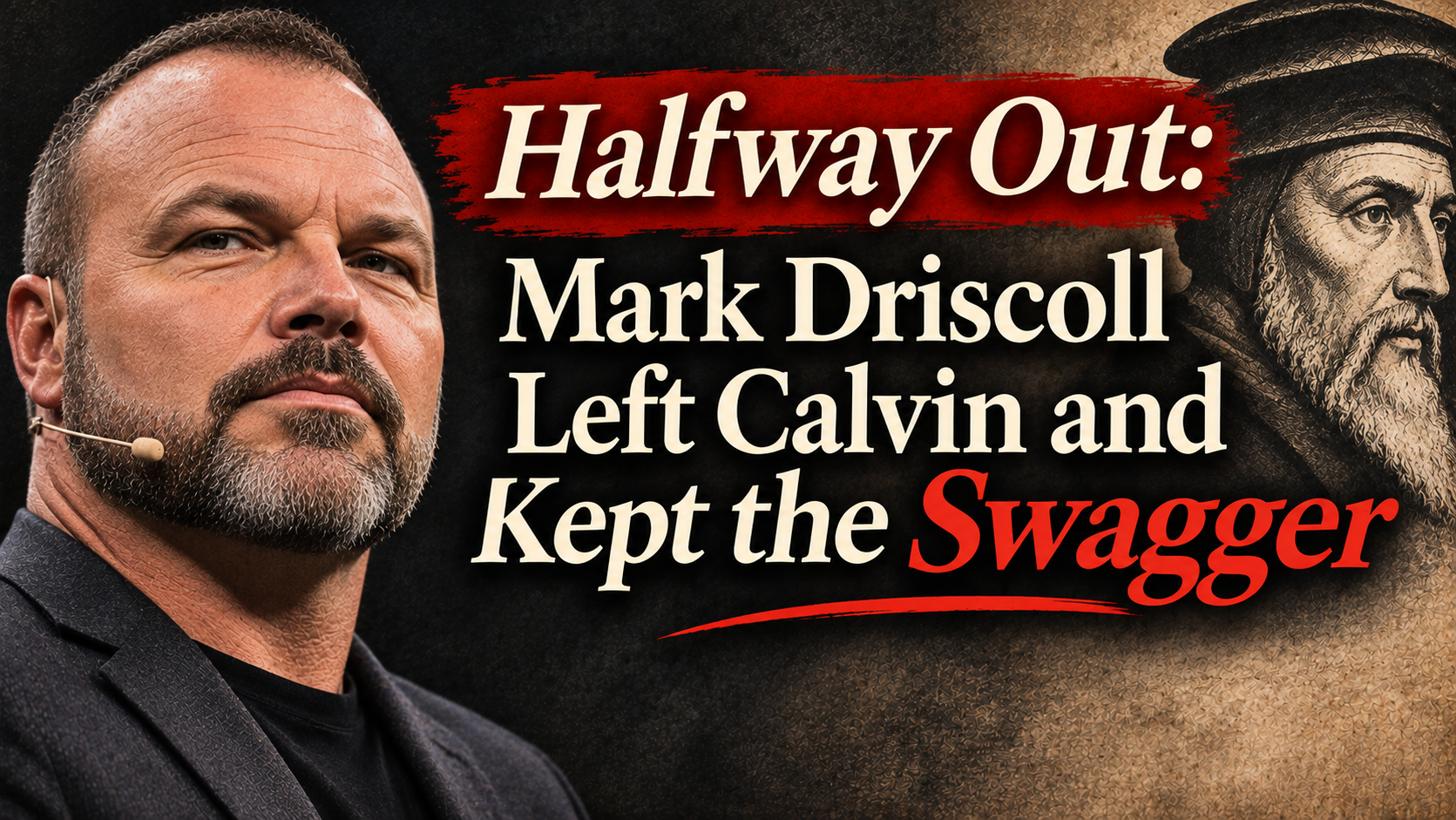
On May 25, 2025, Mark Driscoll posted a two-sentence sermon on X: “A Christian man who doesn’t work is worse than a non-Christian. This includes you, stay-at-home dads.” Two weeks earlier, on Mother’s Day, he had written that a voluntary stay-at-home dad who forces mom to leave the kids to earn the income is, in God’s eyes, worse than an unbeliever. The words echo 1 Timothy 5:8, a verse he had been applying to fathers since at least 2008, when he told viewers of a video that if you cannot provide for your family, you are not a man.
The posts were pure Driscoll, and on their own they would not need an article. What makes them worth a closer look is what had changed around them.
The Man Who Walked Out on Calvin
For most of two decades Driscoll was one of the best-known faces of Calvinism in America. He co-founded Mars Hill Church in Seattle and built it into a multi-site megachurch, co-founded the Acts 29 church-planting network in 1998, and stood near the centre of what Collin Hansen’s 2008 book called the “young, restless, Reformed” movement. He never held all five points of Calvinism, since he rejected limited atonement, but predestination, total depravity and the sovereignty of God were the bones of his preaching.
Then he walked away from it. In a video in 2019, by then preaching at Trinity Church in Arizona, he called the five points of Calvinism garbage. He said Reformed theology leaves God distant and non-relational, and he turned Calvinism’s favourite charge back on it: a system that begins with the total depravity of man, he argued, starts with man and not with God. His former allies in the Reformed world were not pleased. For once, we were.
On this point Driscoll has moved toward the True Testament. Our Systematic Theology teaches that election, in our scripture, is not a decree drawn up before creation that fixes a list of the saved and the passed over. It is the Father going out, by his good pleasure, after strangers who had no claim on him. In the Lord’s own words, “because the Son of Man came to rescue what was lost.” (Evangelion 12:19 TT). “But God chose the foolish things of the world to shame the wise, and God chose the weak things to shame the strong” (1 Corinthians 1:27 TT). The verses on which the church builds its decree are not in our edition, but the Systematic Theology does not argue from that absence. It argues from what the attested texts say, and what they describe is a search, not a list.
So when Driscoll says Calvin’s God is distant, we agree. When he says the system starts in the wrong place, we agree with that too. He found the door out of Calvin’s house. The question is what he carried out with him.
What He Did Not Leave Behind
He did not leave behind his picture of a man.
In 2000, posting as “William Wallace II” on his church’s online forum, Driscoll attacked feminism and the men he considered soft in language crude enough to become a national story when the posts resurfaced fourteen years later. To his credit, he has apologized for them more than once: in his 2006 book Confessions of a Reformission Rev, and again in a 2014 letter to his congregation, where he called the language wrong, said he was embarrassed by it, and wrote that he had changed. We take him at his word that he would not write those posts today.
But the picture behind them has outlasted every change in his theology. It ran through Real Marriage, the 2012 book he wrote with his wife Grace, which gave a full chapter to which sexual acts a Christian couple may perform. It runs through the “Real Men” ministry at Trinity Church. And it runs straight through the stay-at-home-dad posts of 2025. In each, a man is measured by provision, command and hardness, and softness is the sin. Driscoll stopped preaching Calvin’s God, but he kept the ranked household that the Reformed movement of his youth built around that God: authority coming down from a commanding God, through the husband, to everyone beneath him.
That is not an insult. It is a description of what he has said in public for twenty-five years. The fair question is whether the scripture he now reads with fresh eyes on election says what he thinks it says about men.
His Verses, Checked
Our canon is not the church’s Bible. It is the Evangelion and ten letters of Paul, recovered from what the ancient witnesses preserved, and every verse in it carries a grade in the Greek True Testament Critical Edition. That makes it possible to do something Driscoll’s critics rarely do: check his texts one by one, and give him the ones he has.
Where he has a text. Some of his ground is in our scripture, and attested:
- “Wives, be subject to your husbands.” (Laodiceans 5:8 TT)
- “For the husband is head of the wife as Christ is head of the assembly.” (Laodiceans 5:9 TT)
- “But I want you to know that the head of a man is the Christ, the man the head of the woman, and God the head of Christ.” (1 Corinthians 11:2 TT)
- “For even when we were with you, we commanded you this: If anyone is not willing to work, let him not eat.” (2 Thessalonians 3:4 TT)
Anyone who says Marcion’s Paul knew nothing of headship or of the duty to work has not read him. Driscoll would find these verses in our Bible, and we will not pretend otherwise.
Where he does not. His sharpest texts are not there. 1 Timothy 5:8, the verse behind the stay-at-home-dad posts, belongs to the Pastoral letters, which are not among the ten letters of the Apostolikon. The order that women keep silent in the assemblies, 1 Corinthians 14:34 to 35, is not printed in our edition. And the Christ Driscoll described in Relevant magazine in 2007, the prize fighter of Revelation with a sword in his hand, comes from a book our canon does not include. Those are the passages that give his teaching its edge, and our scripture does not supply them.
What cuts against him. Read in full, the verses he does have point somewhere he does not go.
The headship passage in Laodiceans does not define the husband by command. It defines him by care: “He who loves his own wife loves his own flesh. No one hates their own flesh, but feeds it and cares for it, just as Christ cares for the assembly.” (Laodiceans 5:10 to 5:11 TT). Our Systematic Theology states the limit plainly: whether headship means more than the care of one who feeds and cherishes, the attested text leaves open.
The work command is real, but it is about “anyone” who “is not willing to work”. A father who stays home to raise his children is not unwilling to work. He is working. Nothing in 2 Thessalonians makes a paycheck the test of manhood.
And on marriage itself, the Paul of our canon says the opposite of a ministry built on the marriage bed as a man’s great calling: “Concerning what you wrote: it is good for a man not to touch a woman.” (1 Corinthians 7:1 TT). “I wish all men were as I am; but each has his own gift from God, one in this way and another in that.” (1 Corinthians 7:4 TT). He says of his own advice on marriage: “What I say is permission, not command.” (1 Corinthians 7:3 TT). Where marriage is kept, the duty runs both ways: “The husband should give his wife what is due her, and likewise the wife her husband.” (1 Corinthians 7:2a TT). And the Evangelion places marriage itself in this aeon, not the next: “Jesus replied, “The people of this aeon marry and are married. But those whom the God of that age has considered worthy to take part in the resurrection from the dead neither marry nor are married.” (Evangelion 13:19 to 13:20 TT). Our Systematic Theology draws the conclusion: marriage belongs to this aeon and is permitted, not commanded, and continence is a gift some are given.
What Our Paul Asks of a Man
If Driscoll’s man is measured by command, ours is measured by service. Paul describes his own leadership in a single attested line: “For we do not proclaim ourselves but Christ Jesus the Lord, and ourselves as your slaves through Jesus.” (2 Corinthians 4:2 TT). When the disciples argued about which of them was the greatest, the Lord answered: “For the least among you all is the one who is truly great.” (Evangelion 6:8 TT). Our Systematic Theology gathers these into its teaching on leaders: those who lead the assembly serve it as slaves for Christ’s sake, without rank or domination.
Our scripture is not afraid of weakness either. Paul reports what the Lord told him: “And he said to me, “My grace is sufficient for you, for my power is made perfect in weakness.” Therefore I will most gladly boast in my weakness, that the power of Christ may rest upon me.” (2 Corinthians 12:5 TT). And the Evangelion gives men a harder command than any Driscoll has posted: “But I say to you who are listening: love your enemies. Do good to those who hate you.” (Evangelion 3:29 TT). “If someone hits you on one cheek, offer the other as well. If someone takes your coat, let them have your shirt too.” (Evangelion 3:31 TT).
None of that is soft. It is simply not the kind of strength that wins arguments on X.
Carrying the Furniture
Mark Driscoll deserves credit for something few celebrity pastors manage: he changed his mind in public on the doctrine that made his name. He saw that Calvin’s God was distant, and he said so.
But he walked out of Calvin’s house carrying the furniture. The God he preaches now is warmer than the one he left. The man he asks his men to be is still the one from the old house, ranked above his wife, measured by his paycheck, and quick to call another man’s softness a sin. The Paul of our canon left him the verses on headship and work, and then defined the first by feeding and caring and the second by willingness. He did not leave him 1 Timothy.
Driscoll got halfway out. The rest of the way runs through the verses he already has.