
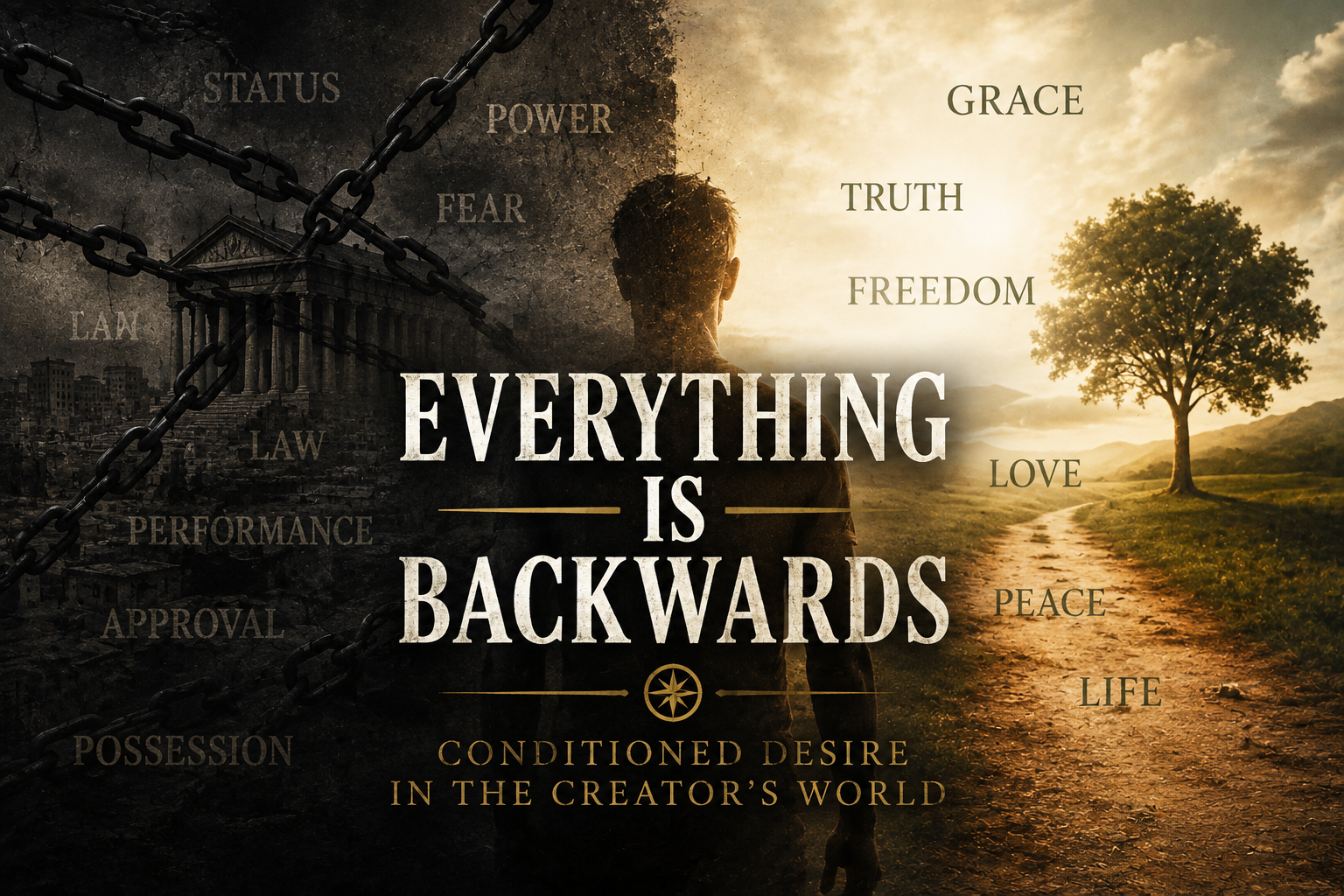
We usually imagine that our desires belong entirely to us. We speak of personal ambition, individual preference, private anxiety, and independent choice as though each arose within an untouched inner space. Paul offers a more difficult account. Before we could evaluate the world, we were already living inside it, and before we could choose its values, those values had already begun forming us.
Paul describes this condition through the language of childhood and slavery: “I still say, speaking in human terms, that while we were children, we were enslaved under the elements of the world” (Galatians 4:3 TT). Childhood matters in this sentence because children do not negotiate the structure into which they are born. They learn its language, depend upon its institutions, and receive its definitions of what is normal before they can ask whether those definitions are true.
Paul later describes the same condition by saying, “Formerly, when you did not know God, you were enslaved to those who are gods by nature” (Galatians 4:8 TT). So humanity’s ordinary religious condition is not knowledge of the Father expressed imperfectly. It is ignorance of the Father combined with enslavement to other powers. The gods available within the world belong to the world that formed us.
Laodiceans expresses the same idea through the metaphor of walking. Paul tells the assembly that they “were dead in your trespasses and sins, in which you once walked according to the aeon of this world, under the ruler of the power of the air, the spirit now working in the children of distrust” (Laodiceans 2:1–2 TT). The people are walking, choosing, working, speaking, and desiring, yet Paul calls them dead. Their activity does not prove freedom because their walk follows a path already established by the ruler of this domain.
Conditioning is an appropriate modern word for this Pauline reality, provided that we do not reduce it to social influence alone. Paul’s account is religious, political, bodily, and spiritual. The world forms people through families, economies, institutions, laws, fears, rewards, rulers, and ordinary habits, but behind these arrangements stands an administration of powers. Paul says that “our struggle is not against flesh and blood, but against the powers and the world rulers of this darkness, against the spiritual forces of wickedness in the heavenly places” (Laodiceans 6:5 TT).
The problem is therefore larger than bad education or inadequate self-awareness. A person cannot simply read a better book, adopt a healthier routine, and think their way outside the aeon. Such things may be useful within their proper limits, but the domain that formed our desires cannot provide the power needed to escape its lordship. We require an act from outside.
We Desire What the World Taught Us to Desire
The Creator’s world teaches that strength provides safety, wealth provides worth, control provides peace, recognition provides identity, and victory provides meaning. These lessons are rarely presented as a formal creed. They are embedded in the ordinary rewards and punishments of life. People learn them by observing who is admired, who is feared, who is ignored, and who is discarded.
This explains a contradiction many people recognize within themselves. We may hate the demands of the world while continuing to want what it promises. We condemn status-seeking while imagining how secure we would feel if we possessed more status. We resent the powerful while dreaming of acquiring enough power that no one can injure us again. We criticize systems of judgment while secretly hoping that the same systems will declare us righteous and condemn those who wounded us.
The contradiction does not mean that our suffering is insincere. It means that the world has trained both our fear and our proposed solution. When the domain wounds us, we instinctively seek healing through the rewards of the same domain. We try to overcome humiliation by becoming impressive, scarcity by possessing more, vulnerability by becoming untouchable, and judgment by obtaining a favorable verdict.
Even rebellion can remain conditioned by the system it opposes. A person may reject one hierarchy only to build another hierarchy with themselves nearer the top. A movement may oppose coercion while learning to coerce more effectively. A religious community may denounce the Creator’s cruelty while reproducing his courtroom through shame, exclusion, and fear. Changing places within the structure is not the same as leaving its lordship.
Paul describes the conflict between the inherited direction of flesh and the new direction of the Spirit: “Walk by Spirit, and you will not bring to completion the desire of the flesh. For the flesh desires against the Spirit, and the Spirit against the flesh; for these are opposed to one another, so that you may not do what you wish” (Galatians 5:16–17 TT). The conflict is not evidence that rescue has failed. It is evidence that a new direction has entered a life still located within mortal flesh.
The rescued person may therefore experience an uncomfortable division. The old rewards can remain emotionally persuasive even after their emptiness has become intellectually visible. We may know that the Creator’s approval cannot give life while still feeling its absence as rejection. We may understand that strength is not the source of power while still feeling ashamed of weakness. Recognition changes our understanding before every habit of desire has been changed.
Paul does not treat this contradiction as a minor lack of discipline. Flesh and Spirit represent opposed directions. The Spirit does not arrive to make flesh more successful at obtaining what the world taught it to want. The Spirit introduces the desire, language, and relationship of another Father.
The Father Did Not Create This World
Everything is backwards because the Father did not create the world that taught us what forward meant. The True Testament does not ask us to believe that one God created the domain, blinded its inhabitants, subjected them to decay, gave them a Law they could not fulfill, and then appeared in Christ to rescue them from His own arrangement. Paul distinguishes the god who administers this aeon from the God revealed in Christ.
He writes, “The god of this aeon has blinded the minds of the untrusting, so that the light of the Evangelion of the glory of Christ, who is the image of God, might not shine to them” (2 Corinthians 4:1 TT). The blinder possesses real authority within this aeon, but his jurisdiction is bounded. He is the god of this aeon, not the Father revealed by Christ.
Paul immediately contrasts blinding with illumination. He explains that the apostles do not proclaim themselves but Christ, and then writes, “For the God who said, Light shall shine out of darkness, has shone in our hearts to give the light of the recognition of his glory in the face of Christ” (2 Corinthians 4:3 TT). One god blinds minds so that the light will not shine; the other God shines in hearts so that recognition becomes possible. Collapsing these referents does not simplify Paul. It makes his argument incoherent.
The Father’s purpose is not to improve our performance within the blinder’s administration. Galatians identifies the direction of Christ’s work: “Who gave himself for our sins so that he might deliver us from the present evil aeon according to the will of God the Father” (Galatians 1:4 TT). The decisive word is from. Christ does not deliver the present evil aeon from poor management so that it can become the Father’s kingdom. He delivers people from the aeon according to the Father’s will.
This distinction prevents us from calling the world’s suffering a lesson designed by the Father. The Creator’s order teaches through penalty, scarcity, decay, and death. The Father reaches into that order through Christ because it cannot produce His life. He is the rescuer, not the architect of the captivity from which rescue is needed.
The world’s values appear normal because they are appropriate to the world that produced them. Strength is valuable in a domain governed by force. Accumulation appears reasonable in a domain of scarcity. Judgment appears necessary in a system organized by Law. Control seems desirable in a life constantly threatened by loss. These instincts are not inexplicable accidents; they are adaptations to the Creator’s house.
The Father’s revelation makes them appear backwards because His goodness comes from outside that house. He does not merely occupy a kinder position within the Creator’s hierarchy. He exposes the hierarchy itself as incapable of producing life.
The Foolishness That Reveals Wisdom
Paul’s proclamation overturns the world’s standards at their center. He writes, “For the message about the stake is foolishness to those who are perishing, but to those who are being rescued it is the power and wisdom of God” (1 Corinthians 1:18 TT). One message produces two perceptions because the hearers stand in different conditions. The perishing hear foolishness, while those being rescued encounter power.
The contrast is not between intelligent and unintelligent people. The world has already trained the perishing to recognize power through domination, visible victory, rank, and survival. A staked Christ cannot appear powerful according to those standards. He looks like someone the ruling order successfully destroyed.
The Father’s action reveals the inadequacy of the world’s perception. The stake is not powerful because execution became good. It is powerful because the Creator’s machinery performed the worst act it knew how to perform, and the Father did not permit that act to own the ending. The domain displayed its power to kill, while the Father revealed a life that death could not retain.
Paul presses the reversal further: “Because the foolishness of God is wiser than men, and the weakness of God is stronger than men” (1 Corinthians 1:25 TT). He then directs the Corinthians toward their own assembly. Not many were wise according to flesh, mighty, or noble. Instead, “God chose the foolish things of the world to shame the wise, and God chose the weak things to shame the strong, and God chose the least, the low-born, and the despised, the nothings, to nullify the things that are, so that no one may boast” (1 Corinthians 1:27–29 TT).
Paul is not claiming that ignorance is a virtue or that suffering automatically produces wisdom. His argument concerns the source of rescue. If the Father’s work depended upon the world’s strongest, wisest, and most honored people, the existing order could claim responsibility for the result. The domain could point to its finest products as evidence that its values had always been correct.
The Father instead reaches people whom the domain considers negligible. Their rescue demonstrates that worth was never determined by the Creator’s rankings. The low-born do not become valuable because they defeat the noble at the noble’s own contest. They expose the contest as irrelevant to the Father’s grace.
Everything is backwards because the people called “nothings” become evidence of the only power that can give life, while those called powerful remain unable to rescue themselves.
Weakness and the Location of True Power
The world treats weakness as disqualification because weakness interrupts production, control, and appearance. Institutions often tolerate vulnerable people only when their vulnerability can be hidden, overcome, or converted into an inspiring story. Paul refuses to hide the weakness of those carrying the Evangelion.
He describes the apostolic condition directly: “We have therefore this treasure in earthen vessels, that the surpassing power may be of God and not of us” (2 Corinthians 4:4 TT). The vessel remains earthen. It does not become the treasure, and it does not become indestructible because treasure has been placed within it.
The purpose of the contrast is attribution. The vessel’s fragility makes clear that the surpassing power comes from God rather than from the messenger. Paul therefore continues, “We are afflicted in every way, but not crushed; perplexed, but not driven to despair; persecuted, but not forsaken; struck down, but not destroyed” (2 Corinthians 4:5–6 TT).
These statements do not deny injury. Paul admits affliction, confusion, persecution, and collapse. His repeated “but not” denies only that these experiences possess final authority. Affliction does not become complete crushing, perplexity does not become final despair, persecution does not prove abandonment, and being struck down does not complete destruction.
This is the reverse of the world’s account of power. The world expects powerful people to avoid being struck down. Paul locates power in what prevents the struck-down person from being finally destroyed. The world expects authority to eliminate perplexity. Paul allows a person to lack answers without concluding that all hope has vanished.
Later in the letter, Paul describes a thorn in his flesh, “a messenger of Adversary,” that torments him (2 Corinthians 12:3 TT). He does not pretend to enjoy it. He says, “Concerning this I implored the Lord three times that it might depart from me” (2 Corinthians 12:4 TT). Seeking relief is therefore not evidence of distrust, and the torment itself should not be reassigned to the Father when Paul identifies its agent with Adversary.
The answer Paul receives is not a declaration that suffering is good. Christ tells him, “My grace is sufficient for you, for my power is made perfect in weakness” (2 Corinthians 12:5 TT). Weakness does not create the power of Christ. It becomes the place where that power can no longer be mistaken for Paul’s own ability.
The Father does not demand that earthen vessels pretend to be iron. He does not wait for weakness to disappear before entrusting people with purpose. He places treasure in clay so that the treasure will not be confused with its carrier.
Anxiety and Depression Are Not Evidence of Failed Rescue
Any theology of weakness must speak carefully about anxiety and depression. The Creator’s world can intensify both through instability, isolation, fear, comparison, violence, economic pressure, shame, and the demand for constant performance. A domain organized around scarcity and judgment gives people many reasons to feel unsafe.
Still, it would be wrong to claim that anxiety or depression proves the Father’s Spirit is absent. Such a claim would simply rebuild the Creator’s courtroom inside the suffering person. The person would endure the original pain and then be required to interpret that pain as evidence of spiritual failure.
Paul does not permit that conclusion. He writes that the outer person is decaying while the inner person is “being renewed day by day” (2 Corinthians 4:10 TT). So renewal and decay can be present within the same life. The Father’s act does not require us to deny the continuing conditions of mortal existence.
The inner person should not be treated as a naturally divine fragment hidden within the body. Paul describes an ongoing renewal, not the discovery of an untouched spiritual possession. The Father acts upon a person who could not generate His life from within the Creator’s order.
Romans makes the relationship between Spirit and weakness even clearer: “The Spirit also helps our weakness, for we do not know how to pray as we should, but the Spirit intercedes for us with groanings too deep for words” (Romans 8:20 TT). The Spirit does not arrive only after weakness has been conquered. The Spirit enters the weakness, helps within it, and prays where our own language fails.
A person who cannot form a confident prayer has not necessarily been abandoned. Groaning can become the location of the Spirit’s intercession. The inability to produce reassuring words may reveal dependence more honestly than a polished prayer produced to satisfy religious expectations.
The Father’s Spirit does not turn mental suffering into a moral defect. Anxiety and depression are not reliable measurements of adoption, trust, or divine presence. They belong to the complex bodily and psychological experience of life within a perishing order, and they deserve care rather than accusation.
Rescue changes whose voice has final authority. The Creator’s world says weakness makes a person less valuable. The Father’s Spirit cries “Abba” from within weak people and contradicts that verdict.
The Spirit Introduces Another Father
Human beings conditioned by the Creator’s world do not need only revised opinions. We need another relationship. Paul places this relationship at the center of adoption: “Because you are God’s children, He has sent His Spirit into our hearts, crying, Abba, Father” (Galatians 4:6 TT).
The cry does not originate as a human achievement. Paul does not say that we correctly identified the Father and then summoned His Spirit through sufficient understanding. The Father sends His Spirit, and the Spirit cries within us. Recognition follows invasion.
This is why the Spirit’s work cannot be reduced to self-improvement. Self-improvement takes the desires supplied by the world and helps us pursue them more efficiently. The Spirit contests those desires. He does not teach us to dominate more gently, accumulate more responsibly, or win the Creator’s approval through better religious performance. He teaches us to cry to a Father who does not belong to this world.
Galatians describes the sending of the Son in the same movement: “But when the time was fulfilled, God sent forth his Son, so that he might purchase those under Law, that we might receive adoption” (Galatians 4:4–5 TT). The Son is sent into the domain of Law to purchase those held beneath it. The Spirit is then sent into the hearts of those received as children.
Both movements begin with the Father. He sends the Son, grants adoption, and sends the Spirit. The rescued do not create the rupture. They are reached through it.
Laodiceans uses the language of resurrection: “But God, being rich in mercy, because of his great love with which he loved us, even when we were dead in trespasses, made us alive together with Christ, by grace you have been rescued” (Laodiceans 2:4–5 TT). Dead people do not cooperate in being made alive. The action belongs to the Father, whose mercy reaches those walking under another ruler.
Paul eliminates boasting explicitly: “For by grace you have been rescued through faith, and this is not from yourselves, it is the gift of God, not from works, so that no one may boast” (Laodiceans 2:8–9 TT). The movement out of conditioned desire cannot become another achievement by which the rescued declare themselves wiser than the perishing. If sight has changed, the Father opened the eyes.
Seeing Differently Does Not Happen All at Once
The indwelling of the Spirit establishes new lordship, but Paul does not describe rescued people as instantly free from every habit learned within the Creator’s world. Flesh continues to desire against Spirit, and Spirit against flesh. The rescued therefore live within a real conflict.
This explains why old desires can return with surprising force. A person may recognize the emptiness of status and still feel wounded when overlooked. Someone may reject the world’s measurements of success and still experience shame when unable to meet them. A person may understand grace and still instinctively attempt to earn love.
These contradictions do not prove that the Spirit has accomplished nothing. They demonstrate how deeply the domain formed us. We learned its grammar before hearing the Evangelion, and some of its sentences continue to sound natural even after we know they are false.
Paul describes renewal as occurring “day by day” rather than all at once. This protects rescued people from panic when they discover the old world still echoing within them. The Father does not abandon His children because the conditioning of the house remains audible.
The Spirit’s opposition to flesh is itself evidence that another direction has entered. Before the Father’s reach, the world’s values could appear simply natural. Conflict begins when they are exposed as belonging to another lordship.
The goal is not perfect self-monitoring. Constantly examining every desire can become another attempt at control. The rescued depend upon the Spirit who helps weakness, intercedes beyond language, and continues the work the Father initiated.
Learning to Live Backwards
If the Creator’s world has reversed our understanding of life, then living according to the Father will often appear backwards. The rescued refuse domination not because they are too weak to obtain it, but because domination belongs to the wrong order. They release the need to prove worth because grace has already excluded boasting. They can admit uncertainty because truth does not depend upon their performance of certainty.
This reversal becomes visible in Paul’s ethic of neighbor-love. Romans does not provide the assembly with a program for seizing the Creator’s institutions in the Father’s name. It gives a much more direct rule: “He who loves his neighbor has fulfilled the law” (Romans 13:1 TT). Paul explains that the commandments are summed up in loving one’s neighbor and concludes, “Love does no wrong to a neighbor; therefore love is the fulfillment of the law” (Romans 13:3 TT).
Love is not weakness according to the Father’s order, even when the world interprets it that way. Refusing to harm another person may look ineffective within a system that rewards coercion. Telling the truth without manipulating its reception may look foolish within a culture organized by appearances. Serving a neighbor who cannot repay us may look wasteful within an economy that measures every relationship by return.
The rescued are not called to serve the Creator’s purposes, but this does not free them to ignore people living inside his world. Neighbor-love must be distinguished from service to the domain. We can feed, comfort, protect, and speak truth to people without pretending that the Creator’s house is the Father’s kingdom.
Paul gives the spatial basis for this life when he writes, “Our citizenship is in the heavens above, from where we eagerly await a rescuer, the Lord Jesus Christ” (Philippians 3:6 TT). The rescued live on Creator soil while belonging to another sovereign. Their conduct is therefore embassy behavior rather than a campaign to renovate the present evil aeon into a permanent home.
An embassy remains present without confusing the foreign city with its homeland. In the same way, the assembly remains among neighbors, workplaces, families, and institutions while refusing to grant those structures final authority. It practices the Father’s love inside a domain that did not produce that love.
The Reversal of Condemnation
The Creator’s world conditions people through accusation. We learn to examine ourselves as defendants, compare ourselves with others, collect evidence of worth, and fear the verdict attached to failure. Religious systems often intensify this conditioning by placing the Father on the Creator’s bench.
Romans rejects that arrangement: “Therefore there is now no condemnation for those who are in Christ Jesus. For the law of the Spirit of life in Christ Jesus has freed us from the law of sin and of death” (Romans 8:1–2 TT). Both verses are Probable in our edition; the attested ground is Galatians 5:1 TT, “Stand firm, then, in the freedom with which Christ freed us.” Freedom does not come from the Creator’s court finally issuing a favorable ruling. It comes from the law of the Spirit liberating people from the law of sin and death.
This is another reason everything feels backwards. We expect acceptance to follow improvement because every institution in the world trains us to earn favorable judgment. The Father makes alive through grace, and renewal follows rescue.
The absence of condemnation is not permission to harm others. Paul’s ethic remains clear that love does no wrong to a neighbor. What disappears is the belief that fear of the Father’s prosecution must produce goodness.
The Father is not the prosecutor from whom Christ persuades us to hide. He is the one who sends the Son and the Spirit. He rescues people from the administration that taught them to understand every relationship as a trial.
Another Direction
The phrase “everything is backwards” should not suggest that the Father simply commands the arbitrary opposite of whatever the Creator commands. The Father is not a reversed Creator. His goodness is not defined by opposition alone.
Rather, the Father’s revelation gives us a true direction from which the world’s distortion becomes visible. We recognize domination as weakness because we have encountered power that does not need to dominate. We recognize Law as incapacity because we have encountered grace that makes alive. We recognize worldly wisdom as foolishness because we have encountered Christ on the stake. We recognize the present aeon as captivity because the Father has given us another citizenship.
The reversal is therefore revelatory. The Father does not become intelligible by rearranging the Creator’s values. The Creator’s values become intelligible when exposed to the Father.
This protects the article’s argument from becoming mere contrarianism. Not everything unpopular is true, and not everything weak is good. The messenger of Adversary is not made good by the weakness it causes. Depression is not spiritually superior to joy. Poverty is not automatically holiness. Ignorance is not revelation.
The Father’s goodness remains the measure. Weakness matters because Christ’s power rests upon the weak. Foolishness matters because the message about the stake reveals the Father’s wisdom. Love matters because it does no wrong to the neighbor. Grace matters because it rescues those who could not rescue themselves.
Conclusion
We were conditioned by the Creator’s world before we understood that conditioning was taking place. Its values entered through ordinary life and taught us what to admire, fear, pursue, and avoid. We learned to seek safety through strength, identity through recognition, peace through control, and righteousness through favorable judgment.
Even after we begin to hate what this system does to us, we may continue to desire what it offers. That contradiction is not proof that our suffering is false or that the Father has rejected us. It reveals how completely the world formed the instincts with which we first approached everything, including God.
The Father does not demand that we escape this conditioning before He reaches us. He sends His Son to deliver us from the present evil aeon, receives us into adoption, and sends His Spirit into our hearts. The Spirit does not merely provide new information. He introduces another Father, another citizenship, and another direction of life.
The resulting conflict is real. Flesh continues to desire according to the world that formed it, while Spirit desires against flesh. The rescued may still struggle with status, fear, control, anxiety, depression, and the longing for approval. None of these experiences authorizes us to declare the Spirit absent. The Spirit helps precisely in weakness and intercedes when words fail.
Paul’s reversals therefore become good news rather than new demands. We do not need to become strong enough to qualify for the Father’s power. The treasure was intentionally placed in earthen vessels so that the power could not be mistaken for ours. We do not need to become wise enough to discover the Father. The message that appears foolish within the domain becomes power among those being rescued. We do not need to earn life through works. By grace we have been rescued, and this is not from ourselves.
Everything is backwards because we learned direction inside the wrong house. Strength looked like power, control looked like peace, approval looked like life, and condemnation looked like justice. The Father did not ask us to locate the exit using the instincts the house gave us. He sent His Son into the house, and He sent His Spirit into our hearts.
We do not see differently because we finally became wise enough. We see because the Father reached us.