
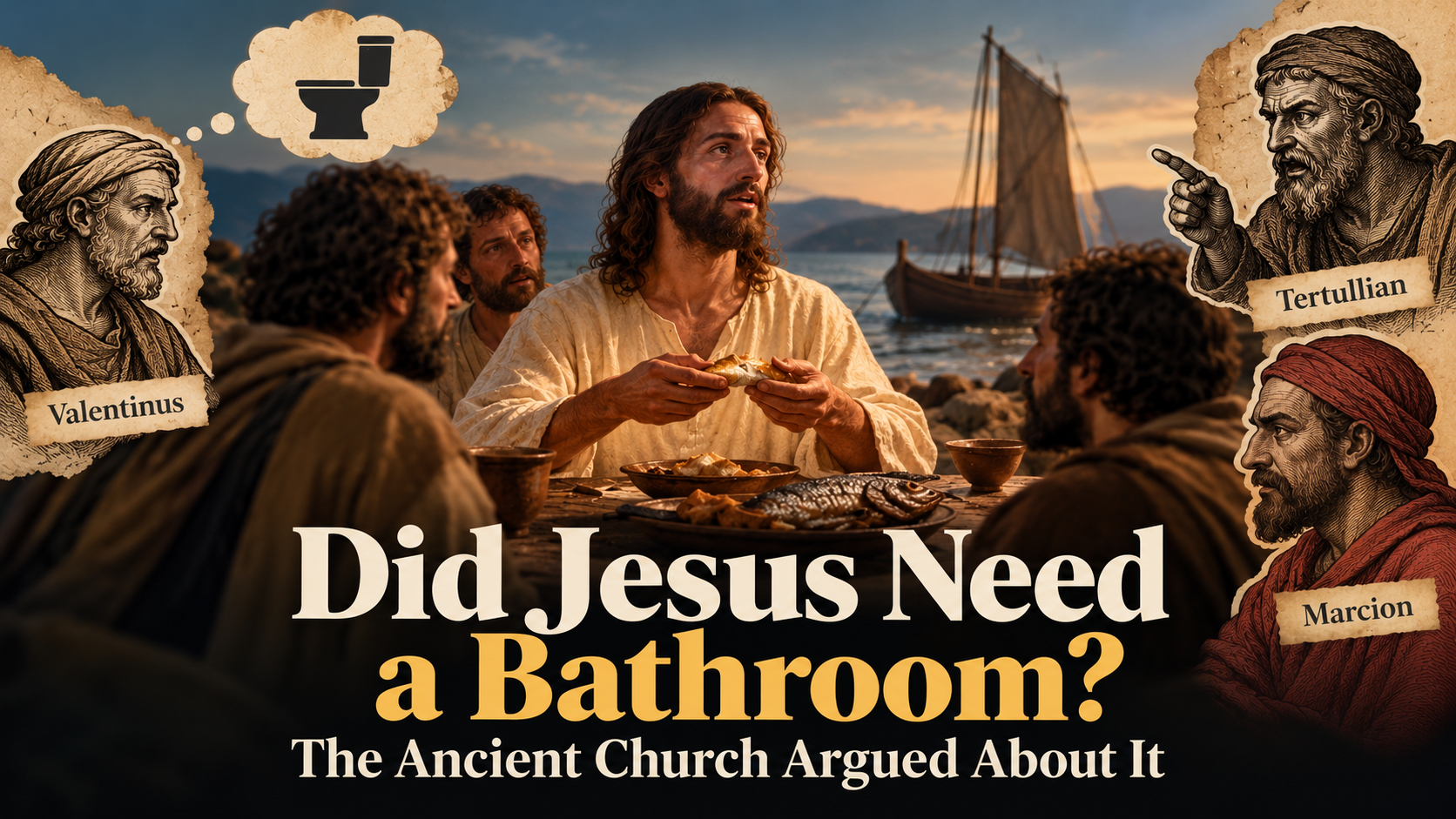
It sounds like the question a ten-year-old asks in Sunday school and gets shushed for. Most adults would never say it out loud. But in the second century, Christian teachers took it seriously, wrote about it, and at least one of them gave a famous answer: no.
The question was never really about plumbing. It was about whether the Son of God had a real body, what kind of body it was, and where it came from. Those questions divided the early church, and they sit right at the center of what the True Testament Assembly believes. So I want to take the question seriously too: what the ancient teachers said, what our Evangelion shows, and what we hold.
A Teacher Who Said No
Valentinus was a Christian teacher from Egypt who came to Rome around the year 140 and taught there for many years. Most of his writings are lost. A few sentences survive because other writers quoted them, and one of those sentences is about Jesus and food.
Clement of Alexandria preserves it in the third book of his Miscellanies, a book about self-control, marriage and the body (Stromata 3.59.3). It comes from one of Valentinus's letters. Here is the Greek, in my own translation:
He endured all things and was self-controlled. Jesus was exercising divinity. He ate and drank in a way all his own, without passing the food. So great was his power of self-control that the food was not corrupted in him, since he himself had no corruption.
Notice what Valentinus does and does not say. He does not deny that Jesus ate. He could hardly deny it, since the Gospels show Jesus at one table after another. What he denies is the other end of the process. In his view the food was never corrupted inside Jesus and never passed out of him, because nothing in Jesus could decay.
That tells you what Valentinus thought holiness was. For him, corruption, rot and waste belonged to the lower world, and a divine being had to be above them. So Valentinus kept the eating and quietly removed the bathroom.
What Marcion Was Accused Of
Marcion was teaching in Rome in the same years. His opponents said his Christ only seemed to have a body, and the charge has followed his name ever since. In our book Against Tertullian I granted that the ancient reports say Marcion denied Christ's flesh, and that Tertullian is not the only writer who says so. I am not going to take that back here.
But look at what, according to Tertullian, the Marcionites actually objected to. In the third book of Against Marcion, written around 207, Tertullian challenges them to explain why their God would not show his Christ in true flesh: "If he disdained it as earthly and, as you say, defiled with excrement, why did he not accordingly despise its image as well?" (Against Marcion 3.10.1). The Latin is blunter than the English. Stercoribus infersam means stuffed with dung. "As you say," Tertullian adds. He is reporting what the Marcionites said, not making the charge up himself.
So the bathroom question is not a modern joke. It is, by Tertullian's report, a Marcionite argument. Human flesh, they said, is full of filth.
Then Tertullian turns the argument around and shows where the real disgust lay. He dares his opponent to go all the way: "call the womb, the workshop for producing such a great animal, that is, man, a sewer; pursue the unclean and shameful torments of birth and the foul, anxious, ridiculous consequences of childhood itself" (Against Marcion 3.11.7). In the fourth book he returns to the same complaint, against heretics "who with great bitterness declaim all the foulness of his birth and upbringing and even the unworthiness of his very flesh" (Against Marcion 4.21.10).
Read those passages together and, in Tertullian's account, the objection falls hardest on birth: the womb, conception, the whole machinery by which the Creator makes human beings. That is a different question from whether Jesus ate, and it leads somewhere different.
What the Evangelion Shows
Our Evangelion, Marcion's Gospel, has no birth story. It does not mention a manger, a mother's pregnancy or a childhood. It begins with a date and an arrival: "It was the fifteenth year of Tiberius Caesar's reign, in the days of Pilate" (Evangelion 1:1 TT). "That's when Jesus descended into Capernaum, a town in Galilee" (Evangelion 1:2 TT).
But once he arrives, this Gospel shows him living in a body. People notice that his disciples do not fast: "Why do John's disciples fast so often and pray, and the Pharisees do the same, but your disciples eat and drink instead?" (Evangelion 3:1 TT). He accepts dinner invitations: "One of the Pharisees invited Jesus to eat with him, so he went into the Pharisee's house and took his place at the table" (Evangelion 4:20 TT). He sleeps: "While they were sailing, he fell asleep" (Evangelion 4:38 TT). On his last night he says, "I have eagerly desired to eat this Passover meal with you before I suffer" (Evangelion 14:7 TT).
The strongest scene comes after he rises. The disciples are terrified: "Startled and afraid, they thought they were seeing a ghost" (Evangelion 16:28 TT). He answers them, "Look at my hands and my feet. It's really me. A spirit doesn't have bones, as you see I have" (Evangelion 16:30 TT). Then he settles the question in the most ordinary way possible. He asks, "Do you have anything here to eat?" (Evangelion 16:31 TT). "They gave him a piece of broiled fish" (Evangelion 16:32 TT). "He took it and ate it in front of them" (Evangelion 16:33 TT).
This scene is not something our edition supplied. Tertullian himself confirms that it stood in Marcion's text. I should note one detail, because a careful reader will find it anyway. Tertullian quotes the line as "a spirit does not have bones, as you see me having them," without the word "flesh," and he says Marcion read it in his own way (Against Marcion 4.43.6-7). Our edition follows his line. On the meal, too, Tertullian leaves no doubt. Marcion kept it, and Tertullian enjoys pointing out what it means: "because they still did not believe, he therefore desired food, so that he might show that he also had teeth" (Against Marcion 4.43.8).
Whatever the Marcionites argued about flesh, their own Gospel, in its closing scene, shows the risen Lord eating fish in front of witnesses.
So Did He?
Scripture does not say, and I am not going to invent a verse. The Evangelion is not interested in the private details of anyone's day, and neither are Paul's letters.
But it tells us enough to draw the ordinary conclusion. He ate at tables. He slept in a boat until a storm forced his disciples to wake him. After he rose he asked for food and ate it so that no one could call him a ghost. A man who eats, sleeps and asks for something to eat is living in a body that does what bodies do. Valentinus had to add a miracle to avoid that conclusion, and no Gospel gives him one. The plain reading of the text is that the Lord's body was not exempt from the life of a body.
What We Hold
Our commentary states our position in three short clauses: "We hold that Christ was not born. His body was real, and no womb produced it."
That puts us in a different place from each of the ancient parties.
We differ from Valentinus, because we do not need to protect Jesus from his own body. A body that takes in food and is untouched by it is hardly a body at all, and our text gives him a real one.
We differ from the Marcion of the ancient reports, who is said to have denied the flesh altogether. Our faith is that his body was real.
And we differ from the Imperial Church, which teaches that he was born of the virgin Mary. Our Evangelion has no birth. Our Paul speaks of the Son being sent, not born: "But when the time was fulfilled, God sent forth his Son" (Galatians 4:4 TT). The words "born of a woman" that follow in the church's Galatians are not in ours. He describes Christ "in the likeness of a human being" (Philippians 2:3 TT), and he says "the Father sent his own Son in the likeness of sinful flesh" (Romans 8:3 TT).
So our answer to the second-century argument has two halves. The objection to the Creator's machinery of birth and generation was right about where the Son did not come from. He was not produced by the womb, the seed and the long chain of human generations that belong to the Creator. He came down from outside. But having come, he did not hold himself back from the world he entered. He ate its food, slept in its boats, and died its death, "becoming obedient unto death: death on the stake" (Philippians 2:4 TT).
Why It Matters
A question like this is useful because it exposes what people think holiness looks like. For Valentinus, holiness meant being untouched by decay. For many Christians today, it still means something close to that: a Jesus so clean and so different from us that we would rather not think about him being hungry, tired or anything else that bodies are.
The Evangelion gives us a different picture. The Father it reveals "is kind even to the ungrateful and the wicked" (Evangelion 3:35 TT). That Father did not send a messenger who kept his distance from the mess of human life. He sent his Son into the actual world, to sit at actual tables with actual people, and to share bread and fish with them.
The ancient church argued about whether Jesus needed a bathroom. Valentinus said no. Tertullian said the Marcionites found the flesh disgusting. Our Gospel answers with a piece of broiled fish, eaten in front of witnesses by a man who had died on the stake. That is enough for me. The Son was not born of this world's machinery, but he did not pretend to be above the life of a body. He came all the way in.
Scripture is quoted from the True Testament. Tertullian is quoted from the True Testament library's English translation of Against Marcion*. The fragment of Valentinus is my own translation of the Greek preserved by Clement of Alexandria,* Stromata 3.59.3.