
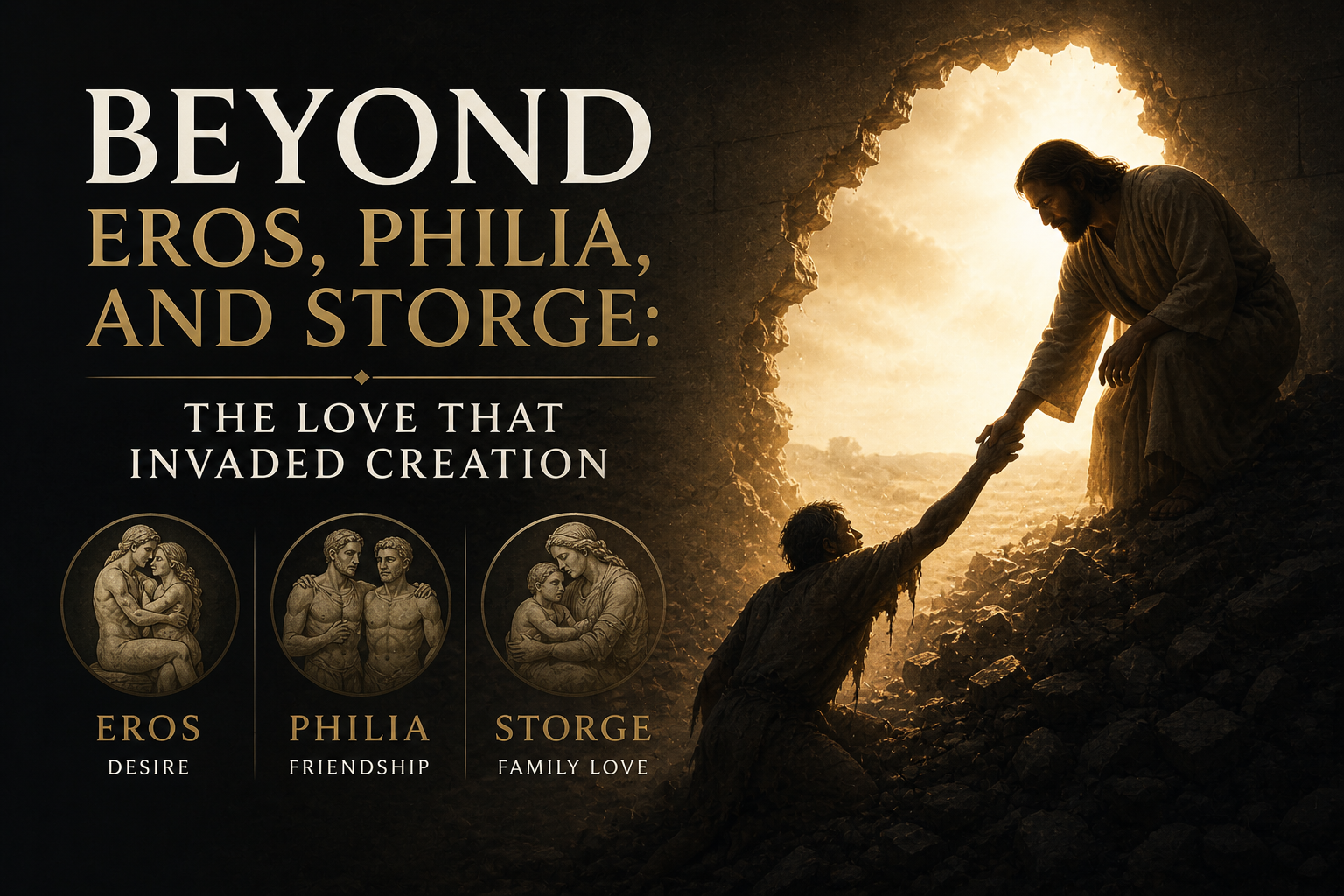
The word "love" has been so thoroughly debased that it now means almost nothing. The same word covers a teenager's infatuation, a mother's attachment to her children, a man's loyalty to his drinking buddies, and the vague warmth a person feels toward a sports team. English has one word where Greek had four, and the culture has exploited that poverty to collapse every human attachment into a single sentimental category. The result is that when Christ speaks about love, most people hear something soft, a feeling, an emotion, a preference for niceness. They hear wrong.
What Christ describes in the Evangelion and what Paul elaborates in his epistles is not an emotion. It is an action directed at people who have done nothing to earn it and will do nothing to repay it. It is the deliberate extension of goodness toward the hostile, the ungrateful, and the wicked. It has no analogy in the Creator's material order, because the Creator's system runs on reciprocity. The Good Father's love breaks that system open from the outside.
The Creator's Economy of Exchange
Every form of affection the material world produces operates on a ledger. Romantic attachment is mutual desire. Parental devotion is biological instinct directed at genetic offspring. Friendship is the comfort of shared interests and reciprocal benefit. None of these are contemptible, they serve the functions the Creator designed them to serve. But they are all, at bottom, transactions. I give because I receive. I protect because the protected one is mine.
The Law codifies this principle and calls it justice. Eye for an eye, tooth for a tooth. Loyalty rewarded, betrayal punished. The neighbor you are commanded to love is defined by tribal and ethnic proximity. The Law adds the stranger who lives among your people, but the enemy falls outside the circle. The Creator's system has a place for enemies: judgment.
Christ walks into this closed economy and detonates it.
The Invasion
Paul describes the event with surgical precision:
"For while we were still helpless, at the right time Christ died for the ungodly." — Romans 5:6
For the ungodly. The word matters. Christ did not arrive to assist people who were making progress, who had shown potential, who were working toward righteousness under the Law. He arrived for the helpless, those who had nothing to offer and no capacity to improve. The Good Father did not wait for humanity to become lovable. He acted first, unilaterally, toward a creation that did not know he existed. That is not generosity. That is invasion.
"And hope does not disappoint, because the love of God has been poured into our hearts through the Spirit who has been given to us." — Romans 5:5
Poured, not earned. The verb is passive. No one opens a valve. No one performs the right ritual or recites the right creed. The Spirit delivers the Father's love directly, bypassing every gate the Creator's religious system erected, temple, priest, sacrifice, purity code. The whole apparatus is irrelevant.
The Test That Exposes Every Counterfeit
Christ provides a single diagnostic that separates the Father's love from every imitation the material world produces. It is not a feeling. It is a command:
"But I say to you who are listening: love your enemies. Do good to those who hate you." — Evangelion 3:29
He sets it against the Creator's law, the system of calibrated retaliation that the material world calls justice, and he dismantles it. "But I say to you." The conjunction is adversative. What follows does not build on the Law. It replaces it.
"Speak blessing over those who curse you, and pray for those who insult you." — Evangelion 3:30
"If someone hits you on one cheek, offer the other as well. If someone takes your coat, let them have your shirt too." — Evangelion 3:31
"Give to everyone who asks from you, and if someone takes from you, don't demand it back." — Evangelion 3:32
Read those commands together and notice what is absent: any reference to the other person's worthiness. Christ does not say "love your enemies if they show signs of repentance." He does not say "do good to those who hate you once they apologize." The condition of the recipient is irrelevant. The love flows one direction, outward, without a return address. Every instinct the Creator wired into flesh screams against this. Retaliate. Protect what is yours. Demand what is owed. Christ says those instincts belong to the old system. They are the Creator's firmware. Delete them.
"If you lend only to those you expect to be paid back from, what kind of generosity is that?" — Evangelion 3:34
This is the blade. If your love only extends to people who can reciprocate, family, friends, allies, people who share your politics or your ethnicity or your religion, you are not practicing the Father's love. You are running the Creator's economy with religious decoration. You are doing exactly what the material world was designed to make you do.
"Instead, love your enemies, do good, and lend without expecting anything in return. Then your reward will be great, and you will be children of God. For he is kind even to the ungrateful and the wicked." — Evangelion 3:35
Children of God, and the God in question is not the Creator. The Creator rewards obedience and punishes disobedience. The Good Father is kind to the ungrateful and the wicked. That phrase alone demolishes every prosperity gospel, every merit-based theology, every system that conditions divine favor on human performance. The Father's kindness has no precondition. It simply arrives.
"Be compassionate, just as your Father has shown you compassion." — Evangelion 3:36
The Woman Simon Could Not See
Theory becomes flesh in Evangelion chapter four. A woman, identified only as a sinner, enters the house of a Pharisee during a meal. She washes Christ's feet with her tears, anoints and kisses him. Simon's reaction is immediate and predictable:
"When Simon Peter saw this, he said to himself, 'If this man were a prophet, he would know who this woman is who's touching him, she's a sinner.'" — Evangelion 4:22
Simon operates inside the Creator's framework. Identity is determined by moral record. A sinner is disqualified from proximity to the holy. The Law draws a line, and she is on the wrong side. Simon does not question the line. He questions Christ for ignoring it.
Christ responds by exposing the entire framework as bankrupt:
"Jesus turned toward the woman and said to Simon, 'Do you see this woman? She washed my feet with her tears," — Evangelion 4:23
"and she anointed and kissed them." — Evangelion 4:24
"That's why I tell you, her many sins are forgiven, because she has loved much." — Evangelion 4:25
Because she has loved much. The forgiveness is tied to love, and the love she demonstrated was precisely the kind the Creator's system cannot produce, uncalculating, reckless, indifferent to what the room thought of her. She had no credentials. She had no standing. She offered everything and expected nothing. That is the Father's love operating through a human being.
"Your faith has rescued you." — Evangelion 4:27
Rescued, not rewarded. The distinction matters. A reward implies she earned something. Rescue implies she was pulled from a system that had already condemned her by a power that owed her nothing.
The Force That Reorganizes Everything
Paul did not treat this love as a theological abstraction. He described it as a force with physical grip:
"The love of Christ constrains us, for we have concluded that one died for all; therefore all died." — 2 Corinthians 5:10
Constrains. The Greek sunechei means to press together, to hold in place, to leave no room for movement in the opposite direction. Paul did not adopt this love as a lifestyle preference. It seized him. Once you arrive at the conclusion that Christ died for all, not for the morally impressive, not for the ethnically selected, but for all without exception, the Creator's ledger of merit and punishment becomes unusable. You cannot go back to loving only those who love you, because the foundation for that discrimination has been destroyed.
"And he died for all, so that those who live might no longer live for themselves but for him who died for them and was raised." — 2 Corinthians 5:11
No longer for themselves. That is the death certificate of transactional love. The self as the center of the economy, my family, my tribe, my interests, is displaced. What replaces it is not altruism in the secular sense, not a moral improvement project. It is a total reorientation around someone who acted without being asked.
The Indestructible Bond
Every love the material world produces can be broken. Romantic love dies when desire fades. Family bonds fracture under betrayal. Friendships dissolve when they stop being convenient. These are features of the Creator's system, not bugs, attachment that depends on conditions will always be vulnerable to changing conditions.
Paul closes Romans 8 by announcing that the Father's love operates under no conditions at all:
"Who will separate us from the love of Christ? Tribulation or distress or persecution or famine or nakedness or peril or sword?" — Romans 8:25
"For your sake we are being killed all day long; we are accounted as sheep for slaughter." — Romans 8:26
"Yet in all these things we prevail through him who loved us." — Romans 8:27
Paul lists every weapon the material order deploys against human beings, and these are the Creator's instruments, the mechanisms of a world built on suffering, scarcity, and death. Can any of them sever what the Father established? The answer is a flat no:
"For I am persuaded that neither death nor life nor angels nor principalities nor things present nor things to come nor powers, nor height nor depth nor any created thing will be able to separate us from the love of God in Christ Jesus our Lord." — Romans 8:28-29
Nor any created thing. That phrase encompasses everything the Creator made, every power structure, every natural force, every angelic hierarchy, every temporal condition. All of it belongs to the material order. None of it can reach the love that entered from outside. The Father's love is not subject to the Creator's jurisdiction because it did not originate within it.
The Identity
Paul and the Evangelion do not present love as one virtue among many. They present it as the defining mark of the Father's children, the single characteristic that separates those who have understood the invasion from those still operating inside the Creator's closed system.
"If I speak in the tongues of men and even of angels, but do not have love, I have become a sounding bronze or a clashing cymbal." — 1 Corinthians 13:1
"And if I have prophecy, and know all mysteries and all knowledge, and if I have all faith so as to move mountains, but do not have love, I am nothing." — 1 Corinthians 13:2
Tongues, prophecy, knowledge, faith, the entire catalog of spiritual accomplishments, amount to zero without this love. Paul is not being rhetorical. He is establishing a hierarchy in which love is not merely the highest virtue but the one that gives the others meaning. A person who speaks in angelic languages but does not love the ungrateful and the wicked has understood nothing about the Father.
"Love never falls. As for prophecies, they will pass away; as for tongues, they will cease; as for knowledge, it will be brought to nothing." — 1 Corinthians 13:3
"And now remain faith, hope, love, these three; and the greatest of these is love." — 1 Corinthians 13:4
Everything else is temporary infrastructure. Love is permanent because it is the nature of the Father himself, and unlike the Creator's material order, the Father does not change, does not degrade, does not expire.
"As God's chosen, holy and beloved, put on a heart of compassion, kindness, humility, gentleness, and patience,", Colossians 3:10
"And above all these, put on love, which is the perfect bond of unity.", Colossians 3:12
"You were called to freedom, brothers and sisters; only do not make the freedom a pretext for the flesh, but through love serve one another." — Galatians 5:13
"Therefore, be imitators of God, as beloved children." — Laodiceans 5:1
"Walk in love, just as Christ loved you and gave himself for you, an offering and a sacrifice to God, a fragrant aroma." — Laodiceans 5:2
"Let everything you do be done in love." — 1 Corinthians 16:6
Everything. The scope is absolute. The love of the Good Father is not a Sunday obligation or a theological position. It is the operating system of a new humanity, one that refuses the Creator's economy of exchange, that extends goodness without precondition, that identifies its enemies as the primary recipients of its compassion. If you love only those who love you back, you have not yet left the Creator's jurisdiction. The border crossing is the moment you love someone who will never return it, and discover that the Father's love was never about receiving anything in the first place.