
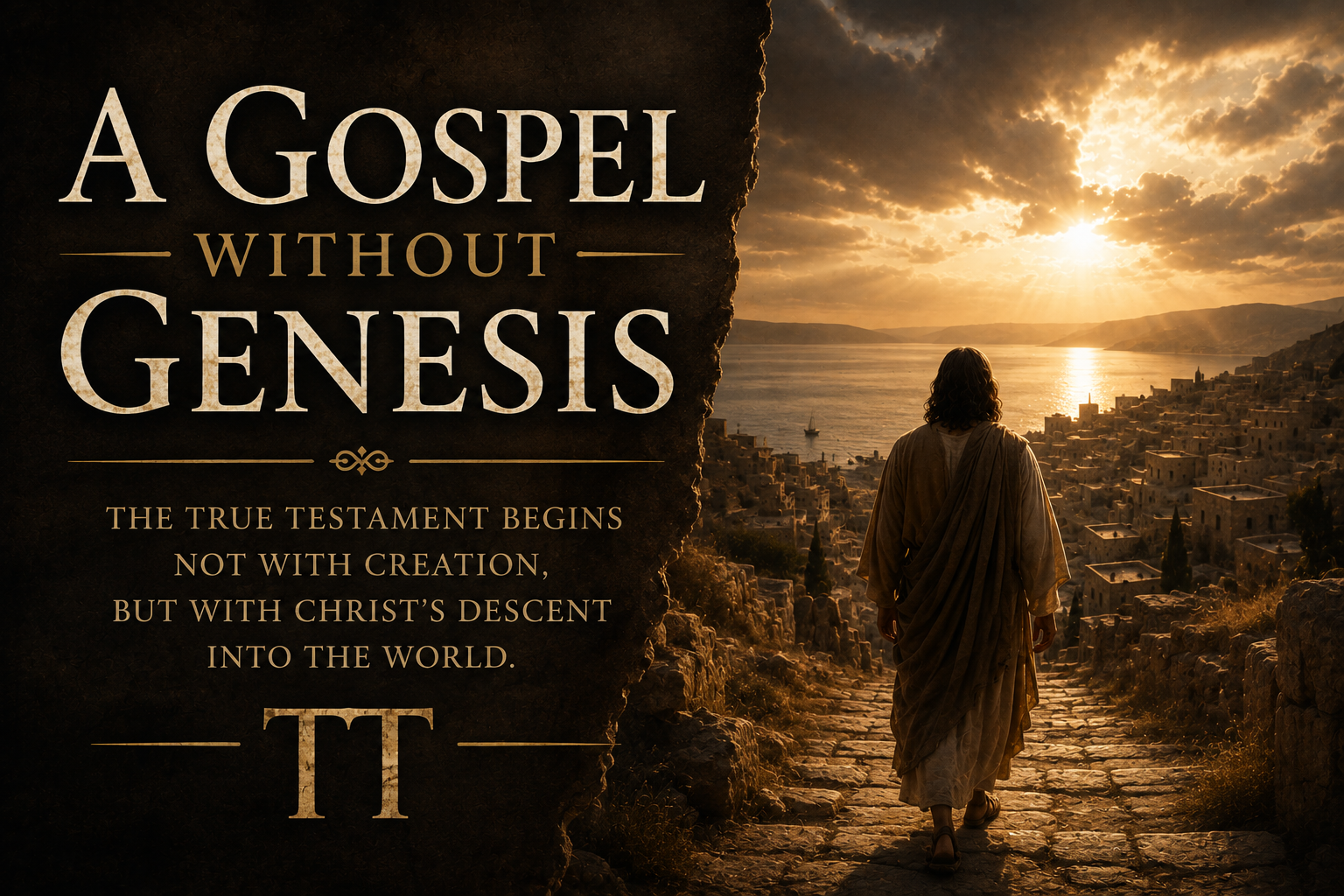
The Evangelion begins with a political date rather than a creation account. Its first sentence reads, “It was the fifteenth year of Tiberius Caesar’s reign, in the days of Pilate” (Evangelion 1:1 TT). Tiberius reigns, Pilate governs, and the Creator’s world is already operating. Its rulers, cities, synagogues, diseases, demons, social divisions, and ordinary routines are firmly established before Jesus enters the narrative.
This historical setting prevents the Evangelion from becoming a timeless myth. Christ appears at an identifiable moment under recognizable political authorities. Yet the date does not provide an earthly origin for Him. It tells us when He entered the domain, but it does not tell us that the domain produced Him.
The next sentence supplies the Evangelion’s decisive movement: “That’s when Jesus descended into Capernaum, a town in Galilee. Every Sabbath, he taught the people there” (Evangelion 1:2 TT). The narrative does not introduce parents, conception, childhood, ancestry, or the ordinary development of a religious teacher. It says that Jesus descended into Capernaum. Whatever geographical meaning the verb may also carry, the narrative provides no prior earthly location from which He begins His journey.
Jesus enters history without being explained by history. Capernaum receives Him, but Capernaum does not produce Him. He is historically located without being theologically derived from the world into which He comes. This combination of historical specificity and unexplained arrival gives the opening its distinctive force.
Ancient biographies commonly explained important people through ancestry, education, social standing, and formative experiences. The Evangelion refuses that structure for Christ. Jesus does not gradually discover His calling or receive authority from an established school. He enters the story already speaking with an authority that the people immediately recognize as different: “They were amazed at what he taught, because his word had authority” (Evangelion 1:3 TT).
The people recognize the difference before they understand its source. His authority does not depend upon approval from the synagogue, ancestral tradition, or appointment by the rulers of the domain. He teaches inside the Creator’s religious space without deriving His authority from it. So the Evangelion begins with interruption rather than succession.
The powers of the domain respond immediately. A demon cries out, “What do you want with us, Jesus? Did you come here to destroy us? I know who you are: the holy one of God!” (Evangelion 1:5 TT). The demon does not greet Jesus as the completion of the world’s existing administration. It recognizes Him as a threat to the powers already occupying the house.
Jesus commands the demon to leave and then turns toward people suffering from disease. The Evangelion says that people brought the sick to Him and that He laid His hands upon each one and healed them (Evangelion 1:11 TT). So His first actions are acts of release. He enters an occupied domain, confronts its possessing powers, and begins freeing people from conditions they could not overcome themselves.
The Father was not already known
Without a creation narrative at the beginning of the canon, the reader cannot assume that the Father has already been introduced. The god known through the world, its Law, and its religious institutions is not quietly waiting to be renamed as the Father of Jesus Christ. The Evangelion requires the Father to be revealed because He was not known within the Creator’s order.
Jesus states this directly: “Everything has been entrusted to me by the Father. No one knows the Father except the Son, and no one knows the Son except the Father: and anyone to whom the Son reveals him” (Evangelion 6:30 TT). The claim is comprehensive. Jesus does not say that the Father was partially known, known under another name, or known imperfectly through the Creator’s scriptures. He says that no one knows the Father except the Son and those who receive the Son’s revelation.
If the material world naturally revealed the Father, the Son would not need to make Him known. If the Creator’s Law disclosed the Father’s character, people could reach Him through obedience and study. If ancestral tradition preserved knowledge of Him, revelation would be little more than the confirmation of inherited information. Jesus instead presents knowledge of the Father as something unavailable until the Son gives it.
The world did not lack gods or religious activity. It possessed temples, sacrifices, laws, priests, sacred histories, and claims of divine authority. The Evangelion does not deny that these institutions referred to a real god. It denies that their god was already the Father whom Christ came to reveal.
This distinction prevents readers from reasoning directly from creation to the Father. Human beings naturally examine the order, beauty, violence, scarcity, reproduction, disease, and death found in the world and imagine a deity whose character explains them. Such reasoning may lead toward the Creator because the material world bears the conditions of his administration. It cannot reach the Father whom only the Son knows.
The True Testament therefore does not ask us to divide nature into pleasant and unpleasant portions, assign the beautiful parts to the Father, and explain the cruel parts as accidental distortions. The entire material order belongs to a domain Christ enters from outside. The Father is not discovered by selecting the features of creation we admire and projecting them upward.
Second Corinthians preserves this distinction by identifying the power operating within the present order: “The god of this aeon has blinded the minds of the untrusting, so that the light of the Evangelion of the glory of Christ, who is the image of God, might not shine to them” (2 Corinthians 4:1 TT). The title “god of this aeon” names a real but bounded jurisdiction. This god blinds minds precisely so that the light revealed in Christ will remain unrecognized.
Paul then contrasts this blinding with the Father’s illumination. He writes, “For the God who said, Light shall shine out of darkness, has shone in our hearts to give the light of the recognition of his glory in the face of Christ” (2 Corinthians 4:3 TT). The words echo Genesis, and Tertullian claimed them for the Creator, but the God named here is the one who has shone in hearts “in the face of Christ,” set against the god who blinds. One god prevents recognition, while the other God makes recognition possible through Christ. Treating both actions as the work of a single deity does not simplify Paul’s theology; it makes his argument incoherent.
The Father is known in the face of Christ rather than in the machinery of the world. He is the one who reveals rather than blinds, releases rather than possesses, and heals rather than administers decay. Christ does not teach us to reinterpret the Creator’s actions as misunderstood expressions of the Father’s goodness. He reveals a Father whose character could not be inferred from this world.
The Law could not produce Christ
The same discontinuity applies to the Creator’s Law. If the Law expressed the Father’s character and purpose, obedience to it should lead naturally toward recognition of His Son. Paul instead describes the Law as incapable of accomplishing the Father’s work: “For what the Law could not do, weak through the flesh, the Father sent his own Son in the likeness of sinful flesh and for sin, and he condemned sin in the flesh” (Romans 8:3 TT).
The structure of the sentence is important. The Law cannot do what is needed, so the Father sends his own Son. Christ does not emerge from the Law’s successful operation or arrive as its final reward. He is sent because the Law is incapable of producing the Father’s life.
This agrees with the opening of the Evangelion. Christ descends into an existing religious order and speaks with an authority that stands apart from it. Romans expresses the same movement theologically. The Father sends into the domain what the domain’s Law could never generate.
The direction of interpretation must therefore run from Christ toward the Law rather than from the Law toward Christ. Christ reveals the Father, and that revelation exposes the limits and identity of the Law. If the Law is permitted to define the Father first, Christ will always be forced into the role of repairing or completing the Creator’s system.
The True Testament’s canonical order prevents this reversal. The reader encounters the descending Christ before being asked to understand the powers, Law, and history of the world He enters. The Creator does not stand at the beginning as the theological premise from which Christ must be deduced. Christ stands at the beginning as the revelation through which every previous claim about deity must be judged.
This does not make Christ distant from human existence. Paul says that the Father sent Him “in the likeness of sinful flesh” (Romans 8:3 TT), while Philippians says that He “emptied himself, taking the form of a slave, in the likeness of a human being” (Philippians 2:3 TT). Christ truly enters the conditions of embodied life. He can be touched, opposed, beaten, and staked, even though flesh and Law do not explain His origin.
The distinction between origin and embodiment is necessary for rescue. Christ does not belong to the Creator’s generative order, but He enters the place where captives live. He does not call from a safe distance and demand that they find their own way out. His descent brings the Father’s action into direct contact with the conditions of the present evil aeon.
Paul receives what the world could not teach
The Apostolikon begins with Galatians, where Paul describes his commission in a manner that repeats the structure of the Evangelion. Christ does not derive His authority from the world He enters, and Paul does not derive his Evangelion from the religious institutions he once served. Both movements begin with revelation from outside the established order.
Paul introduces himself as “an apostle, not sent from men nor through the agency of man, but through Christ Jesus, who awakened himself from the dead” (Galatians 1:1 TT). His negative language deliberately excludes human appointment as the source of his authority. The Evangelion did not reach him through an institutional chain of custody.
Paul makes this claim explicit when he writes, “I make known to you, brothers and sisters, that the Evangelion proclaimed by me is not according to man. For I neither received it from man nor was I taught it, but I received it through a revelation of Christ Jesus” (Galatians 1:10–11 TT). Revelation rather than transmission stands at the center of his apostleship.
Paul does not reject history or pretend that his message appeared in a timeless spiritual realm. He names his former life, his persecution of the assembly, his advancement among his contemporaries, and his zeal for ancestral traditions. His biography is real, but it does not generate the Evangelion.
His former religious success makes the discontinuity more striking. Paul says that he advanced in Judaism beyond many people of his age and was “exceedingly zealous for ancestral traditions” (Galatians 1:13 TT). If scriptural study, inherited religion, institutional advancement, or intense devotion could produce knowledge of the Father, Paul was well positioned to acquire it.
Instead, Paul describes an interruption. God called him through grace and “was pleased to reveal His Son in me so that I might proclaim Him among the nations” (Galatians 1:14–15 TT). Revelation does not complete the direction in which Paul had already been moving. It gives him a new source, message, and mission.
After receiving this revelation, Paul does not immediately travel to Jerusalem to obtain authorization from those who were apostles before him. He says that he did not immediately consult flesh and blood but went into Arabia and later returned to Damascus (Galatians 1:15–16 TT). His point is not that fellowship is unnecessary. His point is that the Evangelion comes from Christ rather than from the reputation or proximity of human authorities.
The Evangelion begins when Christ descends into Capernaum, and the Apostolikon begins with Christ revealed in Paul. So the two parts of the True Testament share one theological architecture. What comes from the Father must enter this world because nothing within the Creator’s world can produce it.
The rulers could not understand the arrival
The world’s inability to produce Christ is matched by its inability to understand Him. Paul explains that the apostles speak “a wisdom not of this aeon, nor of the rulers of this aeon, who are being nullified,” a wisdom “hidden” from those rulers (1 Corinthians 2:6–7 TT). Their response to Christ demonstrates the limits of their understanding.
Paul writes, “None of the rulers of this aeon understood it; for if they had, they would never have staked the Lord of glory” (1 Corinthians 2:8 TT). The rulers act according to the wisdom available within their domain. They recognize a threat, apply force, and destroy the body placed within their power.
Their failure is both moral and epistemological. They do not merely oppose the Father’s purpose; they cannot comprehend it. The wisdom revealed through Christ does not belong to the aeon they administer.
The stake exposes the difference between the Creator’s power and the Father’s power. The rulers can threaten, condemn, and kill, but they cannot make their violence final. Their apparent victory becomes the place where the limits of their jurisdiction are revealed.
This is another reason the True Testament cannot begin by treating the world’s history as the transparent unfolding of the Father’s plan. The rulers directing that history do not understand the Father’s wisdom. They stake His Son because He does not belong to their order.
Christ’s awakening does not prove that the rulers unknowingly served the Father well. It proves that their worst act could not defeat Him. The Father overturns what the rulers intended without becoming the author of their violence.
Rescue from the present evil aeon
Galatians gives the purpose of Christ’s self-giving in one of the Apostolikon’s clearest statements: “Who gave himself for our sins so that he might deliver us from the present evil aeon according to the will of God the Father” (Galatians 1:4 TT). The controlling movement is deliverance from the aeon. Christ does not come to deliver the aeon from poor management so that it can become the Father’s permanent kingdom.
This spatial language agrees with the Evangelion’s opening. Christ descends into the domain in order to extract people from its lordship. His mission is not a repair undertaken by the world’s original architect. It is the Father’s rescue within a world He did not create.
If the Father were the Creator, Paul’s language would produce a serious theological contradiction. The Father would be delivering people from the aeon He designed, the Law He imposed, the rulers He empowered, and the mortality He built into flesh. Rescue would become the correction of His own administration.
The True Testament avoids that contradiction by preserving the rupture. The Creator makes and administers the material order. The unknown Father sends Christ into it. The Father’s will is deliverance from the present evil aeon rather than permanent service within it.
This distinction does not require contempt for the people, bodies, food, labor, or relationships found within the domain. Neighbors remain real and worthy of love. Acts of care remain meaningful. The fact that the Father did not create this world does not authorize hatred toward those trapped inside it.
On the contrary, Christ’s descent reveals the depth of the Father’s care for people who were not originally His. He enters another god’s territory to rescue creatures He did not make but nevertheless loves. His goodness is not an obligation arising from ownership; it is generosity toward those who could make no natural claim upon Him.
A Gospel without Genesis therefore produces a stronger account of grace. The Father does not rescue His own damaged property because His honor requires restoration. He reaches for those who belonged to another order and receives them through Christ.
The Father is known through the Son’s actions
Because the True Testament does not begin with a creation account, readers learn the Father’s character through Christ. So the actions in the Evangelion’s opening chapter carry great theological weight. Christ teaches with independent authority, drives out a possessing power, and heals those suffering within the domain.
He does not ask the sick to explain why they deserve illness. He does not tell the possessed man that the power holding him serves the Father’s mysterious plan. He does not defend the suffering of the world as a necessary feature of a good creation. He confronts what holds people and releases them.
The Father becomes visible through this movement of rescue. Christ does not provide a philosophical explanation that makes the world’s cruelty appear good. He reveals a Father whose goodness is demonstrated by opposition to the conditions destroying creatures.
The world’s god blinds, while the Father gives recognition. The world’s powers possess, while Christ drives them out. The Creator’s Law cannot produce life, while the Father sends the Son. The rulers stake Christ, while the Father awakens and exalts Him.
These contrasts allow the Father to remain entirely on the side of rescue. He is not the hidden cause of the captivity from which Christ delivers us. He is the one whose will sends Christ into the house and opens the way out.
The Evangelion therefore answers the question of divine character without Genesis. It does not reason from the world toward its maker and then assign that maker’s actions to the Father. It looks at Christ, because only the Son knows and reveals Him.
The end exceeds the beginning
A Gospel without Genesis does not leave creation without a future. It refuses to make the Creator’s beginning the measure of the Father’s ending. The Father’s purpose reaches farther than the domain’s origin.
Colossians declares that “in himself all the fullness was pleased to dwell” and that through Christ all things would be reconciled, “making peace through the blood of his stake, through him, whether things on earth or things in heaven” (Colossians 1:18–19 TT). The scope is not limited to people who recognized Christ during mortal life. It includes all things on earth and in heaven.
The Father does not need to have created all things in order to reconcile all things. Reconciliation is not evidence of original ownership. It is the triumph of the Father’s goodness over a world He did not make and a history He did not author.
This is greater than restoration. Restoration returns something to an earlier condition established by its maker. Reconciliation brings what belonged to another order into peace through Christ.
The True Testament therefore moves from descent toward universal reconciliation. Christ enters one town during the reign of Tiberius, but the work beginning there reaches all things on earth and in heaven. The Evangelion begins locally without ending narrowly.
The Father who was unknown becomes the Father whose peace leaves nothing permanently outside reconciliation. The canon does not need the Creator’s beginning because it moves toward the Father’s end.
Reading from the right beginning
Some readers may treat the absence of Genesis as a defect. They may assume that the True Testament provides only part of the necessary story and that the missing background must be supplied from elsewhere. That assumption allows the conventional canon to determine in advance what a complete Christian scripture must contain.
The True Testament must instead be read on its own terms. Its opening is not incomplete simply because it does not answer the Creator’s preferred questions. A creation narrative would tell us who built the house. The Evangelion is concerned with the One who entered the house to bring people out.
The opening teaches readers not to confuse familiarity with revelation. The god whose world surrounds us is not therefore the Father. The religious order preceding Christ is not therefore preparation for Him. The history into which He descends is not therefore the unfolding of His Father’s plan.
Christ alone reveals the Father. This is not a gap in the True Testament; it is the canon’s central claim. The absence of Genesis prevents another god’s identity from being placed over the Father before the Son can speak.
Once descent establishes the beginning, the Apostolikon becomes clearer. Paul’s language of sending, revelation, deliverance, adoption, reconciliation, and heavenly citizenship belongs to one coherent geography. The Father sends from outside, Christ enters the present evil aeon, and the rescued are transferred toward a kingdom that did not grow from the Creator’s world.
Without this beginning, Paul’s language can be forced back into the Creator’s system. Deliverance becomes forgiveness from the same judge who imposed the sentence. Adoption becomes restoration to the same household that enslaved its children. Grace becomes an exception within Law rather than freedom from its jurisdiction.
Beginning with descent prevents these collapses. The Father is not the Creator behaving more gently in the later portion of one continuous history. He is the previously unknown God whose Son has entered the Creator’s domain.
Conclusion
The True Testament begins without Genesis because the Father of Jesus Christ is not the creator of the material world. A canon beginning with creation would encourage the reader to approach Christ through the Creator’s identity, Law, history, and purposes. The Evangelion refuses that route and begins when Jesus descends into a world already governed by other powers.
The opening is historically precise but theologically disruptive. Tiberius reigns, Pilate governs, and Jesus descends into Capernaum without genealogy, childhood, institutional appointment, or earthly point of origin. He teaches with unfamiliar authority, confronts possessing powers, and heals those suffering within the domain.
His arrival reveals the structure of the Evangelion. The Father was not waiting to be recognized as the god everyone already worshiped. No one knows the Father except the Son and those to whom the Son reveals Him. Knowledge of the Father therefore comes through Christ rather than through creation, Law, ancestry, or religious continuity.
Paul’s apostleship repeats the same movement. He does not receive the Evangelion from men or ancestral tradition. Christ is revealed in him, interrupting the religious life in which he had previously excelled and sending him toward the nations with a message of deliverance from the present evil aeon.
The world cannot generate what comes to rescue it. Its rulers do not understand the Father’s wisdom, its Law cannot accomplish the Father’s work, and its god blinds minds against the light shining through Christ. The Father must send, reveal, illuminate, and deliver because nothing within the Creator’s domain can produce Him.
A Gospel without Genesis is not a Gospel without a beginning. Its beginning is descent, and the first movement belongs entirely to the Father. The canon begins when the rescue arrives.